Chapter 36
As soon as we reckoned everybody was asleep that night we went down the lightning-rod, and shut ourselves up in the lean-to, and got out our pile of fox-fire, and went to work. We cleared everything out of the way, about four or five foot along the middle of the bottom log. Tom said he was right behind Jim’s bed now, and we’d dig in under it, and when we got through there couldn’t nobody in the cabin ever know there was any hole there, because Jim’s counter-pin hung down most to the ground, and you’d have to raise it up and look under to see the hole. So we dug and dug with the case-knives till most midnight; and then we was dog-tired, and our hands was blistered, and yet you couldn’t see we’d done anything hardly. At last I says:
As soon as we reckoned everybody was asleep that night, we climbed down the lightning rod. We shut ourselves up in the lean-to, got out our pile of glowing wood, and went to work. We cleared everything out of the way for about four or five foot along the middle of the bottom log. Tom said he was right behind Jim’s bed now, and we’d dig in under it. When we got through, there couldn’t nobody in the cabin ever know there was any hole there. That was because Jim’s bedspread hung down almost to the ground. You’d have to lift the bedspread and look under it to see the hole. So we dug and dug with the table knives till almost midnight. By then we was dog-tired, and our hands was blistered, and yet you couldn’t hardly see we’d done anything. At last I says:
“This ain’t no thirty-seven year job; this is a thirty-eight year job, Tom Sawyer.”
“This ain’t no thirty-seven-year job. This is a thirty-eight-year job, Tom Sawyer.”
He never said nothing. But he sighed, and pretty soon he stopped digging, and then for a good little while I knowed that he was thinking. Then he says:
He never said nothing. But he sighed, and pretty soon he stopped digging. Then for quite a while I knowed that he was thinking. Then he says:
“It ain’t no use, Huck, it ain’t a-going to work. If we was prisoners it would, because then we’d have as many years as we wanted, and no hurry; and we wouldn’t get but a few minutes to dig, every day, while they was changing watches, and so our hands wouldn’t get blistered, and we could keep it up right along, year in and year out, and do it right, and the way it ought to be done. But we can’t fool along; we got to rush; we ain’t got no time to spare. If we was to put in another night this way we’d have to knock off for a week to let our hands get well—couldn’t touch a case-knife with them sooner.”
“It ain’t no use, Huck. It ain’t going to work. If we was prisoners, it would, because then we’d have as many years as we wanted, and no hurry. And we wouldn’t get but a few minutes to dig every day, while they was changing guards. So our hands wouldn’t get blistered, and we could keep digging, year in and year out. We could do it right, the way it ought to be done. But we can’t waste time. We got to rush. We ain’t got no time to spare. If we was to spend another night digging this way, we’d have to stop for a week. We’d need that long to let our hands get well. We couldn’t touch a table knife with them any sooner.”
“Well, then, what we going to do, Tom?”
“Well, then, what we going to do, Tom?”
“I’ll tell you. It ain’t right, and it ain’t moral, and I wouldn’t like it to get out; but there ain’t only just the one way: we got to dig him out with the picks, and let on it’s case-knives.”
“I’ll tell you. It ain’t right, and it ain’t moral, and I wouldn’t like word to get out. But there ain’t only just the one way. We got to dig him out with pickaxes and let on it’s table knives.”
“Now you’re talking!” I says; “your head gets leveler and leveler all the time, Tom Sawyer,” I says. “Picks is the thing, moral or no moral; and as for me, I don’t care shucks for the morality of it, nohow. When I start in to steal a , or a watermelon, or a Sunday-school book, I ain’t no ways particular how it’s done so it’s done. What I want is my ; or what I want is my watermelon; or what I want is my Sunday-school book; and if a pick’s the handiest thing, that’s the thing I’m a-going to dig that or that watermelon or that Sunday-school book out with; and I don’t give a dead rat what the authorities thinks about it nuther.”
“Now you’re talking!” I says. “Your head gets more and more level all the time, Tom Sawyer,” I says. “Pickaxes is the thing, moral or not. And as for me, I don’t care shucks about the morality of it anyway. When I set out to steal a , or a watermelon, or a Sunday school book, I ain’t particular about how. All I care about is getting it done. What I want is my . Or what I want is my watermelon. Or what I want is my Sunday school book. And if a pickaxe is the handiest thing, that’s what I’m going to dig with. I’ll dig that or that watermelon or that Sunday school book out with it. And I don’t give a dead rat what the authorities thinks about it either.”
“Well,” he says, “there’s excuse for picks and letting-on in a case like this; if it warn’t so, I wouldn’t approve of it, nor I wouldn’t stand by and see the rules broke—because right is right, and wrong is wrong, and a body ain’t got no business doing wrong when he ain’t ignorant and knows better. It might answer for you to dig Jim out with a pick, without any letting on, because you don’t know no better; but it wouldn’t for me, because I do know better. Gimme a case-knife.”
“Well,” he says, “there’s excuse for picks and letting-on in a case like this. If it wasn’t so, I wouldn’t approve of it, nor I wouldn’t stand by and see the rules broke. Because right is right, and wrong is wrong, and a body ain’t got no business doing wrong when he ain’t ignorant and knows better. It might do for you to dig Jim out with a pick, without any letting on, because you don’t know no better. But it wouldn’t for me, because I do know better. Gimme a case-knife.”
He had his own by him, but I handed him mine. He flung it down, and says:
He had his own beside him, but I handed him mine. He threw it down and says:
“Gimme a case-knife.”
“Give me a table knife.”
I didn’t know just what to do—but then I thought. I scratched around amongst the old tools, and got a pickaxe and give it to him, and he took it and went to work, and never said a word.
I didn’t know just what to do, but then I thought. I scratched around among the old tools and got a pickaxe. I give it to him, and he took it and went to work. He never said a word.
He was always just that particular. Full of principle.
He was always just that particular. Full of principles.
So then I got a shovel, and then we picked and shoveled, turn about, and made the fur fly. We stuck to it about a half an hour, which was as long as we could stand up; but we had a good deal of a hole to show for it. When I got up stairs I looked out at the window and see Tom doing his level best with the lightning-rod, but he couldn’t come it, his hands was so sore. At last he says:
So then I got a shovel, and we took turns picking and shoveling, and made the fur fly. We stuck to it about half an hour, which was as long as we could stand up. But we had a pretty big hole to show for it. When I got upstairs, I looked out the window and see Tom doing his very best with the lightning rod. But he couldn’t manage it, his hands was so sore. At last he says:
“It ain’t no use, it can’t be done. What you reckon I better do? Can’t you think of no way?”
“It ain’t no use. It can’t be done. What you reckon I better do? Can’t you think of no way?”
“Yes,” I says, “but I reckon it ain’t regular. Come up the stairs, and let on it’s a lightning-rod.”
“Yes,” I says, “but I reckon it ain’t by the rules. Come up the stairs, and pretend it’s a lightning rod.”
So he done it.
So he done it.
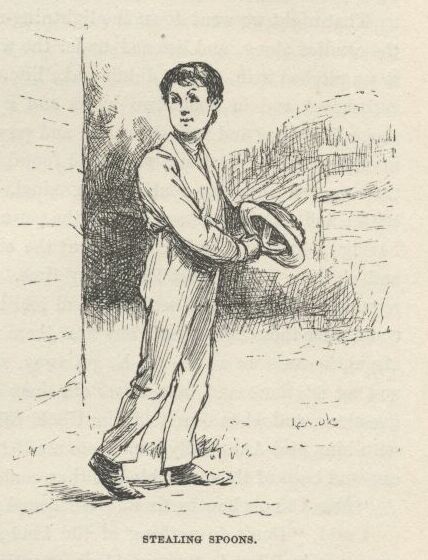
Next day Tom stole a pewter spoon and a brass candlestick in the house, for to make some pens for Jim out of, and six tallow candles; and I hung around the cabins and laid for a chance, and stole three tin plates. Tom says it wasn’t enough; but I said nobody wouldn’t ever see the plates that Jim throwed out, because they’d fall in the dog-fennel and jimpson weeds under the window-hole—then we could tote them back and he could use them over again. So Tom was satisfied. Then he says:
Next day Tom stole a pewter spoon and a brass candlestick from the house to make some pens for Jim. He stole six tallow candles, too. And I hung around the cabins, waited for a chance, and stole three tin plates. Tom says it wasn’t enough. But I said nobody wouldn’t ever see the plates that Jim throwed out. That was because they’d fall in the dog-fennel and jimpson weeds under the window opening. Then we could tote the plates back and Jim could use them over again. So Tom was satisfied. Then he says:
“Now, the thing to study out is, how to get the things to Jim.”
“Now, what we need to figure out is how to get the things to Jim.”
“Take them in through the hole,” I says, “when we get it done.”
“Take them in through the hole,” I says, “when we get it done.”
He only just looked scornful, and said something about nobody ever heard of such an idiotic idea, and then he went to studying. By-and-by he said he had ciphered out two or three ways, but there warn’t no need to decide on any of them yet. Said we’d got to post Jim first.
He just looked scornful and said something about nobody ever heard of such an idiotic idea. Then he started thinking it over. After a while, he said he had figured out two or three ways to do it. But there wasn't no need to decide on any of them yet. Said we'd got to let Jim know first.
That night we went down the lightning-rod a little after ten, and took one of the candles along, and listened under the window-hole, and heard Jim snoring; so we pitched it in, and it didn’t wake him. Then we whirled in with the pick and shovel, and in about two hours and a half the job was done. We crept in under Jim’s bed and into the cabin, and pawed around and found the candle and lit it, and stood over Jim awhile, and found him looking hearty and healthy, and then we woke him up gentle and gradual. He was so glad to see us he most cried; and called us honey, and all the pet names he could think of; and was for having us hunt up a cold-chisel to cut the chain off of his leg with right away, and clearing out without losing any time. But Tom he showed him how unregular it would be, and set down and told him all about our plans, and how we could alter them in a minute any time there was an alarm; and not to be the least afraid, because we would see he got away, sure. So Jim he said it was all right, and we set there and talked over old times awhile, and then Tom asked a lot of questions, and when Jim told him Uncle Silas come in every day or two to pray with him, and Aunt Sally come in to see if he was comfortable and had plenty to eat, and both of them was kind as they could be, Tom says:
That night we climbed down the lightning rod a little after ten and took one of the candles along. We listened under the window opening and heard Jim snoring. So we tossed the candle in, and it didn’t wake him. Then we got to work with the pick and shovel. In about two and a half hours, the job was done. We crept into the cabin under Jim’s bed, felt around for the candle, and lit it. We stood over Jim awhile and found him looking strong and healthy. Then we woke him up gentle and gradual. He was so glad to see us he almost cried. He called us honey and all the pet names he could think of. He wanted us to find a cold chisel to cut the chain off his leg right away. Then we could clear out without losing any time. But Tom he showed him how that wouldn’t follow the proper rules. He set down and told him all about our plans. He explained how we could change them in a minute any time there was an alarm. Jim wasn’t to be the least afraid, because we would see he got away, sure. So Jim he said it was all right, and we set there and talked over old times awhile. Then Tom asked a lot of questions. Jim told him Uncle Silas come in every day or two to pray with him. Aunt Sally come in to see if he was comfortable and had plenty to eat. Both of them was as kind as they could be. When Jim told him all this, Tom says:
“Now I know how to fix it. We’ll send you some things by them.”
“Now I know how to fix it. We’ll send you some things with them.”
I said, “Don’t do nothing of the kind; it’s one of the most jackass ideas I ever struck;” but he never paid no attention to me; went right on. It was his way when he’d got his plans set.
I said, “Don’t do nothing of the kind. It’s one of the most jackass ideas I ever struck.” But he never paid no attention to me. He went right on. That was his way when he’d got his plans set.
So he told Jim how we’d have to smuggle in the rope-ladder pie and other large things by Nat, the that fed him, and he must be on the lookout, and not be surprised, and not let Nat see him open them; and we would put small things in uncle’s coat-pockets and he must steal them out; and we would tie things to aunt’s apron-strings or put them in her apron-pocket, if we got a chance; and told him what they would be and what they was for. And told him how to keep a journal on the shirt with his blood, and all that. He told him everything. Jim he couldn’t see no sense in the most of it, but he allowed we was white folks and knowed better than him; so he was satisfied, and said he would do it all just as Tom said.
So he told Jim how we’d have to smuggle in the rope-ladder pie and other large things through Nat. Nat was the that fed him. Jim must watch for the things and not be surprised or let Nat see him open them. We would put small things in uncle’s coat pockets, and Jim must steal them out. We would tie things to aunt’s apron strings or put them in her apron pocket, if we got a chance. He told Jim what the things would be and what they was for. And he told him how to keep a journal on the shirt with his blood, and all that. He told him everything. Jim he couldn’t see no sense in most of it. But he figured we was white folks and knowed better than him. So he was satisfied and said he would do it all just as Tom said.
Jim had plenty corn-cob pipes and tobacco; so we had a right down good sociable time; then we crawled out through the hole, and so home to bed, with hands that looked like they’d been chawed. Tom was in high spirits. He said it was the best fun he ever had in his life, and the most intellectural; and said if he only could see his way to it we would keep it up all the rest of our lives and leave Jim to our children to get out; for he believed Jim would come to like it better and better the more he got used to it. He said that in that way it could be strung out to as much as eighty year, and would be the best time on record. And he said it would make us all celebrated that had a hand in it.
Jim had plenty corn-cob pipes and tobacco, so we had a right down good sociable time. Then we crawled out through the hole, and so home to bed, with hands that looked like they’d been chewed. Tom was in high spirits. He said it was the best fun he ever had in his life, and the most intellectural. He said if he only could see his way to it, we would keep it up all the rest of our lives and leave Jim to our children to get out, because he believed Jim would come to like it better and better the more he got used to it. He said that in that way it could be strung out to as much as eighty year, and would be the best time on record. And he said it would make us all celebrated that had a hand in it.
In the morning we went out to the woodpile and chopped up the brass candlestick into handy sizes, and Tom put them and the pewter spoon in his pocket. Then we went to the cabins, and while I got Nat’s notice off, Tom shoved a piece of candlestick into the middle of a corn-pone that was in Jim’s pan, and we went along with Nat to see how it would work, and it just worked noble; when Jim bit into it it most mashed all his teeth out; and there warn’t ever anything could a worked better. Tom said so himself. Jim he never let on but what it was only just a piece of rock or something like that that’s always getting into bread, you know; but after that he never bit into nothing but what he jabbed his fork into it in three or four places first.
In the morning we went out to the woodpile and chopped up the brass candlestick into handy-sized pieces. Tom put them and the pewter spoon in his pocket. Then we went to the cabins. While I distracted Nat, Tom shoved a piece of candlestick into a corn-pone in Jim’s pan. We went along with Nat to see how it would work, and it just worked noble. When Jim bit into the corn-pone, the brass most knocked all his teeth out. And there wasn't ever anything could have worked better. Tom said so himself. Jim he never let on that it was anything but a piece of rock or something like that. Those things are always getting into bread, you know. But after that he never bit into nothing without first jabbing his fork into it in three or four places.
And whilst we was a-standing there in the dimmish light, here comes a couple of the hounds bulging in from under Jim’s bed; and they kept on piling in till there was eleven of them, and there warn’t hardly room in there to get your breath. By jings, we forgot to fasten that lean-to door! The Nat he only just hollered “Witches” once, and keeled over on to the floor amongst the dogs, and begun to groan like he was dying. Tom jerked the door open and flung out a slab of Jim’s meat, and the dogs went for it, and in two seconds he was out himself and back again and shut the door, and I knowed he’d fixed the other door too. Then he went to work on the , coaxing him and petting him, and asking him if he’d been imagining he saw something again. He raised up, and blinked his eyes around, and says:
And while we was standing there in the dim light, here comes a couple of hounds rushing from under Jim’s bed. They kept piling in till there was eleven of them, and there wasn’t hardly room to breathe. By jings, we forgot to fasten that lean-to door! The Nat only hollered “Witches” once, then fell over on the floor among the dogs. He begun to groan like he was dying. Tom jerked the door open and flung out a thick piece of Jim’s meat, and the dogs went for it. In two seconds he was out himself and back again and had shut the door. And I knowed he’d fastened the other door too. Then he went to work on the , coaxing him and comforting him. He asked him if he’d been imagining he saw something again. Nat raised up, blinked his eyes around, and says:
“Mars Sid, you’ll say I’s a fool, but if I didn’t b’lieve I see most a million dogs, er devils, er some’n, I wisht I may die right heah in dese tracks. I did, mos’ sholy. Mars Sid, I felt um—I felt um, sah; dey was all over me. Dad fetch it, I jis’ wisht I could git my han’s on one er dem witches jis’ wunst—on’y jis’ wunst—it’s all I’d ast. But mos’ly I wisht dey’d lemme ’lone, I does.”
“Master Sid, you’ll say I’s a fool. But if I didn’t believe I see almost a million dogs, or devils, or something, I wish I may die right here in these tracks. I did, most surely. Master Sid, I felt them. I felt them, sir. They was all over me. Dad fetch it, I just wish I could get my hands on one of them witches just once. Only just once, it’s all I’d ask. But mostly I wish they’d leave me alone, I does.”
Tom says:
Tom says:
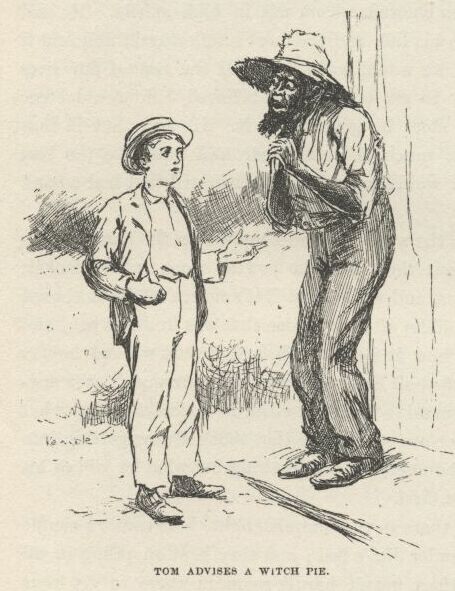
“Well, I tell you what I think. What makes them come here just at this runaway ’s breakfast-time? It’s because they’re hungry; that’s the reason. You make them a witch pie; that’s the thing for you to do.”
“Well, I’ll tell you what I think. Why do they come here right at this runaway ’s breakfast time? It’s because they’re hungry. That’s the reason. You make them a witch pie. That’s what you should do.”
“But my lan’, Mars Sid, how’s I gwyne to make ’m a witch pie? I doan’ know how to make it. I hain’t ever hearn er sich a thing b’fo’.”
“But my land, Mars Sid, how’s I going to make ’em a witch pie? I don’t know how to make it. I ain’t ever hearn of such a thing before.”
“Well, then, I’ll have to make it myself.”
“Well, then, I’ll have to make it myself.”
“Will you do it, honey?—will you? I’ll wusshup de groun’ und’ yo’ foot, I will!”
“Will you do it, honey? Will you? I’ll worship the ground under your foot, I will!”
“All right, I’ll do it, seeing it’s you, and you’ve been good to us and showed us the runaway . But you got to be mighty careful. When we come around, you turn your back; and then whatever we’ve put in the pan, don’t you let on you see it at all. And don’t you look when Jim unloads the pan—something might happen, I don’t know what. And above all, don’t you handle the witch-things.”
“All right, I’ll do it, seeing it’s you. And you’ve been good to us and showed us the runaway . But you got to be mighty careful. When we come around, you turn your back. And whatever we’ve put in the pan, don’t you let on you see it at all. And don’t you look when Jim empties the pan. Something might happen, I don’t know what. And above all, don’t you handle the witch-things.”
“Hannel ’m, Mars Sid? What is you a-talkin’ ’bout? I wouldn’ lay de weight er my finger on um, not f’r ten hund’d thous’n billion dollars, I wouldn’t.”
“Handle them, Master Sid? What is you talking about? I wouldn’t lay the weight of my finger on them, not for ten hundred thousand billion dollars, I wouldn’t.”