Chapter 26
Well, when they was all gone the king he asks Mary Jane how they was off for spare rooms, and she said she had one spare room, which would do for Uncle William, and she’d give her own room to Uncle Harvey, which was a little bigger, and she would turn into the room with her sisters and sleep on a cot; and up garret was a little cubby, with a pallet in it. The king said the cubby would do for his valley—meaning me.
Well, when they was all gone, the king he asks Mary Jane how many spare rooms they had. She said she had one spare room, which would do for Uncle William. And she’d give her own room to Uncle Harvey, since it was a little bigger. She would move into the room with her sisters and sleep on a cot. And up in the attic was a tiny room with a thin mattress on the floor. The king said the tiny room would do for his valley, meaning me.
So Mary Jane took us up, and she showed them their rooms, which was plain but nice. She said she’d have her frocks and a lot of other traps took out of her room if they was in Uncle Harvey’s way, but he said they warn’t. The frocks was hung along the wall, and before them was a curtain made out of calico that hung down to the floor. There was an old hair trunk in one corner, and a guitar-box in another, and all sorts of little knickknacks and jimcracks around, like girls brisken up a room with. The king said it was all the more homely and more pleasanter for these fixings, and so don’t disturb them. The duke’s room was pretty small, but plenty good enough, and so was my cubby.
So Mary Jane took us upstairs and showed them their rooms, which was plain but nice. She said she’d have her dresses and a lot of other things took out of her room if they was in Uncle Harvey’s way. But he said they weren’t. The dresses was hung along the wall, behind a cotton curtain that hung down to the floor. There was an old hair-covered trunk in one corner, and a guitar case in another. There was all sorts of little knickknacks and trinkets around, like girls brighten up a room with. The king said the room was all the more homey and more pleasanter for these decorations, so don’t disturb them. The duke’s room was pretty small, but plenty good enough, and so was my little room.
That night they had a big supper, and all them men and women was there, and I stood behind the king and the duke’s chairs and waited on them, and the waited on the rest. Mary Jane she set at the head of the table, with Susan alongside of her, and said how bad the biscuits was, and how mean the preserves was, and how ornery and tough the fried chickens was—and all that kind of rot, the way women always do for to force out compliments; and the people all knowed everything was tiptop, and said so—said “How do you get biscuits to brown so nice?” and “Where, for the land’s sake, did you get these amaz’n pickles?” and all that kind of humbug talky-talk, just the way people always does at a supper, you know.
That night they had a big supper, and all them men and women was there. I stood behind the king and the duke’s chairs and waited on them. The waited on the rest. Mary Jane she sat at the head of the table, with Susan alongside her. She said how bad the biscuits was, and how poor the preserves was, and how ornery and tough the fried chickens was. She went on with all that kind of rot, the way women always do to get people to compliment them. And the people all knowed everything was first-rate, and said so. They said, “How do you get biscuits to brown so nice?” and “Where, for the land’s sake, did you get these amazing pickles?” They went on with all that kind of phony chatter, just the way people always does at a supper, you know.
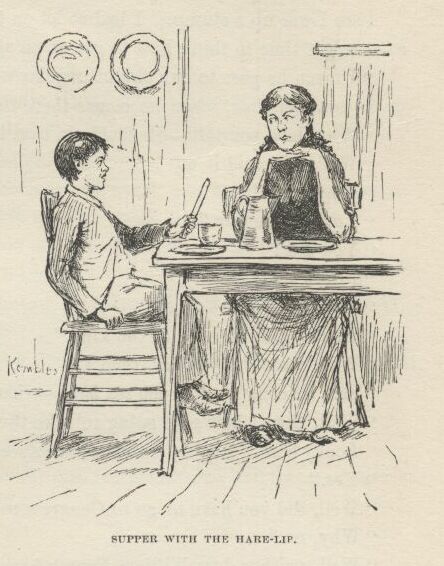
And when it was all done me and the hare-lip had supper in the kitchen off of the leavings, whilst the others was helping the clean up the things. The hare-lip she got to pumping me about England, and blest if I didn’t think the ice was getting mighty thin sometimes. She says:
And when it was all done, me and the hare-lip had supper in the kitchen off the leftovers. Meanwhile, the others was helping the clean up. The hare-lip she got to questioning me about England. And blessed if I didn’t think the ice was getting mighty thin sometimes. She says:
“Did you ever see the king?”
“Did you ever see the king?”
“Who? William Fourth? Well, I bet I have—he goes to our church.” I knowed he was dead years ago, but I never let on. So when I says he goes to our church, she says:
“Who? William Fourth? Well, I bet I have. He goes to our church.” I knowed he was dead years ago, but I never let on. So when I says he goes to our church, she says:
“What—regular?”
“What, regular?”
“Yes—regular. His pew’s right over opposite ourn—on t’other side the pulpit.”
“Yes, regular. His pew’s right opposite ours, on the other side of the pulpit.”
“I thought he lived in London?”
“I thought he lived in London?”
“Well, he does. Where would he live?”
“Well, he does. Where would he live?”
“But I thought you lived in Sheffield?”
“But I thought you lived in Sheffield?”
I see I was up a stump. I had to let on to get choked with a chicken bone, so as to get time to think how to get down again. Then I says:
I see I was in a tight spot. I had to pretend I was choking on a chicken bone. That would give me time to think how to get out of the mess. Then I says:
“I mean he goes to our church regular when he’s in Sheffield. That’s only in the summer time, when he comes there to take the sea baths.”
“I mean he goes to our church regular when he’s in Sheffield. He’s only there in the summer, when he comes to bathe in the sea.”
“Why, how you talk—Sheffield ain’t on the sea.”
“Why, how you talk! Sheffield ain’t on the coast.”
“Well, who said it was?”
“Well, who said it was?”
“Why, you did.”
“Why, you did.”
“I didn’t nuther.”
“I didn’t neither.”
“You did!”
“You did!”
“I didn’t.”
“I didn’t.”
“You did.”
“You did.”
“I never said nothing of the kind.”
“I never said nothing of the kind.”
“Well, what did you say, then?”
“Well, what did you say, then?”
“Said he come to take the sea baths—that’s what I said.”
“Said he come to take the sea baths. That’s what I said.”
“Well, then, how’s he going to take the sea baths if it ain’t on the sea?”
“Well, then, how’s he going to take sea baths if it ain’t on the sea?”
“Looky here,” I says; “did you ever see any Congress-water?”
“Look here,” I says. “Did you ever see any Congress-water?”
“Yes.”
“Yes.”
“Well, did you have to go to Congress to get it?”
“Well, did you have to go to Congress to get it?”
“Why, no.”
“Why, no.”
“Well, neither does William Fourth have to go to the sea to get a sea bath.”
“Well, neither does William Fourth have to go to the sea to take a saltwater bath.”
“How does he get it, then?”
“How does he get it, then?”
“Gets it the way people down here gets Congress-water—in barrels. There in the palace at Sheffield they’ve got furnaces, and he wants his water hot. They can’t bile that amount of water away off there at the sea. They haven’t got no conveniences for it.”
“Gets it the way people down here gets Congress-water, in barrels. There in the palace at Sheffield they’ve got furnaces, and he wants his water hot. They can’t boil that much water way off there at the sea. They haven’t got no equipment for it.”
“Oh, I see, now. You might a said that in the first place and saved time.”
“Oh, I see now. You might have said that in the first place and saved time.”
When she said that I see I was out of the woods again, and so I was comfortable and glad. Next, she says:
When she said that, I see I was out of the woods again. So I was comfortable and glad. Next, she says:
“Do you go to church, too?”
“Do you go to church, too?”
“Yes—regular.”
“Yes, regular.”
“Where do you set?”
“Where do you sit?”
“Why, in our pew.”
“Why, in our pew.”
“Whose pew?”
“Whose pew?”
“Why, ourn—your Uncle Harvey’s.”
“Why, ours, your Uncle Harvey’s.”
“His’n? What does he want with a pew?”
“His? What does he want with a pew?”
“Wants it to set in. What did you reckon he wanted with it?”
“Wants it to sit in. What did you reckon he wanted it for?”
“Why, I thought he’d be in the pulpit.”
“Why, I thought he’d be in the pulpit.”
Rot him, I forgot he was a preacher. I see I was up a stump again, so I played another chicken bone and got another think. Then I says:
Rot him, I forgot he was a preacher. I see I was up a stump again, so I let on to choke on another chicken bone and got another think. Then I says:
“Blame it, do you suppose there ain’t but one preacher to a church?”
“Blame it, do you suppose there ain’t but one preacher in a church?”
“Why, what do they want with more?”
“Why, what do they want more for?”
“What!—to preach before a king? I never did see such a girl as you. They don’t have no less than seventeen.”
“What! To preach before a king? I never did see such a girl as you. They don’t have no less than seventeen.”
“Seventeen! My land! Why, I wouldn’t set out such a string as that, not if I never got to glory. It must take ’em a week.”
“Seventeen! My land! Why, I wouldn’t go through such a long string, not if I never got to heaven. It must take them a week.”
“Shucks, they don’t all of ’em preach the same day—only one of ’em.”
“Shucks, they don’t all of them preach the same day, only one of them.”
“Well, then, what does the rest of ’em do?”
“Well, then, what does the rest of them do?”
“Oh, nothing much. Loll around, pass the plate—and one thing or another. But mainly they don’t do nothing.”
“Oh, nothing much. Lounge around, pass the plate, and one thing or another. But mainly they don’t do nothing.”
“Well, then, what are they for?”
“Well, then, what are they for?”
“Why, they’re for style. Don’t you know nothing?”
“Why, they’re for style. Don’t you know nothing?”
“Well, I don’t want to know no such foolishness as that. How is servants treated in England? Do they treat ’em better ’n we treat our ?”
“Well, I don’t want to know no such foolishness as that. How is servants treated in England? Do they treat them better than we treat our ?”
“No! A servant ain’t nobody there. They treat them worse than dogs.”
“No! A servant ain’t nobody there. They treat them worse than dogs.”
“Don’t they give ’em holidays, the way we do, Christmas and New Year’s week, and Fourth of July?”
“Don’t they give them holidays the way we do, for Christmas and New Year’s week and the Fourth of July?”
“Oh, just listen! A body could tell you hain’t ever been to England by that. Why, Hare-l—why, Joanna, they never see a holiday from year’s end to year’s end; never go to the circus, nor theater, nor shows, nor nowheres.”
“Oh, just listen! A body could tell you ain’t ever been to England by that. Why, Hare-l... why, Joanna, they never see a holiday all year long. They never go to the circus, nor theater, nor shows, nor nowhere.”
“Nor church?”
“Not church either?”
“Nor church.”
“Nor church.”
“But you always went to church.”
“But you always went to church.”
Well, I was gone up again. I forgot I was the old man’s servant. But next minute I whirled in on a kind of an explanation how a valley was different from a common servant and had to go to church whether he wanted to or not, and set with the family, on account of its being the law. But I didn’t do it pretty good, and when I got done I see she warn’t satisfied. She says:
Well, I was gone up again. I forgot I was the old man’s servant. But the next minute I whirled in on a kind of an explanation how a valley was different from a common servant and had to go to church whether he wanted to or not, and set with the family, on account of its being the law. But I didn’t do it pretty good, and when I got done I see she wasn’t satisfied. She says:
“Honest injun, now, hain’t you been telling me a lot of lies?”
“Honest injun, now, ain't you been telling me a lot of lies?”
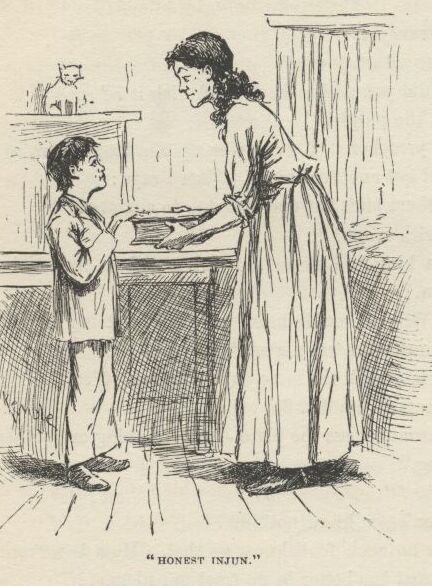
“Honest injun,” says I.
“Honest Injun,” says I.
“None of it at all?”
“None of it at all?”
“None of it at all. Not a lie in it,” says I.
“None of it at all. Not a lie in it,” says I.
“Lay your hand on this book and say it.”
“Put your hand on this book and say it.”
I see it warn’t nothing but a dictionary, so I laid my hand on it and said it. So then she looked a little better satisfied, and says:
I see it wasn't nothing but a dictionary. So I laid my hand on it and said it. So then she looked a little more satisfied, and says:
“Well, then, I’ll believe some of it; but I hope to gracious if I’ll believe the rest.”
“Well, then, I’ll believe some of it. But goodness knows I won’t believe the rest.”
“What is it you won’t believe, Joe?” says Mary Jane, stepping in with Susan behind her. “It ain’t right nor kind for you to talk so to him, and him a stranger and so far from his people. How would you like to be treated so?”
“What won’t you believe, Joe?” says Mary Jane, stepping in with Susan behind her. “It ain’t right nor kind to talk to him like that, and him a stranger so far from his people. How would you like to be treated like that?”
“That’s always your way, Maim—always sailing in to help somebody before they’re hurt. I hain’t done nothing to him. He’s told some stretchers, I reckon, and I said I wouldn’t swallow it all; and that’s every bit and grain I did say. I reckon he can stand a little thing like that, can’t he?”
“That’s always your way, Maim, always rushing in to help somebody before they’re hurt. I ain’t done nothing to him. He’s told some tall tales, I reckon, and I said I wouldn’t swallow it all. And that’s all I did say. I reckon he can stand a little thing like that, can’t he?”
“I don’t care whether ’twas little or whether ’twas big; he’s here in our house and a stranger, and it wasn’t good of you to say it. If you was in his place it would make you feel ashamed; and so you oughtn’t to say a thing to another person that will make them feel ashamed.”
“I don’t care whether it was little or big. He’s here in our house and a stranger, and it wasn’t good of you to say it. If you was in his place, it would make you feel ashamed. So you oughtn’t to say something to another person that will make them feel ashamed.”
“Why, Mam, he said—”
“Why, Mam, he said...”
“It don’t make no difference what he said—that ain’t the thing. The thing is for you to treat him kind, and not be saying things to make him remember he ain’t in his own country and amongst his own folks.”
“It don’t make no difference what he said. What he said ain’t the point. The point is for you to treat him kind. And don’t be saying things to make him remember he ain’t in his own country and among his own folks.”
I says to myself, this is a girl that I’m letting that old reptile rob her of her money!
I says to myself, this is a girl that I’m letting that old reptile rob her of her money!
Then Susan she waltzed in; and if you’ll believe me, she did give Hare-lip hark from the tomb!
Then Susan she jumped in. And if you’ll believe me, she really did give Hare-lip a tongue-lashing!
Says I to myself, and this is another one that I’m letting him rob her of her money!
Says I to myself, and this is another one that I’m letting him rob her of her money!
Then Mary Jane she took another inning, and went in sweet and lovely again—which was her way; but when she got done there warn’t hardly anything left o’ poor Hare-lip. So she hollered.
Then Mary Jane she took another turn, and went at it sweet and lovely again. That was her way. But when she got done, there wasn't hardly anything left of poor Hare-lip. So she hollered.
“All right, then,” says the other girls; “you just ask his pardon.”
“All right, then,” says the other girls. “You just ask him to forgive you.”
She done it, too; and she done it beautiful. She done it so beautiful it was good to hear; and I wished I could tell her a thousand lies, so she could do it again.
She done it, too, and she done it beautiful. She done it so beautiful it was good to hear. And I wished I could tell her a thousand lies, so she could do it again.
I says to myself, this is another one that I’m letting him rob her of her money. And when she got through they all jest laid theirselves out to make me feel at home and know I was amongst friends. I felt so ornery and low down and mean that I says to myself, my mind’s made up; I’ll hive that money for them or bust.
I says to myself, this is another one that I’m letting him rob her of her money. And when she got through, they all just put theirselves out to make me feel at home and know I was among friends. I felt so ornery and low-down and mean that I says to myself, my mind’s made up: I’ll get hold of that money for them or bust.
So then I lit out—for bed, I said, meaning some time or another. When I got by myself I went to thinking the thing over. I says to myself, shall I go to that doctor, private, and blow on these frauds? No—that won’t do. He might tell who told him; then the king and the duke would make it warm for me. Shall I go, private, and tell Mary Jane? No—I dasn’t do it. Her face would give them a hint, sure; they’ve got the money, and they’d slide right out and get away with it. If she was to fetch in help I’d get mixed up in the business before it was done with, I judge. No; there ain’t no good way but one. I got to steal that money, somehow; and I got to steal it some way that they won’t suspicion that I done it. They’ve got a good thing here, and they ain’t a-going to leave till they’ve played this family and this town for all they’re worth, so I’ll find a chance time enough. I’ll steal it and hide it; and by-and-by, when I’m away down the river, I’ll write a letter and tell Mary Jane where it’s hid. But I better hive it tonight if I can, because the doctor maybe hasn’t let up as much as he lets on he has; he might scare them out of here yet.
So then I took off. I said I was going to bed, meaning sometime or other. When I got by myself, I started thinking the thing over. I says to myself, shall I go to that doctor in private and tell on these frauds? No, that won’t do. He might tell who told him. Then the king and the duke would make trouble for me. Shall I go in private and tell Mary Jane? No, I don’t dare do it. Her face would give them a hint for sure. They’ve got the money, and they’d slip right out and get away with it. If she was to bring in help, I’d get mixed up in the business before it was over, I reckon. No, there ain’t no good way but one. I got to steal that money somehow. And I got to steal it so they won’t suspect I done it. They’ve got a good thing going here. They ain’t going to leave till they’ve cheated this family and this town out of all they can get. So I’ll have plenty of time to find a chance. I’ll steal the money and hide it. Then, when I’m away down the river, I’ll write a letter and tell Mary Jane where it’s hid. But I better get hold of it tonight if I can. The doctor maybe hasn’t backed off as much as he lets on. He might scare them out of here yet.
So, thinks I, I’ll go and search them rooms. Upstairs the hall was dark, but I found the duke’s room, and started to paw around it with my hands; but I recollected it wouldn’t be much like the king to let anybody else take care of that money but his own self; so then I went to his room and begun to paw around there. But I see I couldn’t do nothing without a candle, and I dasn’t light one, of course. So I judged I’d got to do the other thing—lay for them and eavesdrop. About that time I hears their footsteps coming, and was going to skip under the bed; I reached for it, but it wasn’t where I thought it would be; but I touched the curtain that hid Mary Jane’s frocks, so I jumped in behind that and snuggled in amongst the gowns, and stood there perfectly still.
So, thinks I, I’ll go and search them rooms. Upstairs the hall was dark, but I found the duke’s room and started feeling around with my hands. But I remembered it wouldn’t be much like the king to let anybody but his own self handle that money. So then I went to the king’s room and begun to feel around there. But I see I couldn’t do nothing without a candle, and I didn’t dare light one, of course. So I figured I’d got to do the other thing, wait for them and listen in. About that time I hears their footsteps coming, and I was going to slip under the bed. I reached for it, but the bed wasn’t where I thought it would be. But I touched the curtain that hid Mary Jane’s dresses. So I jumped in behind the curtain, squeezed in among the dresses, and stood there perfectly still.
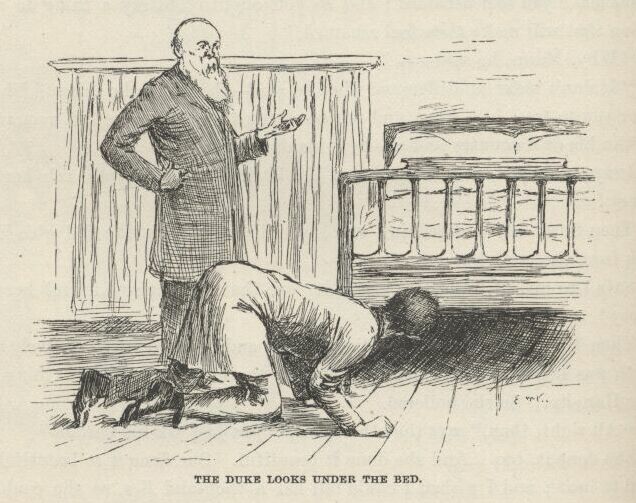
They come in and shut the door; and the first thing the duke done was to get down and look under the bed. Then I was glad I hadn’t found the bed when I wanted it. And yet, you know, it’s kind of natural to hide under the bed when you are up to anything private. They sets down then, and the king says:
They come in and shut the door. And the first thing the duke done was to get down and look under the bed. Then I was glad I hadn’t found the bed when I wanted it. And yet, you know, it’s kind of natural to hide under the bed when you’re up to anything private. They sets down then, and the king says:
“Well, what is it? And cut it middlin’ short, because it’s better for us to be down there a-whoopin’ up the mournin’ than up here givin’ ’em a chance to talk us over.”
“Well, what is it? And keep it pretty short. Because we're better off downstairs making a big show of mourning than up here giving them a chance to talk us over.”
“Well, this is it, Capet. I ain’t easy; I ain’t comfortable. That doctor lays on my mind. I wanted to know your plans. I’ve got a notion, and I think it’s a sound one.”
“Well, here’s the thing, Capet. I ain’t at ease. I ain’t comfortable. That doctor weighs on my mind. I wanted to know your plans. I’ve got an idea, and I think it’s a good one.”
“What is it, duke?”
“What is it, duke?”
“That we better glide out of this before three in the morning, and clip it down the river with what we’ve got. Specially, seeing we got it so easy—given back to us, flung at our heads, as you may say, when of course we allowed to have to steal it back. I’m for knocking off and lighting out.”
“That we better slip out of here before three in the morning and hurry down the river with what we’ve got. Especially seeing we got it so easy. It was given back to us, thrown at our heads, you might say. And of course we expected to have to steal it back. I’m for calling it quits and taking off.”
That made me feel pretty bad. About an hour or two ago it would a been a little different, but now it made me feel bad and disappointed. The king rips out and says:
That made me feel pretty bad. An hour or two ago it would have been a little different. But now it made me feel bad and disappointed. The king bursts out and says:
“What! And not sell out the rest o’ the property? March off like a passel of fools and leave eight or nine thous’n’ dollars’ worth o’ property layin’ around jest sufferin’ to be scooped in?—and all good, salable stuff, too.”
“What! And not sell off the rest of the property? March off like a bunch of fools? And leave eight or nine thousand dollars’ worth of property lying around just begging to be scooped up? And all good, sellable stuff, too.”
The duke he grumbled; said the bag of gold was enough, and he didn’t want to go no deeper—didn’t want to rob a lot of orphans of everything they had.
The duke he grumbled. Said the bag of gold was enough, and he didn’t want to go any further. He didn’t want to rob a lot of orphans of everything they had.
“Why, how you talk!” says the king. “We sha’n’t rob ’em of nothing at all but jest this money. The people that buys the property is the suff’rers; because as soon ’s it’s found out ’at we didn’t own it—which won’t be long after we’ve slid—the sale won’t be valid, and it’ll all go back to the estate. These yer orphans ’ll git their house back agin, and that’s enough for them; they’re young and spry, and k’n easy earn a livin’. They ain’t a-goin to suffer. Why, jest think—there’s thous’n’s and thous’n’s that ain’t nigh so well off. Bless you, they ain’t got noth’n’ to complain of.”
“Why, how you talk!” says the king. “We shan’t rob them of nothing at all but just this money. The people that buys the property is the ones who suffer. Because as soon as it’s found out that we didn’t own the property, the sale won’t be valid. That won’t be long after we’ve slipped away. And the property will all go back to the estate. These here orphans will get their house back again, and that’s enough for them. They’re young and spry, and can easily earn a living. They ain’t going to suffer. Why, just think, there’s thousands and thousands that ain’t nearly so well off. Bless you, they ain’t got nothing to complain of.”
Well, the king he talked him blind; so at last he give in, and said all right, but said he believed it was blamed foolishness to stay, and that doctor hanging over them. But the king says:
Well, the king he talked until he wore him down. So at last he give in and said all right. But he said he believed it was blamed foolishness to stay, with that doctor hanging over them. But the king says:
“Cuss the doctor! What do we k’yer for him? Hain’t we got all the fools in town on our side? And ain’t that a big enough majority in any town?”
“Cuss the doctor! What do we care for him? Ain’t we got all the fools in town on our side? And ain’t that a big enough majority in any town?”
So they got ready to go down stairs again. The duke says:
So they got ready to go downstairs again. The duke says:
“I don’t think we put that money in a good place.”
“I don’t think we put that money in a good place.”
That cheered me up. I’d begun to think I warn’t going to get a hint of no kind to help me. The king says:
That cheered me up. I’d begun to think I wasn’t going to get a hint of no kind to help me. The king says:
“Why?”
“Why?”
“Because Mary Jane ’ll be in mourning from this out; and first you know the that does up the rooms will get an order to box these duds up and put ’em away; and do you reckon a can run across money and not borrow some of it?”
“Because Mary Jane will be in mourning from now on. And before you know it, the who cleans the rooms will get orders to box these clothes up and put them away. And do you reckon a can come across money and not borrow some of it?”
“Your head’s level agin, duke,” says the king; and he comes a-fumbling under the curtain two or three foot from where I was. I stuck tight to the wall and kept mighty still, though quivery; and I wondered what them fellows would say to me if they catched me; and I tried to think what I’d better do if they did catch me. But the king he got the bag before I could think more than about a half a thought, and he never suspicioned I was around. They took and shoved the bag through a rip in the straw tick that was under the feather-bed, and crammed it in a foot or two amongst the straw and said it was all right now, because a only makes up the feather-bed, and don’t turn over the straw tick only about twice a year, and so it warn’t in no danger of getting stole now.
“Your head’s level again, duke,” says the king. And he comes fumbling under the curtain two or three foot from where I was. I stuck tight to the wall and kept mighty still, though I was shaking. And I wondered what them fellows would say to me if they catched me. And I tried to think what I’d better do if they did catch me. But the king he got the bag before I could think more than about half a thought. And he never suspicioned I was around. They shoved the bag through a rip in the straw mattress under the feather bed. And they crammed it a foot or two into the straw and said it was all right now. That was because a only makes up the feather bed, and don’t turn over the straw mattress except about twice a year. So the bag wasn’t in no danger of getting stole now.
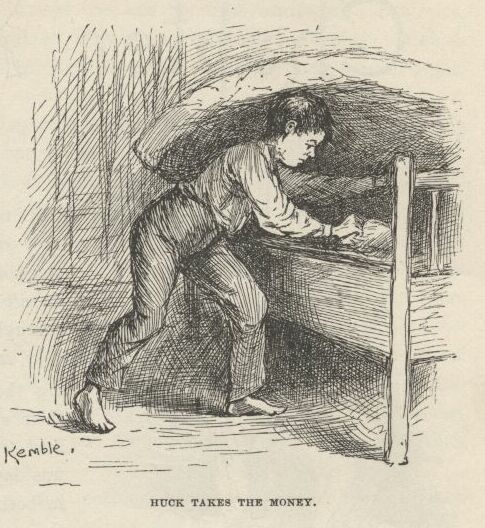
But I knowed better. I had it out of there before they was half-way down stairs. I groped along up to my cubby, and hid it there till I could get a chance to do better. I judged I better hide it outside of the house somewheres, because if they missed it they would give the house a good ransacking: I knowed that very well. Then I turned in, with my clothes all on; but I couldn’t a gone to sleep if I’d a wanted to, I was in such a sweat to get through with the business. By-and-by I heard the king and the duke come up; so I rolled off my pallet and laid with my chin at the top of my ladder, and waited to see if anything was going to happen. But nothing did.
But I knowed better. I had it out of there before they was halfway downstairs. I felt my way up to my cubby and hid it there till I could find a better place. I figured I better hide it somewhere outside the house. Because if they missed it, they would search the house from top to bottom. I knowed that very well. Then I went to bed with all my clothes on. But I couldn’t have gone to sleep if I’d wanted to. I was so anxious to get the business over with. After a while, I heard the king and the duke come up. So I rolled off my thin mattress and laid with my chin at the top of my ladder. I waited to see if anything was going to happen. But nothing did.
So I held on till all the late sounds had quit and the early ones hadn’t begun yet; and then I slipped down the ladder.
So I waited till all the late-night sounds had stopped and the early-morning ones hadn’t started yet. And then I slipped down the ladder.