Chapter 24
Next day, towards night, we laid up under a little willow tow-head out in the middle, where there was a village on each side of the river, and the duke and the king begun to lay out a plan for working them towns. Jim he spoke to the duke, and said he hoped it wouldn’t take but a few hours, because it got mighty heavy and tiresome to him when he had to lay all day in the wigwam tied with the rope. You see, when we left him all alone we had to tie him, because if anybody happened on to him all by himself and not tied it wouldn’t look much like he was a runaway , you know. So the duke said it was kind of hard to have to lay roped all day, and he’d cipher out some way to get around it.
Next day, toward night, we stopped under the willows on a little island out in the middle of the river. There was a village on each side of the river. The duke and the king begun making plans for cheating them towns. Jim he spoke to the duke and said he hoped it wouldn’t take more than a few hours. Because it got mighty hard and tiresome for him to lay all day in the shelter, tied with the rope. You see, when we left him all alone, we had to tie him. Because if anybody found him all by himself and not tied, he wouldn’t look much like a runaway , you know. So the duke said it was kind of hard to have to lay tied up all day. And he’d figure out some way around it.
He was uncommon bright, the duke was, and he soon struck it. He dressed Jim up in King Lear’s outfit—it was a long curtain-calico gown, and a white horse-hair wig and whiskers; and then he took his theater paint and painted Jim’s face and hands and ears and neck all over a dead, dull, solid blue, like a man that’s been drownded nine days. Blamed if he warn’t the horriblest looking outrage I ever see. Then the duke took and wrote out a sign on a shingle so:
The duke was uncommon bright, and he soon figured it out. He dressed Jim up in King Lear’s outfit. It was a long gown made of curtain calico, with a white horsehair wig and whiskers. Then he took his theater paint and painted Jim’s face and hands and ears and neck all over. He painted them a dead, dull, solid blue, like a man that’s been drowned nine days. Blamed if he weren’t the horriblest looking sight I ever see. Then the duke wrote out a sign on a wooden shingle like this:
Sick Arab—but harmless when not out of his head.
Sick Arab, but harmless when he isn't delirious.
And he nailed that shingle to a lath, and stood the lath up four or five foot in front of the wigwam. Jim was satisfied. He said it was a sight better than lying tied a couple of years every day, and trembling all over every time there was a sound. The duke told him to make himself free and easy, and if anybody ever come meddling around, he must hop out of the wigwam, and carry on a little, and fetch a howl or two like a wild beast, and he reckoned they would light out and leave him alone. Which was sound enough judgment; but you take the average man, and he wouldn’t wait for him to howl. Why, he didn’t only look like he was dead, he looked considerable more than that.
And he nailed that shingle to a thin strip of wood. He stood the strip up four or five foot in front of the wigwam. Jim was satisfied. He said it was a whole lot better than lying tied up a couple of years every day. And it was better than trembling all over every time there was a sound. The duke told him to make himself comfortable. If anybody ever come snooping around, he must hop out of the wigwam and act wild a little. He must let out a howl or two like a wild beast. The duke reckoned they would run off and leave him alone. That was sensible enough advice, but you take the average man, and he wouldn’t wait for Jim to howl. Why, he didn’t only look like he was dead, he looked a good deal worse than that.
These rapscallions wanted to try the Nonesuch again, because there was so much money in it, but they judged it wouldn’t be safe, because maybe the news might a worked along down by this time. They couldn’t hit no project that suited exactly; so at last the duke said he reckoned he’d lay off and work his brains an hour or two and see if he couldn’t put up something on the Arkansaw village; and the king he allowed he would drop over to t’other village without any plan, but just trust in Providence to lead him the profitable way—meaning the devil, I reckon. We had all bought store clothes where we stopped last; and now the king put his’n on, and he told me to put mine on. I done it, of course. The king’s duds was all black, and he did look real swell and starchy. I never knowed how clothes could change a body before. Why, before, he looked like the orneriest old rip that ever was; but now, when he’d take off his new white beaver and make a bow and do a smile, he looked that grand and good and pious that you’d say he had walked right out of the ark, and maybe was old Leviticus himself. Jim cleaned up the canoe, and I got my paddle ready. There was a big steamboat laying at the shore away up under the point, about three mile above the town—been there a couple of hours, taking on freight. Says the king:
These scoundrels wanted to try the Nonesuch again, because there was so much money in it. But they figured it wouldn’t be safe, because maybe the news might have spread downriver by this time. They couldn’t find no scheme that suited them exactly. So at last the duke said he reckoned he’d take an hour or two to think. He’d see if he couldn’t pull something off in the Arkansaw village. And the king, he said he would drop over to the other village without any plan. He would just trust in Providence to lead him to some money. He meant the devil, I reckon. We had all bought store clothes where we stopped last. And now the king put his on, and he told me to put mine on. I done it, of course. The king’s clothes was all black, and he did look real fancy and proper. I never knowed how clothes could change a body before. Why, before, he looked like the meanest old rascal that ever was. But now he’d take off his new white beaver hat and bow and smile. He looked that grand and good and holy that you’d say he had walked right out of the ark. Maybe he was old Leviticus himself. Jim cleaned up the canoe, and I got my paddle ready. There was a big steamboat sitting at the shore, up under the point, about three miles above the town. The steamboat had been there a couple of hours, taking on freight. Says the king:
“Seein’ how I’m dressed, I reckon maybe I better arrive down from St. Louis or Cincinnati, or some other big place. Go for the steamboat, Huckleberry; we’ll come down to the village on her.”
“Seeing how I’m dressed, I reckon maybe I better come down from St. Louis or Cincinnati, or some other big place. Go for the steamboat, Huckleberry. We’ll come down to the village on her.”
I didn’t have to be ordered twice to go and take a steamboat ride. I fetched the shore a half a mile above the village, and then went scooting along the bluff bank in the easy water. Pretty soon we come to a nice innocent-looking young country jake setting on a log swabbing the sweat off of his face, for it was powerful warm weather; and he had a couple of big carpet-bags by him.
I didn’t have to be told twice to go and take a steamboat ride. I reached the shore half a mile above the village, then went scooting along the steep bank in calm water. Pretty soon we come to a nice, innocent-looking young country bumpkin sitting on a log. He was wiping the sweat off his face, because it was powerful warm weather. And he had a couple of big travel bags beside him.
“Run her nose in shore,” says the king. I done it. “Wher’ you bound for, young man?”
“Steer her bow toward shore,” says the king. I done it. “Where you bound for, young man?”
“For the steamboat; going to Orleans.”
“For the steamboat, going to Orleans.”
“Git aboard,” says the king. “Hold on a minute, my servant ’ll he’p you with them bags. Jump out and he’p the gentleman, Adolphus”—meaning me, I see.
“Get aboard,” says the king. “Hold on a minute, my servant’ll help you with them bags. Jump out and help the gentleman, Adolphus.” He means me, I see.
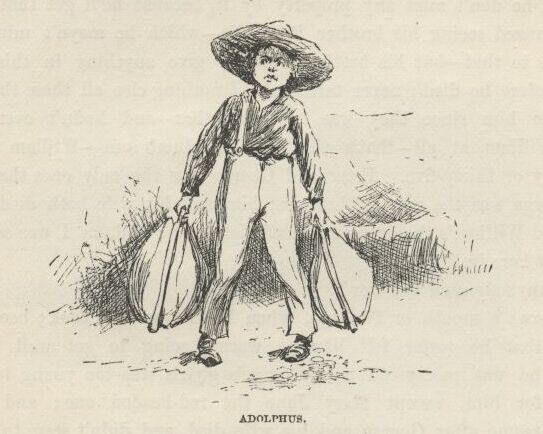
I done so, and then we all three started on again. The young chap was mighty thankful; said it was tough work toting his baggage such weather. He asked the king where he was going, and the king told him he’d come down the river and landed at the other village this morning, and now he was going up a few mile to see an old friend on a farm up there. The young fellow says:
I done so, and then all three of us started on again. The young fellow was mighty thankful. He said it was hard work carrying his baggage in weather like this. He asked the king where he was going. The king told him he’d come down the river and landed at the other village this morning. Now he was going a few mile farther to see an old friend on a farm up there. The young fellow says:
“When I first see you I says to myself, ‘It’s Mr. Wilks, sure, and he come mighty near getting here in time.’ But then I says again, ‘No, I reckon it ain’t him, or else he wouldn’t be paddling up the river.’ You ain’t him, are you?”
“When I first see you I says to myself, ‘It’s Mr. Wilks, sure. And he come mighty near getting here in time.’ But then I says again, ‘No, I reckon it ain’t him, or else he wouldn’t be paddling up the river.’ You ain’t him, are you?”
“No, my name’s Blodgett—Elexander Blodgett—Reverend Elexander Blodgett, I s’pose I must say, as I’m one o’ the Lord’s poor servants. But still I’m jist as able to be sorry for Mr. Wilks for not arriving in time, all the same, if he’s missed anything by it—which I hope he hasn’t.”
“No, my name’s Blodgett. Elexander Blodgett. Reverend Elexander Blodgett, I suppose I must say, as I’m one of the Lord’s poor servants. But I’m still just as able to feel sorry for Mr. Wilks for not arriving in time. That is, if he’s missed anything by arriving late, which I hope he hasn’t.”
“Well, he don’t miss any property by it, because he’ll get that all right; but he’s missed seeing his brother Peter die—which he mayn’t mind, nobody can tell as to that—but his brother would a give anything in this world to see him before he died; never talked about nothing else all these three weeks; hadn’t seen him since they was boys together—and hadn’t ever seen his brother William at all—that’s the deef and dumb one—William ain’t more than thirty or thirty-five. Peter and George were the only ones that come out here; George was the married brother; him and his wife both died last year. Harvey and William’s the only ones that’s left now; and, as I was saying, they haven’t got here in time.”
“Well, he don’t lose any property over it, because he’ll get all that all right. But he’s missed seeing his brother Peter die. He may not mind missing that, nobody can tell. But his brother would have give anything in this world to see him before he died. Peter never talked about nothing else all these three weeks. He hadn’t seen him since they was boys together. And Peter hadn’t ever seen his brother William at all. William’s the one who’s deaf and can’t speak. William ain’t more than thirty or thirty-five. Peter and George were the only ones that come out here. George was the married brother. Him and his wife both died last year. Harvey and William’s the only ones that’s left now. And, as I was saying, they haven’t got here in time.”
“Did anybody send ’em word?”
“Did anybody send them word?”
“Oh, yes; a month or two ago, when Peter was first took; because Peter said then that he sorter felt like he warn’t going to get well this time. You see, he was pretty old, and George’s g’yirls was too young to be much company for him, except Mary Jane, the red-headed one; and so he was kinder lonesome after George and his wife died, and didn’t seem to care much to live. He most desperately wanted to see Harvey—and William, too, for that matter—because he was one of them kind that can’t bear to make a will. He left a letter behind for Harvey, and said he’d told in it where his money was hid, and how he wanted the rest of the property divided up so George’s g’yirls would be all right—for George didn’t leave nothing. And that letter was all they could get him to put a pen to.”
“Oh, yes, a month or two ago, when Peter was first took sick. Because Peter said then that he sort of felt like he wasn’t going to get well this time. You see, he was pretty old, and George’s girls was too young to be much company for him. The exception was Mary Jane, the red-headed one. So he was kind of lonesome after George and his wife died, and didn’t seem to care much to live. He wanted most desperately to see Harvey, and William, too, for that matter. Because he was one of them kind that can’t bear to make a will. He left a letter behind for Harvey. He said he’d told in the letter where his money was hid, and how he wanted the remaining property divided. He wanted it divided so George’s girls would be all right, because George didn’t leave nothing. And that letter was all they could get him to put a pen to.”
“Why do you reckon Harvey don’t come? Wher’ does he live?”
“Why do you reckon Harvey don’t come? Where does he live?”
“Oh, he lives in England—Sheffield—preaches there—hasn’t ever been in this country. He hasn’t had any too much time—and besides he mightn’t a got the letter at all, you know.”
“Oh, he lives in England, in Sheffield. He preaches there. He hasn’t ever been in this country. He hasn’t had any too much time. And besides, he might not have got the letter at all, you know.”
“Too bad, too bad he couldn’t a lived to see his brothers, poor soul. You going to Orleans, you say?”
“Too bad, too bad he couldn’t have lived to see his brothers, poor soul. You going to Orleans, you say?”
“Yes, but that ain’t only a part of it. I’m going in a ship, next Wednesday, for Ryo Janeero, where my uncle lives.”
“Yes, but that ain’t only a part of it. I’m going by ship next Wednesday to Ryo Janeero, where my uncle lives.”
“It’s a pretty long journey. But it’ll be lovely; wisht I was a-going. Is Mary Jane the oldest? How old is the others?”
“It’s a pretty long journey. But it’ll be lovely. Wish I was going. Is Mary Jane the oldest? How old is the others?”
“Mary Jane’s nineteen, Susan’s fifteen, and Joanna’s about fourteen—that’s the one that gives herself to good works and has a hare-lip.”
“Mary Jane’s nineteen, Susan’s fifteen, and Joanna’s about fourteen. Joanna’s the one who devotes herself to good works and has a cleft lip.”
“Poor things! to be left alone in the cold world so.”
“Poor things! Left all alone in this cold world like that.”
“Well, they could be worse off. Old Peter had friends, and they ain’t going to let them come to no harm. There’s Hobson, the Babtis’ preacher; and Deacon Lot Hovey, and Ben Rucker, and Abner Shackleford, and Levi Bell, the lawyer; and Dr. Robinson, and their wives, and the widow Bartley, and—well, there’s a lot of them; but these are the ones that Peter was thickest with, and used to write about sometimes, when he wrote home; so Harvey ’ll know where to look for friends when he gets here.”
“Well, they could be worse off. Old Peter had friends, and they ain’t going to let them come to no harm. There’s Hobson, the Baptist preacher, and Deacon Lot Hovey, and Ben Rucker, and Abner Shackleford, and Levi Bell, the lawyer. And Dr. Robinson, and their wives, and the widow Bartley. Well, there’s a lot of them. But these are the ones Peter was closest to. He used to write about them sometimes when he wrote home. So Harvey’ll know where to look for friends when he gets here.”
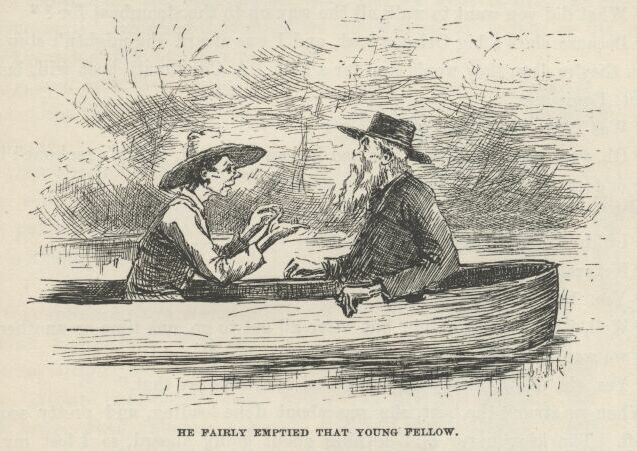
Well, the old man went on asking questions till he just fairly emptied that young fellow. Blamed if he didn’t inquire about everybody and everything in that blessed town, and all about the Wilkses; and about Peter’s business—which was a tanner; and about George’s—which was a carpenter; and about Harvey’s—which was a dissentering minister; and so on, and so on. Then he says:
Well, the old man kept asking questions till he got everything that young fellow knew out of him. Blamed if he didn’t ask about everybody and everything in that blessed town, and all about the Wilkses. He asked about Peter’s business, which was tanning leather, and about George’s work as a carpenter. And about Harvey’s work as a dissenting minister, and so on, and so on. Then he says:
“What did you want to walk all the way up to the steamboat for?”
“Why did you want to walk all the way up to the steamboat?”
“Because she’s a big Orleans boat, and I was afeard she mightn’t stop there. When they’re deep they won’t stop for a hail. A Cincinnati boat will, but this is a St. Louis one.”
“Because she’s a big Orleans boat, and I was afraid she might not stop there. When boats are heavily loaded, they won’t stop when someone calls to them. A Cincinnati boat will, but this is a St. Louis one.”
“Was Peter Wilks well off?”
“Was Peter Wilks well off?”
“Oh, yes, pretty well off. He had houses and land, and it’s reckoned he left three or four thousand in cash hid up som’ers.”
“Oh, yes, pretty well off. He had houses and land. And it’s reckoned he left three or four thousand in cash hid up somewhere.”
“When did you say he died?”
“When did you say he died?”
“I didn’t say, but it was last night.”
“I didn’t say, but it was last night.”
“Funeral to-morrow, likely?”
“Funeral tomorrow, likely?”
“Yes, ’bout the middle of the day.”
“Yes, about the middle of the day.”
“Well, it’s all terrible sad; but we’ve all got to go, one time or another. So what we want to do is to be prepared; then we’re all right.”
“Well, it’s all terrible sad. But we’ve all got to go, one time or another. So what we want to do is be prepared. Then we’re all right.”
“Yes, sir, it’s the best way. Ma used to always say that.”
“Yes, sir, it’s the best way. Ma used to always say that.”
When we struck the boat she was about done loading, and pretty soon she got off. The king never said nothing about going aboard, so I lost my ride, after all. When the boat was gone the king made me paddle up another mile to a lonesome place, and then he got ashore and says:
When we reached the boat, she was about done loading, and pretty soon she left. The king never said nothing about going aboard, so I lost my ride, after all. When the boat was gone, the king made me paddle another mile upstream to a lonely spot. Then he went ashore and says:
“Now hustle back, right off, and fetch the duke up here, and the new carpet-bags. And if he’s gone over to t’other side, go over there and git him. And tell him to git himself up regardless. Shove along, now.”
“Now hustle back, right away, and fetch the duke up here, and the new travel bags. And if he’s gone over to the other side, go over there and get him. And tell him to dress himself up as fancy as he can. Get moving, now.”
I see what he was up to; but I never said nothing, of course. When I got back with the duke we hid the canoe, and then they set down on a log, and the king told him everything, just like the young fellow had said it—every last word of it. And all the time he was a-doing it he tried to talk like an Englishman; and he done it pretty well, too, for a slouch. I can’t imitate him, and so I ain’t a-going to try to; but he really done it pretty good. Then he says:
I see what he was up to, but I never said nothing, of course. When I got back with the duke, we hid the canoe. Then they set down on a log, and the king told him everything, just like the young fellow had said it. Every last word of it. And all the time he was doing it, he tried to talk like an Englishman. And he done it pretty well, too, for a slouch. I can’t imitate him, and so I ain’t going to try to. But he really done it pretty good. Then he says:
“How are you on the deef and dumb, Bilgewater?”
“How good are you at playing deaf and mute, Bilgewater?”
The duke said, leave him alone for that; said he had played a deef and dumb person on the histronic boards. So then they waited for a steamboat.
The duke said to leave that to him. Said he had played a person who was deaf and couldn't speak in a stage play. So then they waited for a steamboat.
About the middle of the afternoon a couple of little boats come along, but they didn’t come from high enough up the river; but at last there was a big one, and they hailed her. She sent out her yawl, and we went aboard, and she was from Cincinnati; and when they found we only wanted to go four or five mile they was booming mad, and gave us a cussing, and said they wouldn’t land us. But the king was ca’m. He says:
About the middle of the afternoon a couple of little boats come along. But they didn’t come from far enough upriver. At last there was a big one, and they called out to her. She sent out her small boat, and we went aboard. She was from Cincinnati. When the crew found we only wanted to go four or five mile, they was booming mad. They gave us a cussing and said they wouldn’t put us ashore. But the king was calm. He says:
“If gentlemen kin afford to pay a dollar a mile apiece to be took on and put off in a yawl, a steamboat kin afford to carry ’em, can’t it?”
“If gentlemen can afford to pay a dollar a mile apiece to be took on and put off in a rowboat, a steamboat can afford to carry them, can’t it?”
So they softened down and said it was all right; and when we got to the village they yawled us ashore. About two dozen men flocked down when they see the yawl a-coming, and when the king says:
So they eased up and said it was all right. And when we got to the village, they rowed us ashore. About two dozen men came running down when they see the boat coming, and when the king says:
“Kin any of you gentlemen tell me wher’ Mr. Peter Wilks lives?” they give a glance at one another, and nodded their heads, as much as to say, “What d’ I tell you?” Then one of them says, kind of soft and gentle:
“Can any of you gentlemen tell me where Mr. Peter Wilks lives?” They give a glance at one another and nodded their heads, as much as to say, “What did I tell you?” Then one of them says, kind of soft and gentle:
“I’m sorry sir, but the best we can do is to tell you where he did live yesterday evening.”
“I’m sorry, sir. But the best we can do is tell you where he did live yesterday evening.”
Sudden as winking the ornery old cretur went all to smash, and fell up against the man, and put his chin on his shoulder, and cried down his back, and says:
Sudden as winking, the ornery old creature broke down completely and fell against the man. He put his chin on the man's shoulder, cried down the man's back, and says:
“Alas, alas, our poor brother—gone, and we never got to see him; oh, it’s too, too hard!”
“Oh, oh, our poor brother is gone, and we never got to see him. Oh, it’s too, too hard!”
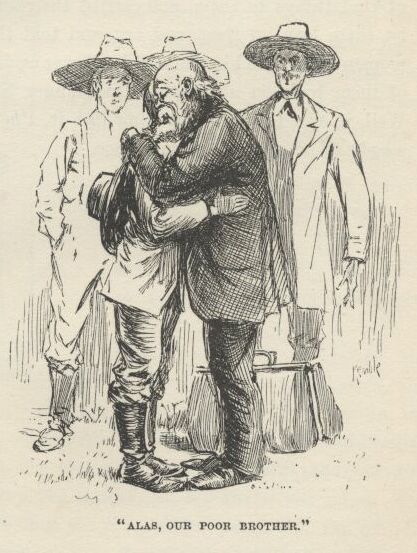
Then he turns around, blubbering, and makes a lot of idiotic signs to the duke on his hands, and blamed if he didn’t drop a carpet-bag and bust out a-crying. If they warn’t the beatenest lot, them two frauds, that ever I struck.
Then he turns around, blubbering, and makes a lot of idiotic signs to the duke with his hands. And blamed if he didn't drop a travel bag and bust out crying. If they weren't the most outrageous lot, them two frauds, that ever I ran into.
Well, the men gathered around and sympathized with them, and said all sorts of kind things to them, and carried their carpet-bags up the hill for them, and let them lean on them and cry, and told the king all about his brother’s last moments, and the king he told it all over again on his hands to the duke, and both of them took on about that dead tanner like they’d lost the twelve disciples. Well, if ever I struck anything like it, I’m a . It was enough to make a body ashamed of the human race.
Well, the men gathered around and felt sorry for them. They said all sorts of kind things and carried their travel bags up the hill for them. They let them lean on them and cry, and told the king all about his brother’s last moments. And the king he told it all over again in sign language to the duke. Both of them carried on about that dead tanner like they’d lost the twelve disciples. Well, if ever I saw anything like it, I’m a . It was enough to make a person ashamed of the human race.