Chapter 15
Books on the Moon and Their Form, Death, Burial, Burning, Timekeeping, and Noses
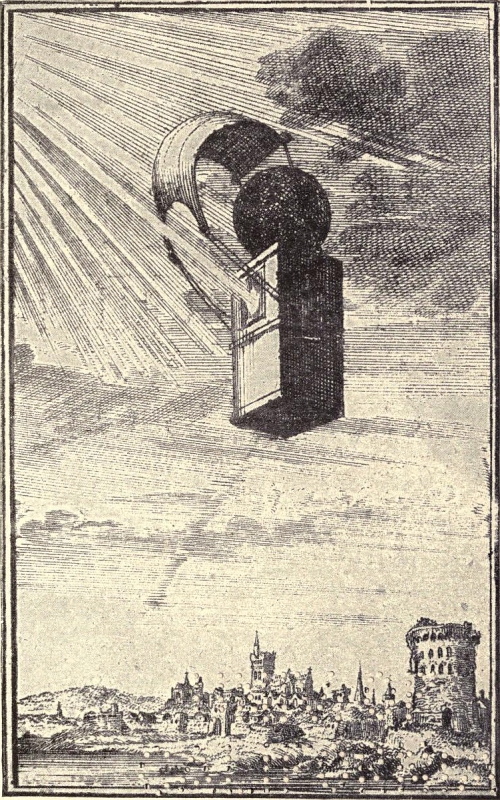
Next Morning about Nine a Clock, my Spirit came in, and told me that he was come from Court, where one of the Queens Maids of Honour, had sent for him, and that she had enquired after me, protesting that she still persisted in her Design to be as good as her Word; that is, that with all her Heart she would follow me, if I would take her along with me to the other World; "which exceedingly pleased me," said he, "when I understood that the chief Motive which inclined her to the Voyage, was to become Christian: And therefore, I have promised to forward her Design, what lies in me; and for that end to invent a Machine that may hold three or four, wherein you may mount to day, both together, if you think fit. I'll go seriously set about the performance of my Undertaking; and in the mean time, to entertain you, during my Absence, I leave you here a Book, which heretofore I brought with me from my Native Countrey; the Title of it is, The States and Empires of the Sun, with an Addition of the History of the Spark. I also give you this, which I esteem much more; it is the great Work of the Philosophers, composed by one of the greatest Wits of the Sun. He proves in it that all things are true, and shews the way of uniting Physically the Truths of every Contradiction; as, for Example, That White is Black, and Black White; that one may be, and not be at the same time; that there may be a Mountain without a Valley; that nothing is something, and that all things that are, are not; but observe, that he proves all these unheard-of Paradoxes without any Captious or Sophistical Argument."
The next morning, around nine o’clock, my Spirit came in and told me he had come from Court. One of the Queen’s maids of honor had sent for him and asked about me. She insisted that she still intended to keep her word. She would gladly follow me to the other World, if I would take her with me. "This pleased me greatly," he said, "when I learned that her chief reason for making the journey was to become a Christian. So I have promised to help her as much as I can. To that end, I will invent a machine that can hold three or four people. You can both set off in it today, if you wish. "I will go and get to work on it in earnest. Meanwhile, I will leave you a book to entertain you while I am away. I brought it with me long ago from my native country. Its title is The States and Empires of the Sun, with an Addition of the History of the Spark. I also give you this other book, which I value much more. It is the great work of the Philosophers, written by one of the greatest minds of the Sun. "In it, he proves that all things are true. He also shows how to unite physically the truths of every contradiction. For example, he shows that white is black, and black is white. He shows that something may exist and not exist at the same time. He shows that there may be a mountain without a valley, that nothing is something, and that all things that exist do not exist. But note that he proves all these unheard-of paradoxes without any trickery or false reasoning."
Cyrano's own work. It is full of interesting material, including a trip through the country of the Birds. This trip offers many points of comparison with Gulliver's Voyage to the country of the Houyhnhms. Finally, guided by Campanella, Cyrano arrives at the land of the Philosophers of the Sun (compare Swift's Laputa). There he meets Descartes and Gassendi, as Gulliver does in the Laputan province of Glubbdubdrib (Voyage to Laputa, chap. viii.).
Probably Campanella. Cf. p. 78, n. 1. On his "great work," cf. also p. 79, n. 1.
"When you are weary of Reading, you may Walk, or Converse with our Landlord's Son, he has a very Charming Wit; but that which I dislike in him is, that he is a little Atheistical. If he chance to Scandalize you, or by any Argument shake your Faith, fail not immediately to come and propose it to me, and I'll clear the Difficulties of it; any other, but I, would enjoin you to break Company with him; but since he is extreamly proud and conceited, I am certain he would take your flight for a Defeat, and would believe your Faith to be grounded on no Reason, if you refused to hear his."
"When you grow tired of reading, you can take a walk or talk with our landlord's son. He has a very charming wit, but I dislike the fact that he is a little atheistic. If he shocks you or shakes your faith with an argument, come to me at once and tell me about it. I will clear up any difficulties. Anyone but me would order you to stop spending time with him. But he is extremely proud and conceited. If you refused to listen to his arguments, I am sure he would take your departure as a defeat. He would believe that your faith was not grounded in reason."
Having said so, he left me; and no sooner was his back turned, but I fell to consider attentively my Books and their Boxes, that's to say, their Covers, which seemed to me to be wonderfully Rich; the one was cut of a single Diamond, incomparably more resplendent than ours; the second looked like a prodigious great Pearl, cloven in two. My Spirit had translated those Books into the Language of that World; but because I have none of their Print, I'll now explain to you the Fashion of these two Volumes.
Having said this, he left me. As soon as he turned his back, I began to examine my books and their boxes, or covers, carefully. The covers seemed wonderfully rich. One was cut from a single diamond, incomparably more brilliant than ours. The second looked like an enormous pearl split in two. My spirit had translated the books into the language of that world. But because I have none of their print, I will now describe the form of these two volumes.
As I opened the Box, I found within somewhat of Metal, almost like to our Clocks, full of I know not what little Springs and imperceptible Engines: It was a Book, indeed; but a Strange and Wonderful Book, that had neither Leaves nor Letters: In fine, it was a Book made wholly for the Ears, and not the Eyes. So that when any Body has a mind to read in it, he winds up that Machine with a great many Strings; then he turns the Hand to the Chapter which he desires to hear, and straight, as from the Mouth of a Man, or a Musical Instrument, proceed all the distinct and different Sounds, which the Lunar Grandees make use of for expressing their Thoughts, instead of Language.
When I opened the box, I found something metal inside, rather like one of our clocks. It was full of tiny springs and hidden mechanisms of a kind I did not understand. It was a book, indeed, but a strange and wonderful book with neither pages nor letters. In short, it was a book made entirely for the ears, not the eyes. So when anyone wants to read it, they wind up the machine, which has many strings. Then they turn the hand to the chapter they want to hear. At once, all the distinct and different sounds come out, as if from a man's mouth or a musical instrument. These are the sounds that the Lunar Grandees use to express their thoughts instead of language.
Does this anticipate the phonograph?
When I since reflected on this Miraculous Invention, I no longer wondred that the Young—Men of that Country were more knowing at Sixteen or Eighteen years Old, than the Gray-Beards of our Climate; for knowing how to Read as soon as Speak, they are never without Lectures, in their Chambers, their Walks, the Town, or Travelling; they may have in their Pockets, or at their Girdles, Thirty of these Books, where they need but wind up a Spring to hear a whole Chapter, and so more, if they have a mind to hear the Book quite through; so that you never want the Company of all the great Men, living and Dead, who entertain you with Living Voices. This Present employed me about an hour; and then hanging them to my Ears, like a pair of Pendants, I went a Walking; but I was hardly at End of the Street when I met a Multitude of People very Melancholy.
When I later thought about this miraculous invention, I was no longer surprised that the young men of that country knew more at sixteen or eighteen than the graybeards of our country. They could read as soon as they could speak, so they were never without something to listen to. They could listen in their rooms, on walks, in town, or while traveling. They could carry thirty of these books in their pockets or on their belts. They only had to wind up a spring to hear a whole chapter. They could wind it again if they wanted to hear the entire book. So they were never without the company of all the great men, living and dead, who entertained them with living voices. This gift occupied me for about an hour. Then I hung the books from my ears like a pair of earrings and went for a walk. But I had hardly reached the end of the street when I met a crowd of very sad people.
Readings. Compare Sir Thomas Browne: "In the lecture of Holy Scripture, their apprehensions are commonly confined unto the literal sense of the text."
Four of them carried upon their Shoulders a kind of a Herse, covered with Black: I asked a Spectator, what that Procession, like to a Funeral in my Country, meant? He made me answer, that that naughty called so by the People because of a knock he had received upon the Right Knee, being convicted of Envy and Ingratitude, died the day before; and that Twenty Years ago, the Parliament had Condemned him to die in his Bed, and then to be interred after his Death. I fell a Laughing at that Answer. And he asking me, why? "You amaze me," said I, "that that which is counted a Blessing in our World, as a long Life, a peaceable Death, and an Honourable Burial, should pass here for an exemplary Punishment." "What, do you take a Burial for a precious thing then," replyed that Man? "And, in good earnest, can you conceive any thing more Horrid than a Corps crawling with Worms, at the discretion of Toads which feed on his Cheeks; the Plague it self Clothed with the Body of a Man? Good God! The very thought of having, even when I am Dead, my Face wrapt up in a Shroud, and a Pike-depth of Earth upon my Mouth, makes me I can hardly fetch breath. The Wretch whom you see carried here, besides the disgrace of being thrown into a Pit, hath been Condemned to be attended by an Hundred and Fifty of his Friends; who are strictly charged, as a Punishment for their having loved an envious and ungrateful Person, to appear with a sad Countenance at his Funeral; and had it not been that the Judges took some compassion of him, imputing his Crimes partly to his want of Wit, they would have been commanded to Weep there also.
Four of them carried a kind of bier on their shoulders, covered in black. I asked a spectator what the procession meant, since it looked like a funeral in my country. He told me that the man had died the day before, after being convicted of envy and ingratitude. The people called him “naughty” because he had received a knock on his right knee. Twenty years earlier, Parliament had sentenced him to die in his bed and be buried afterward. I laughed at his answer, and he asked me why. "You amaze me," I said. "In our world, a long life, a peaceful death, and an honorable burial are counted as blessings. Yet here they are considered an exemplary punishment." "What, do you think burial is a precious thing, then?" the man replied. "Honestly, can you imagine anything more horrible than a corpse crawling with worms? Toads can feed on its cheeks at will. It is the plague itself clothed in a human body. Good God! The very thought of having my face wrapped in a shroud, even when I am dead, makes me hardly able to breathe. And there would be a pike’s depth of earth over my mouth. The wretch you see carried here faces the disgrace of being thrown into a pit. Besides that, he has been sentenced to have 150 of his friends attend him. They have been strictly ordered to look sad at his funeral. That is their punishment for having loved an envious and ungrateful person. The judges took some pity on him, though, and blamed his crimes partly on his lack of wit. Otherwise, his friends would have been ordered to weep there too.
"All are Burnt here, except Malefactors: And, indeed, it is a most rational and decent Custom: For we believe, that the Fire having separated the pure from the impure, the Heat by Sympathy reassembles the natural Heat which made the Soul, and gives it force to mount up till it arrive at some Star, the Country of certain people more immaterial and intellectual than us; because their Temper ought to suit with, and participate of the Globe which they inhabit.
"Everyone here is burned, except criminals. Indeed, it is a most reasonable and decent custom. We believe that fire separates the pure from the impure. Then, through sympathy, its heat gathers together the natural heat that made the soul. This gives the soul the strength to rise until it reaches a star. There it finds the home of people who are more immaterial and intellectual than we are. For their nature must suit and share in the nature of the globe they inhabit.
"However, this is not our neatest way of Burying neither; for when any one of our Philosophers comes to an Age, wherein he finds his Wit begin to decay, and the Ice of his years to numm the Motions of his Soul, he invites all his Friends to a sumptuous Banquet; then having declared to them the Reasons that move him to bid farewel to Nature, and the little hopes he has of adding any thing more to his worthy Actions, they shew him Favour; that's to say, they suffer him to Dye; or otherwise are severe to him and command him to Live. When then, by plurality of Voices, they have put his Life into his own Hands, he acquaints his dearest Friends with the day and place. These purge, and for Four and Twenty hours abstain from Eating; then being come to the House of the Sage, and having Sacrificed to the Sun, they enter the Chamber where the generous Philosopher waits for them on a Bed of State; every one embraces him, and when it comes to his turn whom he loves best, having kissed him affectionately, leaning upon his Bosom, and joyning Mouth to Mouth, with his right hand he sheaths a Dagger in his Heart."
"However, this is not our most elegant way of burying the dead. When one of our philosophers grows old, he finds his mind beginning to weaken. The ice of his years numbs the movements of his soul. He then invites all his friends to a splendid banquet. He explains why he wishes to say farewell to nature. He also tells them how little hope he has of adding to his worthy deeds. They may show him favor, that is, allow him to die. Or they may be strict with him and order him to live. If a majority of his friends leave the decision to him, he tells his dearest friends the day and place. These friends purge themselves and eat nothing for twenty-four hours. Then they come to the wise man's house and sacrifice to the Sun. They enter the room where the noble philosopher awaits them on a ceremonial bed. Each embraces him in turn. When the friend he loves best comes to him, the philosopher kisses him affectionately. He leans against his friend's chest and presses his mouth to his. Then, with his right hand, he plunges a dagger into his own heart."
I interrupted this Discourse, saying to him that told me all, That this Manner of Acting much resembled the ways of some People of our World; and so pursued my Walk, which was so long that when I came back Dinner had been ready Two Hours. They asked me, why I came so late? It is not my Fault, said I to the Cook, who complained: I asked what it was a Clock several times in the Street, but they made me no answer but by opening their Mouths, shutting their Teeth, and turning their Faces awry.
I interrupted the man who was telling me all this. I said that this way of acting was much like the ways of some people in our world. Then I continued my walk. It was so long that dinner had been ready for two hours when I returned. They asked why I was so late. The cook complained, and I told him it was not my fault. I had asked people in the street several times what time it was. But they only opened their mouths, clenched their teeth, and turned their faces away.
"How," cried all the Company, "did not you know by that, that they shewed you what it was a Clock?" "Faith," said I, "they might have held their great Noses in the Sun long enough, before I had understood what they meant." "It's a Commodity," said they, "that saves them the Trouble of a Watch; for with their Teeth they make so true a Dial, that when they would tell any Body the Hour of the day, they do no more but open their Lips, and the shadow of that Nose, falling upon their Teeth, like the Gnomon of a Sun-Dial, makes the precise time.
“What?” cried everyone in the company. “Didn't you realize they were showing you the time?” “Honestly,” I said, “they could have held their big noses in the sun for ages before I understood what they meant.” “It's a convenience,” they said. “It saves them the trouble of carrying a watch. Their teeth make such an accurate dial that they only have to open their lips to tell someone the time. The shadow of the nose falls on their teeth like the pointer of a sundial, showing the exact time.”
"Now that you may know the reason, why all People in this Country have great Noses; as soon as a Woman is brought to Bed the Midwife carries the Child to the Master of the Seminary; and exactly at the years end, the Skillful being assembled, if his Nose prove shorter than the standing Measure, which an Alderman keeps, he is judged to be a Flat Nose, and delivered over to be gelt. You'll ask me, no doubt, the Reason of that Barbarous Custom, and how it comes to pass that we, amongst whom Virginity is a Crime, should enjoyn Continence by force; but know that we do so, because after Thirty Ages experience we have observed, that a great Nose is the mark of a Witty, Courteous, Affable, Generous and Liberal Man; and that a little Nose is a Sign of the contrary: Wherefore of Flat Noses we make Eunuchs, because the Republick had rather have no Children at all than Children like them."
"Now, let me explain why all the people in this country have large noses. As soon as a woman gives birth, the midwife takes the child to the Master of the Seminary. Exactly one year later, the experts gather. An alderman keeps the standard measure. If the child's nose is shorter than that measure, he is judged a Flat Nose and sent to be castrated. No doubt you will ask why we have such a barbarous custom. You will also ask why we force men to abstain from sex when virginity is a crime among us. But know that we do so because of what we have observed over thirty ages. A large nose is the mark of a witty, courteous, friendly, generous, and open-handed man. A small nose is a sign of the opposite. So we make eunuchs of Flat Noses, because the Republic would rather have no children at all than children like them."
Cf. M. Rostand's Cyrano de Bergerac, act I. scene iv.: "Cyrano. A great nose is properly the index of an affable, kindly, courteous man, witty, liberal, brave, such as I am! and such as you are forevermore precluded from supposing yourself, deplorable rogue!"
He was still a speaking, when I saw a man come in stark Naked; I presently sat down and put on my Hat to shew him Honour, for these are the greatest Marks of Respect, that can be shew'd to any in that Country. "The Kingdom," said he, "desires you would give the Magistrates notice, before you return to your own World; because a Mathematician hath just now undertaken before the Council, that provided when you are returned home, you would make a certain Machine, that he'll teach you how to do; he'll attract your Globe, and joyn it to this."
He was still speaking when I saw a man come in completely naked. I immediately sat down and put on my hat to honor him. In that country, these are the greatest signs of respect one can show anyone. "The kingdom asks you to notify the magistrates before you return to your own world," he said. "A mathematician has just made a promise before the council. If you make a certain machine when you return home, he will draw your globe to this one and join them together. He will teach you how to make it."
During all this Discourse we went on with our Dinner; and as soon as we rose from Table, we went to take the Air in the Garden; where taking Occasion to speak of the Generation and Conception of things, he said to me, "You must know, that the Earth, converting it self into a Tree, from a Tree into a Hog, and from a Hog into a Man, is an Argument that all things in Nature aspire to be Men; since that is the most perfect Being, as being a Quintessence, and the best devised Mixture in the World; which alone unites the Animal and Rational Life into one. None but a Pedant will deny me this, when we see that a Plumb-Tree, by the Heat of its Germ, as by a Mouth, sucks in and digests the Earth that's about it; that a Hog devours the Fruit of this Tree, and converts it into the Substance of it self; and that a Man feeding on that Hog, reconcocts that dead Flesh, unites it to himself, and makes that Animal to revive under a more Noble Species. So the Man whom you see, perhaps threescore years ago was no more but a Tuft of Grass in my Garden; which is the more probable, that the Opinion of the Pythagorean Metamorphosis, which so many Great Men maintain, in all likelyhood has only reached us to engage us into an Enquiry after the truth of it; as, in reality, we have found that Matter, and all that has a Vegetative or Sensitive Life, when once it hath attained to the period of its Perfection, wheels about again and descends into its Inanity, that it may return upon the Stage and Act the same Parts over and over." I went down extreamly satisfyed to the Garden, and was beginning to rehearse to my Companion what our Master had taught me; when the Physiognomist came to conduct us to Supper, and afterwards to Rest.
We continued eating dinner throughout this discussion. As soon as we rose from the table, we went into the garden for some fresh air. There, he took the opportunity to speak about how things are generated and conceived. He said to me, "You must understand that the earth changes into a tree, the tree into a hog, and the hog into a man. This shows that all things in nature aspire to become men. Man is the most perfect being, a quintessence and the best-designed mixture in the world. Man alone unites animal and rational life. Only a pedant would deny this when we can see how it happens. A plum tree draws in and digests the earth around it through the heat of its germ, as if through a mouth. A hog eats the tree's fruit and turns it into its own substance. A man eats the hog, digests its dead flesh again, and makes it part of himself. In this way, he brings the animal back to life in a nobler form. "So the man you see was perhaps no more than a clump of grass in my garden sixty years ago. This is all the more likely because of the doctrine of Pythagorean Metamorphosis, which so many great men uphold. In all likelihood, that doctrine has reached us only to prompt us to investigate its truth. Indeed, we have found that matter, and everything with plant or animal life, eventually reaches its highest perfection. Then it turns around and sinks back into nothingness, so that it can return to the stage and play the same parts again and again." I went down to the garden, extremely satisfied, and began to tell my companion what our master had taught me. But the Physiognomist came to lead us to supper, and afterwards to bed.