The Stranger’s Story
I am an American. I was born and reared in Hartford, in the State of Connecticut—anyway, just over the river, in the country. So I am a Yankee of the Yankees—and practical; yes, and nearly barren of sentiment, I suppose—or poetry, in other words. My father was a blacksmith, my uncle was a horse doctor, and I was both, along at first. Then I went over to the great arms factory and learned my real trade; learned all there was to it; learned to make everything: guns, revolvers, cannon, boilers, engines, all sorts of labor-saving machinery. Why, I could make anything a body wanted—anything in the world, it didn’t make any difference what; and if there wasn’t any quick new-fangled way to make a thing, I could invent one—and do it as easy as rolling off a log. I became head superintendent; had a couple of thousand men under me.
I am an American. I was born and raised in Hartford, in the State of Connecticut. Well, actually, just across the river in the country. So I am a Yankee through and through, and practical too. I suppose I have almost no sentiment, or poetry, in me. My father was a blacksmith, my uncle was a horse doctor, and at first I did both jobs. Then I went to work at the great weapons factory and learned my real trade. I learned everything there was to know about it. I learned to make everything: guns, revolvers, cannon, boilers, engines, and all kinds of labor-saving machines. Why, I could make anything a person wanted, anything in the world. It didn’t matter what. And if there was no quick, modern way to make something, I could invent one. I could do it as easily as rolling off a log. I became head superintendent, with a couple of thousand men working under me.
Well, a man like that is a man that is full of fight—that goes without saying. With a couple of thousand rough men under one, one has plenty of that sort of amusement. I had, anyway. At last I met my match, and I got my dose. It was during a misunderstanding conducted with crowbars with a fellow we used to call Hercules. He laid me out with a crusher alongside the head that made everything crack, and seemed to spring every joint in my skull and made it overlap its neighbor. Then the world went out in darkness, and I didn’t feel anything more, and didn’t know anything at all—at least for a while.
Well, a man like that is always ready for a fight. That goes without saying. With a couple of thousand rough men working under you, you get plenty of that kind of fun. I did, anyway. At last I met my match and got what was coming to me. It happened during a disagreement with a fellow we used to call Hercules. We settled it with crowbars. He knocked me out with a crushing blow to the side of my head. It made everything crack. It felt as if every joint in my skull had sprung loose and overlapped the next one. Then the world went dark. I didn’t feel anything more or know anything at all, at least for a while.
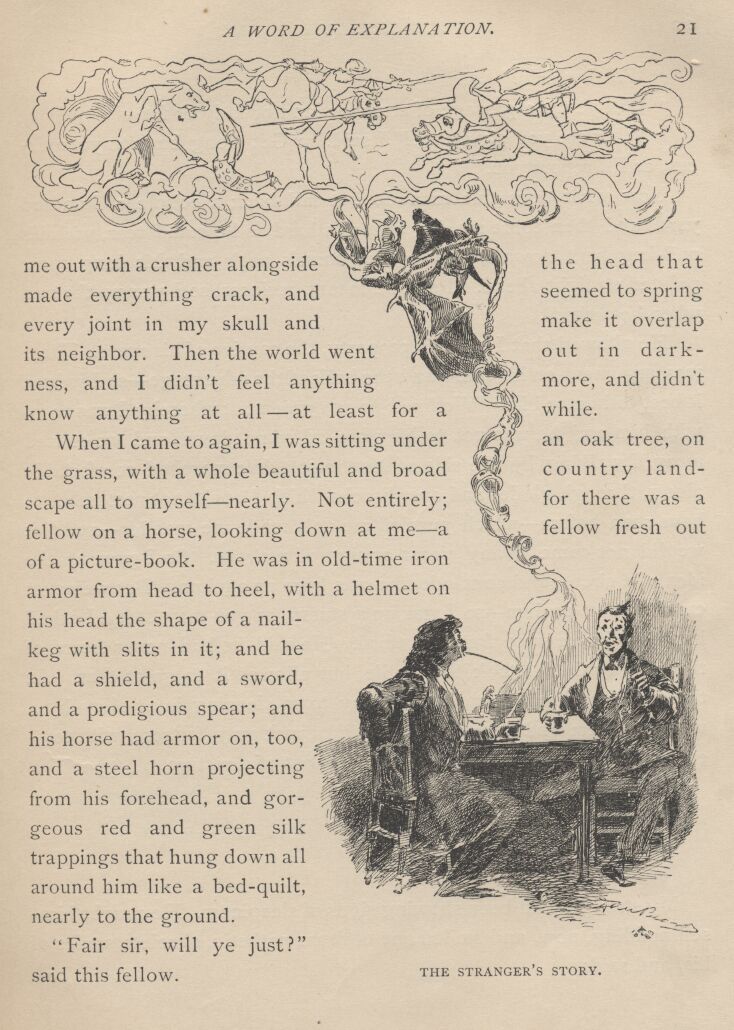
When I came to again, I was sitting under an oak tree, on the grass, with a whole beautiful and broad country landscape all to myself—nearly. Not entirely; for there was a fellow on a horse, looking down at me—a fellow fresh out of a picture-book. He was in old-time iron armor from head to heel, with a helmet on his head the shape of a nail-keg with slits in it; and he had a shield, and a sword, and a prodigious spear; and his horse had armor on, too, and a steel horn projecting from his forehead, and gorgeous red and green silk trappings that hung down all around him like a bedquilt, nearly to the ground.
When I came to, I was sitting on the grass under an oak tree. I had a beautiful, sweeping country landscape all to myself. Nearly, anyway. A fellow on horseback was looking down at me. He looked like he had stepped out of a picture book. He wore old-fashioned iron armor from head to toe. His helmet was shaped like a nail barrel, with slits in it. He carried a shield, a sword, and an enormous spear. His horse wore armor too, with a steel horn sticking out from its forehead. Gorgeous red and green silk coverings hung all around the horse, almost to the ground, like a bedspread.
“Fair sir, will ye just?” said this fellow.
“Sir, will you joust?” said the fellow.
“Will I which?”
“Will I what?”
“Will ye try a passage of arms for land or lady or for—”
“Will you fight for land or a lady or for...”
“What are you giving me?” I said. “Get along back to your circus, or I’ll report you.”
“Are you kidding me?” I said. “Get back to your circus, or I’ll report you.”
Now what does this man do but fall back a couple of hundred yards and then come rushing at me as hard as he could tear, with his nail-keg bent down nearly to his horse’s neck and his long spear pointed straight ahead. I saw he meant business, so I was up the tree when he arrived.
What does this man do? He backs up a couple of hundred yards, then charges at me as fast as he can. His nail-keg helmet is bent down nearly to his horse’s neck, and his long spear points straight ahead. I saw he meant business, so I was up the tree when he arrived.
He allowed that I was his property, the captive of his spear. There was argument on his side—and the bulk of the advantage—so I judged it best to humor him. We fixed up an agreement whereby I was to go with him and he was not to hurt me. I came down, and we started away, I walking by the side of his horse. We marched comfortably along, through glades and over brooks which I could not remember to have seen before—which puzzled me and made me wonder—and yet we did not come to any circus or sign of a circus. So I gave up the idea of a circus, and concluded he was from an asylum. But we never came to an asylum—so I was up a stump, as you may say. I asked him how far we were from Hartford. He said he had never heard of the place; which I took to be a lie, but allowed it to go at that. At the end of an hour we saw a far-away town sleeping in a valley by a winding river; and beyond it on a hill, a vast gray fortress, with towers and turrets, the first I had ever seen out of a picture.
He claimed I was his property, a captive taken by his spear. He had an argument on his side, and most of the advantage, so I thought it best to humor him. We made an agreement. I would go with him, and he would not hurt me. I came down, and we set off, with me walking beside his horse. We traveled comfortably through clearings and across streams I couldn't remember seeing before. That puzzled me and made me wonder. But we found no circus or any sign of one. So I gave up the circus idea and decided he must be from an asylum. But we never reached an asylum either, so I was stumped, you might say. I asked him how far we were from Hartford. He said he had never heard of it. I took that for a lie, but let it pass. After an hour, we saw a distant town sleeping in a valley beside a winding river. Beyond it, on a hill, stood a vast gray fortress with towers and turrets. It was the first one I had ever seen outside a picture.
“Bridgeport?” said I, pointing.
“Bridgeport?” I said, pointing.
“Camelot,” said he.
“Camelot,” he said.
My stranger had been showing signs of sleepiness. He caught himself nodding, now, and smiled one of those pathetic, obsolete smiles of his, and said:
My stranger had been showing signs of sleepiness. He caught himself nodding off and gave one of his pitiful, old-fashioned smiles. Then he said:
“I find I can’t go on; but come with me, I’ve got it all written out, and you can read it if you like.”
“I can’t go on. But come with me. I’ve written it all down, and you can read it if you like.”
In his chamber, he said: “First, I kept a journal; then by and by, after years, I took the journal and turned it into a book. How long ago that was!”
In his room, he said: “First, I kept a journal. Then, years later, I turned the journal into a book. How long ago that was!”
He handed me his manuscript, and pointed out the place where I should begin:
He handed me his manuscript and pointed out where I should begin:
“Begin here—I’ve already told you what goes before.” He was steeped in drowsiness by this time. As I went out at his door I heard him murmur sleepily: “Give you good den, fair sir.”
“Begin here. I’ve already told you what comes before.” By then he was very sleepy. As I left his room, I heard him murmur sleepily: “Good evening to you, sir.”
I sat down by my fire and examined my treasure. The first part of it—the great bulk of it—was parchment, and yellow with age. I scanned a leaf particularly and saw that it was a palimpsest. Under the old dim writing of the Yankee historian appeared traces of a penmanship which was older and dimmer still—Latin words and sentences: fragments from old monkish legends, evidently. I turned to the place indicated by my stranger and began to read—as follows.
I sat down by my fire and examined my treasure. Most of it was parchment, yellow with age. I looked closely at one page and saw that it was a palimpsest, a page written over older writing. Beneath the old, faded writing of the Yankee historian were traces of writing that was even older and fainter. These were Latin words and sentences, evidently fragments of old monks’ legends. I turned to the place the stranger had pointed out and began to read: