Chapter 32
Dowley's Humiliation
Well, when that cargo arrived toward sunset, Saturday afternoon, I had my hands full to keep the Marcos from fainting. They were sure Jones and I were ruined past help, and they blamed themselves as accessories to this bankruptcy. You see, in addition to the dinner-materials, which called for a sufficiently round sum, I had bought a lot of extras for the future comfort of the family: for instance, a big lot of wheat, a delicacy as rare to the tables of their class as was ice-cream to a hermit’s; also a sizeable deal dinner-table; also two entire pounds of salt, which was another piece of extravagance in those people’s eyes; also crockery, stools, the clothes, a small cask of beer, and so on. I instructed the Marcos to keep quiet about this sumptuousness, so as to give me a chance to surprise the guests and show off a little. Concerning the new clothes, the simple couple were like children; they were up and down, all night, to see if it wasn’t nearly daylight, so that they could put them on, and they were into them at last as much as an hour before dawn was due. Then their pleasure—not to say delirium—was so fresh and novel and inspiring that the sight of it paid me well for the interruptions which my sleep had suffered. The king had slept just as usual—like the dead. The Marcos could not thank him for their clothes, that being forbidden; but they tried every way they could think of to make him see how grateful they were. Which all went for nothing: he didn’t notice any change.
Well, when that load arrived around sunset on Saturday afternoon, I had my hands full keeping the Marcos from fainting. They were sure Jones and I were ruined beyond help. They also blamed themselves for helping bring about our bankruptcy. You see, the dinner supplies alone cost a good deal. But I had also bought extras to make the family more comfortable in the future. There was a large supply of wheat, for instance. Wheat was as rare on the tables of people in their class as ice cream was on a hermit's table. I also bought a good-sized pine dinner table and two whole pounds of salt. In their eyes, the salt was another extravagance. There were dishes, stools, the clothes, a small barrel of beer, and so on. I told the Marcos to keep quiet about all this luxury. That way, I could surprise the guests and show off a little. The simple couple were like children over their new clothes. All night, they kept getting up to see if it was nearly daylight, so they could put them on. At last, they put them on a full hour before dawn was due. Their delight, not to say delirium, was so fresh, new, and inspiring that watching them more than repaid me for my interrupted sleep. The king had slept as usual, like the dead. The Marcos were forbidden to thank him for their clothes, but they tried everything they could think of to show him how grateful they were. It was all for nothing. He didn't notice any change.
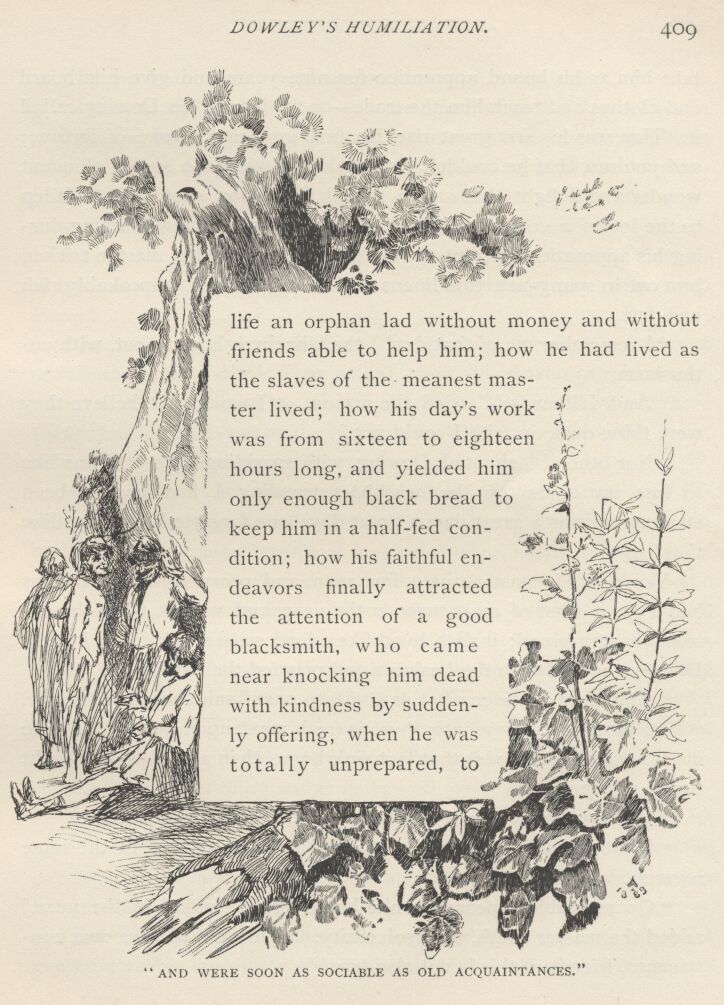
It turned out to be one of those rich and rare fall days which is just a June day toned down to a degree where it is heaven to be out of doors. Toward noon the guests arrived, and we assembled under a great tree and were soon as sociable as old acquaintances. Even the king’s reserve melted a little, though it was some little trouble to him to adjust himself to the name of Jones along at first. I had asked him to try to not forget that he was a farmer; but I had also considered it prudent to ask him to let the thing stand at that, and not elaborate it any. Because he was just the kind of person you could depend on to spoil a little thing like that if you didn’t warn him, his tongue was so handy, and his spirit so willing, and his information so uncertain.
It turned out to be one of those rich, rare fall days, like a June day cooled just enough to make being outdoors heavenly. Around noon, the guests arrived, and we gathered under a great tree. Soon we were as friendly as old acquaintances. Even the king became a little less reserved, though at first he had some trouble getting used to the name Jones. I had asked him to try to remember that he was a farmer. But I had also thought it wise to ask him to leave it at that and not add any details. Without a warning, he was just the sort of person you could count on to spoil a little thing like that. His tongue was so quick, his spirit so willing, and his knowledge so uncertain.
Dowley was in fine feather, and I early got him started, and then adroitly worked him around onto his own history for a text and himself for a hero, and then it was good to sit there and hear him hum. Self-made man, you know. They know how to talk. They do deserve more credit than any other breed of men, yes, that is true; and they are among the very first to find it out, too. He told how he had begun life an orphan lad without money and without friends able to help him; how he had lived as the slaves of the meanest master lived; how his day’s work was from sixteen to eighteen hours long, and yielded him only enough black bread to keep him in a half-fed condition; how his faithful endeavors finally attracted the attention of a good blacksmith, who came near knocking him dead with kindness by suddenly offering, when he was totally unprepared, to take him as his bound apprentice for nine years and give him board and clothes and teach him the trade—or “mystery” as Dowley called it. That was his first great rise, his first gorgeous stroke of fortune; and you saw that he couldn’t yet speak of it without a sort of eloquent wonder and delight that such a gilded promotion should have fallen to the lot of a common human being. He got no new clothing during his apprenticeship, but on his graduation day his master tricked him out in spang-new tow-linens and made him feel unspeakably rich and fine.
Dowley was in high spirits, and I soon got him talking. Then I skillfully steered him toward the story of his own life, with himself as the hero. After that, it was a pleasure to sit there and listen to him go on. A self-made man, you know. They know how to talk. They do deserve more credit than any other kind of man, yes, that is true. And they are among the first to realize it, too. He told how he had started life as an orphan boy, with no money and no friends who could help him. He had lived like the slaves of the cruelest master. He worked sixteen to eighteen hours a day and earned only enough black bread to keep himself half-fed. At last, his faithful efforts caught the attention of a good blacksmith. The blacksmith nearly knocked him dead with kindness by making him a sudden offer, when he was completely unprepared. He offered to take Dowley as his bound apprentice for nine years, give him food and clothes, and teach him the trade, or “mystery,” as Dowley called it. That was his first great rise, his first glorious stroke of fortune. You could see he still couldn’t speak of it without a kind of eloquent wonder and delight. Such a golden opportunity had fallen to an ordinary human being! He got no new clothes during his apprenticeship. But on the day he finished it, his master dressed him in brand-new coarse linen clothes. They made him feel unspeakably rich and grand.
“I remember me of that day!” the wheelwright sang out, with enthusiasm.
“I remember that day!” the wheelwright called out enthusiastically.
“And I likewise!” cried the mason. “I would not believe they were thine own; in faith I could not.”
“And I feel the same!” cried the mason. “I wouldn’t believe they were your own. Honestly, I couldn’t.”
“Nor other!” shouted Dowley, with sparkling eyes. “I was like to lose my character, the neighbors wending I had mayhap been stealing. It was a great day, a great day; one forgetteth not days like that.”
“Nothing else!” shouted Dowley, his eyes sparkling. “I nearly lost my reputation because the neighbors thought I might have been stealing. It was a great day, a great day. You don't forget days like that.”
Yes, and his master was a fine man, and prosperous, and always had a great feast of meat twice in the year, and with it white bread, true wheaten bread; in fact, lived like a lord, so to speak. And in time Dowley succeeded to the business and married the daughter.
Yes, and his master was a fine man and prosperous. Twice a year, he always had a great feast of meat, with white bread made from real wheat. In fact, he lived like a lord, so to speak. In time, Dowley took over the business and married the master's daughter.
“And now consider what is come to pass,” said he, impressively. “Two times in every month there is fresh meat upon my table.” He made a pause here, to let that fact sink home, then added—“and eight times salt meat.”
“And now consider what has happened,” he said impressively. “Twice a month, I have fresh meat on my table.” He paused to let that fact sink in, then added, “and salt meat eight times.”
“It is even true,” said the wheelwright, with bated breath.
“It really is true,” said the wheelwright, holding his breath.
“I know it of mine own knowledge,” said the mason, in the same reverent fashion.
“I know it firsthand,” said the mason, in the same reverent manner.
“On my table appeareth white bread every Sunday in the year,” added the master smith, with solemnity. “I leave it to your own consciences, friends, if this is not also true?”
“White bread appears on my table every Sunday of the year,” added the master smith solemnly. “Friends, I leave it to your own consciences to say whether this is also true.”
“By my head, yes,” cried the mason.
“I swear, yes!” cried the mason.
“I can testify it—and I do,” said the wheelwright.
“I can testify to that, and I do,” said the wheelwright.
“And as to furniture, ye shall say yourselves what mine equipment is.” He waved his hand in fine gesture of granting frank and unhampered freedom of speech, and added: “Speak as ye are moved; speak as ye would speak; an I were not here.”
“And as for my equipment, you can judge for yourselves what it is.” He waved his hand with a grand gesture, granting them complete freedom to speak, and added: “Speak as you feel moved to speak. Speak as you would if I were not here.”
“Ye have five stools, and of the sweetest workmanship at that, albeit your family is but three,” said the wheelwright, with deep respect.
“You have five stools, and they’re beautifully made, though there are only three in your family,” said the wheelwright, with deep respect.
“And six wooden goblets, and six platters of wood and two of pewter to eat and drink from withal,” said the mason, impressively. “And I say it as knowing God is my judge, and we tarry not here alway, but must answer at the last day for the things said in the body, be they false or be they sooth.”
“And six wooden goblets, six wooden platters, and two pewter platters to eat and drink from,” said the mason solemnly. “I say this knowing that God is my judge. We do not stay here forever. On the last day, we must answer for what we said in this life, whether it was false or true.”
“Now ye know what manner of man I am, brother Jones,” said the smith, with a fine and friendly condescension, “and doubtless ye would look to find me a man jealous of his due of respect and but sparing of outgo to strangers till their rating and quality be assured, but trouble yourself not, as concerning that; wit ye well ye shall find me a man that regardeth not these matters but is willing to receive any he as his fellow and equal that carrieth a right heart in his body, be his worldly estate howsoever modest. And in token of it, here is my hand; and I say with my own mouth we are equals—equals”—and he smiled around on the company with the satisfaction of a god who is doing the handsome and gracious thing and is quite well aware of it.
“Now you know what kind of man I am, brother Jones,” said the smith with a gracious, friendly air of superiority. “No doubt you would expect me to insist on the respect I am due. You would expect me to give little respect to strangers until I knew their rank and standing. But don’t worry about that. You can be sure I don’t concern myself with such matters. I am willing to accept any man as my companion and equal if his heart is in the right place, however modest his worldly position. And to show it, here is my hand. I say it myself: we are equals, equals.” He smiled around at the company, as pleased as a god who knows he is doing something noble and gracious.
The king took the hand with a poorly disguised reluctance, and let go of it as willingly as a lady lets go of a fish; all of which had a good effect, for it was mistaken for an embarrassment natural to one who was being called upon by greatness.
The king took the hand, barely hiding his reluctance. He let go as readily as a lady lets go of a fish. All this had a good effect. People mistook his behavior for the natural embarrassment of someone receiving a visit from a great person.
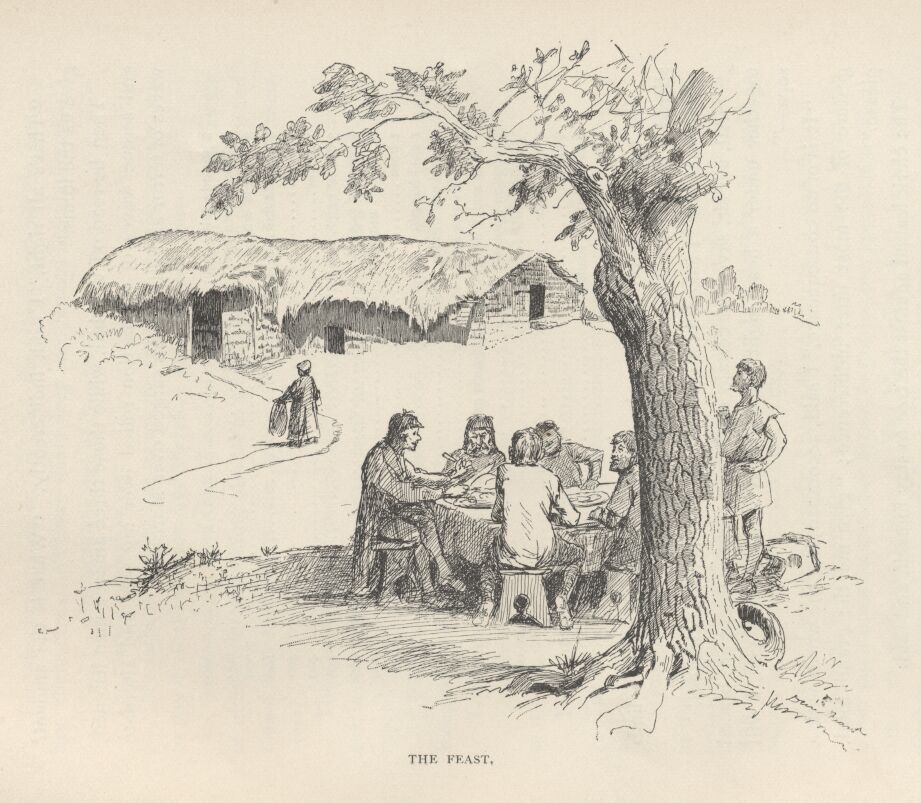
The dame brought out the table now, and set it under the tree. It caused a visible stir of surprise, it being brand new and a sumptuous article of deal. But the surprise rose higher still when the dame, with a body oozing easy indifference at every pore, but eyes that gave it all away by absolutely flaming with vanity, slowly unfolded an actual simon-pure tablecloth and spread it. That was a notch above even the blacksmith’s domestic grandeurs, and it hit him hard; you could see it. But Marco was in Paradise; you could see that, too. Then the dame brought two fine new stools—whew! that was a sensation; it was visible in the eyes of every guest. Then she brought two more—as calmly as she could. Sensation again—with awed murmurs. Again she brought two—walking on air, she was so proud. The guests were petrified, and the mason muttered:
The woman now brought out the table and set it under the tree. It caused a visible stir of surprise because it was brand new and made of fine pine. But the surprise grew even greater when she slowly unfolded a genuine tablecloth and spread it over the table. She acted as if it were nothing special, but her eyes gave her away. They were blazing with pride. This was a step above even the blacksmith’s household luxuries, and it hit him hard. You could see that. But Marco was in heaven. You could see that, too. Then the woman brought out two fine new stools. Whew! They caused a sensation. You could see it in every guest’s eyes. Then she brought out two more, as calmly as she could. Another sensation, with awed murmurs. Again she brought out two. She was so proud she seemed to be walking on air. The guests were frozen with amazement, and the mason muttered:
“There is that about earthly pomps which doth ever move to reverence.”
“There is something about worldly splendor that always inspires reverence.”
As the dame turned away, Marco couldn’t help slapping on the climax while the thing was hot; so he said with what was meant for a languid composure but was a poor imitation of it:
As the woman turned away, Marco couldn’t resist adding the finishing touch while he had the chance. He tried to sound casually composed, but didn’t do a very good job of it:
“These suffice; leave the rest.”
“These are enough. Leave the rest.”
So there were more yet! It was a fine effect. I couldn’t have played the hand better myself.
So there were even more! It was a great effect. I couldn’t have played the hand better myself.
From this out, the madam piled up the surprises with a rush that fired the general astonishment up to a hundred and fifty in the shade, and at the same time paralyzed expression of it down to gasped “Oh’s” and “Ah’s,” and mute upliftings of hands and eyes. She fetched crockery—new, and plenty of it; new wooden goblets and other table furniture; and beer, fish, chicken, a goose, eggs, roast beef, roast mutton, a ham, a small roast pig, and a wealth of genuine white wheaten bread. Take it by and large, that spread laid everything far and away in the shade that ever that crowd had seen before. And while they sat there just simply stupefied with wonder and awe, I sort of waved my hand as if by accident, and the storekeeper’s son emerged from space and said he had come to collect.
From then on, the lady piled on surprises in a rush. She sent everyone’s astonishment up to a hundred and fifty in the shade. At the same time, they were so stunned they could only gasp “Oh” and “Ah” and silently raise their hands and eyes. She brought out plenty of new dishes, new wooden goblets, and other tableware. Then came beer, fish, chicken, a goose, eggs, roast beef, roast mutton, a ham, a small roast pig, and plenty of genuine white wheat bread. All in all, that feast put everything the crowd had ever seen before far in the shade. They sat there, simply stunned with wonder and awe. While they sat there, I gave a little wave of my hand, as if by accident. The storekeeper’s son appeared out of nowhere and said he had come to collect.
“That’s all right,” I said, indifferently. “What is the amount? give us the items.”
“That’s all right,” I said casually. “How much is it? Give us the details.”
Then he read off this bill, while those three amazed men listened, and serene waves of satisfaction rolled over my soul and alternate waves of terror and admiration surged over Marco’s:
Then he read the bill aloud as the three amazed men listened. Gentle waves of satisfaction washed over me, while Marco felt waves of terror and admiration in turn:
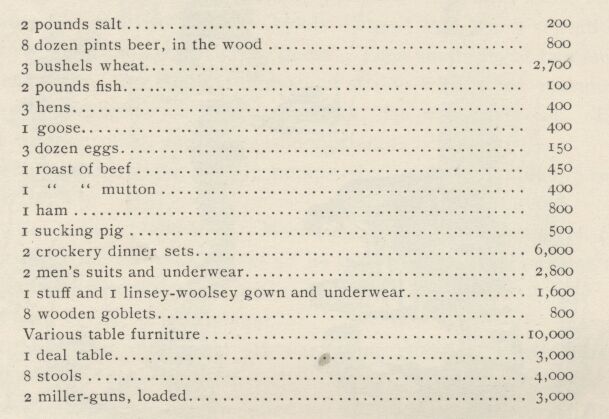
He ceased. There was a pale and awful silence. Not a limb stirred. Not a nostril betrayed the passage of breath.
He stopped. A pale, terrible silence followed. No one moved a limb. Not a nostril showed the slightest sign of breathing.
“Is that all?” I asked, in a voice of the most perfect calmness.
“Is that all?” I asked in a perfectly calm voice.
“All, fair sir, save that certain matters of light moment are placed together under a head hight sundries. If it would like you, I will sepa—”
“All, good sir, except that certain minor matters are grouped under a heading called sundries. If you would like, I will sepa...”
“It is of no consequence,” I said, accompanying the words with a gesture of the most utter indifference; “give me the grand total, please.”
“It doesn't matter,” I said with a gesture of complete indifference. “Please give me the grand total.”
The clerk leaned against the tree to stay himself, and said:
The clerk leaned against the tree for support and said:
“Thirty-nine thousand one hundred and fifty milrays!”
“39,150 milrays!”
The wheelwright fell off his stool, the others grabbed the table to save themselves, and there was a deep and general ejaculation of:
The wheelwright fell off his stool. The others grabbed the table to keep from falling, and everyone exclaimed deeply:
“God be with us in the day of disaster!”
“May God be with us in times of disaster!”
The clerk hastened to say:
The clerk quickly said:
“My father chargeth me to say he cannot honorably require you to pay it all at this time, and therefore only prayeth you—”
“My father has asked me to tell you that he cannot honorably require you to pay it all now. So he only asks you to...”
I paid no more heed than if it were the idle breeze, but, with an air of indifference amounting almost to weariness, got out my money and tossed four dollars on to the table. Ah, you should have seen them stare!
I paid no more attention than if it were a passing breeze. Instead, looking so indifferent I seemed almost bored, I took out my money and tossed four dollars on the table. Ah, you should have seen them stare!
The clerk was astonished and charmed. He asked me to retain one of the dollars as security, until he could go to town and—I interrupted:
The clerk was amazed and delighted. He asked me to keep one of the dollars as security until he could go to town and... I interrupted:
“What, and fetch back nine cents? Nonsense! Take the whole. Keep the change.”
“What, and bring back nine cents? Nonsense! Take it all. Keep the change.”
There was an amazed murmur to this effect:
There was a murmur of amazement, saying something like this:
“Verily this being is made of money! He throweth it away even as if it were dirt.”
“Truly, this person is made of money! He throws it away as if it were dirt.”
The blacksmith was a crushed man.
The blacksmith was a crushed man.
The clerk took his money and reeled away drunk with fortune. I said to Marco and his wife:
The clerk took his money and staggered away, drunk with good fortune. I said to Marco and his wife:
“Good folk, here is a little trifle for you”—handing the miller-guns as if it were a matter of no consequence, though each of them contained fifteen cents in solid cash; and while the poor creatures went to pieces with astonishment and gratitude, I turned to the others and said as calmly as one would ask the time of day:
“Good people, here’s a little gift for you.” I handed them the miller-guns as if it were nothing, though each contained fifteen cents in solid cash. While the poor creatures were overcome with astonishment and gratitude, I turned to the others. I spoke as calmly as if I were asking the time:
“Well, if we are all ready, I judge the dinner is. Come, fall to.”
“Well, if we are all ready, I suppose dinner is ready too. Come on, let's eat.”
Ah, well, it was immense; yes, it was a daisy. I don’t know that I ever put a situation together better, or got happier spectacular effects out of the materials available. The blacksmith—well, he was simply mashed. Land! I wouldn’t have felt what that man was feeling, for anything in the world. Here he had been blowing and bragging about his grand meat-feast twice a year, and his fresh meat twice a month, and his salt meat twice a week, and his white bread every Sunday the year round—all for a family of three; the entire cost for the year not above 69.2.6 (sixty-nine cents, two mills and six milrays), and all of a sudden here comes along a man who slashes out nearly four dollars on a single blow-out; and not only that, but acts as if it made him tired to handle such small sums. Yes, Dowley was a good deal wilted, and shrunk-up and collapsed; he had the aspect of a bladder-balloon that’s been stepped on by a cow.
Ah, well, it was magnificent. Yes, it was a real beauty. I don’t know that I ever staged a situation better or got more spectacular results from the materials I had. The blacksmith was simply crushed. Goodness! I wouldn’t have wanted to feel what that man was feeling for anything in the world. He had been boasting and bragging about his grand meat feast twice a year. He had fresh meat twice a month, salt meat twice a week, and white bread every Sunday all year. That was all for a family of three. The total cost for the year was no more than 69.2.6 (sixty-nine cents, two mills and six milrays). Then suddenly a man comes along and spends nearly four dollars on a single feast. And not only that, but he acts as if handling such small sums tires him out. Yes, Dowley was thoroughly deflated, shriveled up, and collapsed. He looked like a balloon that had been stepped on by a cow.