Chapter 27
The Yankee and the King Travel in Disguise
About bedtime I took the king to my private quarters to cut his hair and help him get the hang of the lowly raiment he was to wear. The high classes wore their hair banged across the forehead but hanging to the shoulders the rest of the way around, whereas the lowest ranks of commoners were banged fore and aft both; the slaves were bangless, and allowed their hair free growth. So I inverted a bowl over his head and cut away all the locks that hung below it. I also trimmed his whiskers and mustache until they were only about a half-inch long; and tried to do it inartistically, and succeeded. It was a villainous disfigurement. When he got his lubberly sandals on, and his long robe of coarse brown linen cloth, which hung straight from his neck to his ankle-bones, he was no longer the comeliest man in his kingdom, but one of the unhandsomest and most commonplace and unattractive. We were dressed and barbered alike, and could pass for small farmers, or farm bailiffs, or shepherds, or carters; yes, or for village artisans, if we chose, our costume being in effect universal among the poor, because of its strength and cheapness. I don’t mean that it was really cheap to a very poor person, but I do mean that it was the cheapest material there was for male attire—manufactured material, you understand.
Around bedtime, I took the king to my private quarters. I wanted to cut his hair and help him get used to the humble clothes he was going to wear. Upper-class people wore bangs across their foreheads, with the rest of their hair hanging to their shoulders. The lowest ranks of commoners wore bangs both in front and in back. Slaves had no bangs and were allowed to let their hair grow freely. So I turned a bowl upside down on his head and cut off all the hair hanging below it. I also trimmed his beard and mustache until they were only about half an inch long. I tried to do a bad job of it, and succeeded. The result was a hideous disfigurement. Once he had put on his clumsy sandals and long robe of coarse brown linen, he was no longer the best-looking man in his kingdom. The robe hung straight from his neck to his ankles, and he looked like one of the ugliest, plainest, and least attractive men around. We were dressed alike and had the same haircut. We could pass for small farmers, farm bailiffs, shepherds, or carters. Yes, we could even pass for village craftspeople, if we chose. Our outfit was worn by practically all poor people because it was strong and cheap. I don’t mean it was really cheap for a very poor person. I mean it was the cheapest material available for men’s clothing. Manufactured material, you understand.
We slipped away an hour before dawn, and by broad sun-up had made eight or ten miles, and were in the midst of a sparsely settled country. I had a pretty heavy knapsack; it was laden with provisions—provisions for the king to taper down on, till he could take to the coarse fare of the country without damage.
We slipped away an hour before dawn. By full sunrise, we had traveled eight or ten miles into sparsely settled country. I carried a fairly heavy knapsack full of provisions for the king. He could gradually eat less of them until he could manage the country’s coarse food without harm.
I found a comfortable seat for the king by the roadside, and then gave him a morsel or two to stay his stomach with. Then I said I would find some water for him, and strolled away. Part of my project was to get out of sight and sit down and rest a little myself. It had always been my custom to stand when in his presence; even at the council board, except upon those rare occasions when the sitting was a very long one, extending over hours; then I had a trifling little backless thing which was like a reversed culvert and was as comfortable as the toothache. I didn’t want to break him in suddenly, but do it by degrees. We should have to sit together now when in company, or people would notice; but it would not be good politics for me to be playing equality with him when there was no necessity for it.
I found the king a comfortable place to sit by the roadside and gave him a bite or two to hold him over. Then I said I would find him some water and strolled away. Part of my plan was to get out of sight, sit down, and rest a little myself. I had always stood in his presence, even at council meetings. The only exceptions were the rare meetings that lasted for hours. Then I had a tiny backless seat that looked like an upside-down culvert and was as comfortable as a toothache. I didn’t want to make him get used to the change all at once. I wanted to do it gradually. From now on, we would have to sit together in company, or people would notice. But it would not be good politics to act like his equal when there was no need.
I found the water some three hundred yards away, and had been resting about twenty minutes, when I heard voices. That is all right, I thought—peasants going to work; nobody else likely to be stirring this early. But the next moment these comers jingled into sight around a turn of the road—smartly clad people of quality, with luggage-mules and servants in their train! I was off like a shot, through the bushes, by the shortest cut. For a while it did seem that these people would pass the king before I could get to him; but desperation gives you wings, you know, and I canted my body forward, inflated my breast, and held my breath and flew. I arrived. And in plenty good enough time, too.
I found the water about three hundred yards away. I had been resting for about twenty minutes when I heard voices. That’s all right, I thought. They must be peasants going to work. Nobody else was likely to be up this early. But the next moment, the people came into sight around a bend in the road. They were well-dressed people of high rank, followed by luggage mules and servants! I shot off through the bushes, taking the shortest route. For a while, it looked as though they would pass the king before I could reach him. But desperation gives you wings, you know. I leaned forward, puffed out my chest, held my breath, and flew. I arrived. And in plenty of time, too.
“Pardon, my king, but it’s no time for ceremony—jump! Jump to your feet—some quality are coming!”
“Sorry, my king, but there’s no time for formalities. Jump! Get to your feet. Some nobles are coming!”
“Is that a marvel? Let them come.”
“Is that a wonder? Let them come.”
“But my liege! You must not be seen sitting. Rise!—and stand in humble posture while they pass. You are a peasant, you know.”
“But my lord! You must not be seen sitting. Get up and stand humbly while they pass. You are a peasant, you know.”
“True—I had forgot it, so lost was I in planning of a huge war with Gaul”—he was up by this time, but a farm could have got up quicker, if there was any kind of a boom in real estate—“and right-so a thought came randoming overthwart this majestic dream the which—”
“True, I had forgotten it. I was so absorbed in planning a huge war with Gaul.” By this time he was up. But a farm could have gotten up quicker if there was any kind of real estate boom. “And just then, a thought came wandering across this majestic dream, which...”
“A humbler attitude, my lord the king—and quick! Duck your head!—more!—still more!—droop it!”
“Show more humility, my lord the king, and quickly! Duck your head! More! Still more! Lower it!”
He did his honest best, but lord, it was no great things. He looked as humble as the leaning tower at Pisa. It is the most you could say of it. Indeed, it was such a thundering poor success that it raised wondering scowls all along the line, and a gorgeous flunkey at the tail end of it raised his whip; but I jumped in time and was under it when it fell; and under cover of the volley of coarse laughter which followed, I spoke up sharply and warned the king to take no notice. He mastered himself for the moment, but it was a sore tax; he wanted to eat up the procession. I said:
He did his honest best, but Lord, it was not much. He looked as humble as the leaning tower at Pisa. That was the most you could say for his effort. In fact, it was such a thundering failure that wondering scowls appeared all along the line. A splendidly dressed servant at the end raised his whip, but I jumped in time and took the blow. As a volley of coarse laughter followed, I spoke up sharply and warned the king to take no notice. He controlled himself for the moment, but it was a terrible strain. He wanted to eat up the procession. I said:
“It would end our adventures at the very start; and we, being without weapons, could do nothing with that armed gang. If we are going to succeed in our emprise, we must not only look the peasant but act the peasant.”
“It would end our adventures before they began. And without weapons, we could do nothing against that armed gang. If we are going to succeed in our mission, we must not only look like peasants but act like them.”
“It is wisdom; none can gainsay it. Let us go on, Sir Boss. I will take note and learn, and do the best I may.”
“That is wise. No one can deny it. Let’s go on, Sir Boss. I’ll pay attention, learn, and do my best.”
He kept his word. He did the best he could, but I’ve seen better. If you have ever seen an active, heedless, enterprising child going diligently out of one mischief and into another all day long, and an anxious mother at its heels all the while, and just saving it by a hair from drowning itself or breaking its neck with each new experiment, you’ve seen the king and me.
He kept his word. He did the best he could, but I’ve seen better. Imagine an energetic, careless, adventurous child getting into one kind of trouble after another all day. Imagine an anxious mother following the child everywhere, barely saving it from drowning or breaking its neck with each new experiment. If you’ve ever seen that, you’ve seen the king and me.
If I could have foreseen what the thing was going to be like, I should have said, No, if anybody wants to make his living exhibiting a king as a peasant, let him take the layout; I can do better with a menagerie, and last longer. And yet, during the first three days I never allowed him to enter a hut or other dwelling. If he could pass muster anywhere during his early novitiate it would be in small inns and on the road; so to these places we confined ourselves. Yes, he certainly did the best he could, but what of that? He didn’t improve a bit that I could see.
If I had known what it would be like, I would have said no. If anyone wants to make a living showing off a king disguised as a peasant, let him have the job. I could do better with a menagerie, and last longer. Even so, for the first three days, I never let the king enter a hut or any other home. If he could pass as a peasant anywhere during his early training, it would be in small inns and on the road. So we stuck to those places. Yes, he certainly did the best he could, but what good was that? As far as I could see, he didn’t improve a bit.
He was always frightening me, always breaking out with fresh astonishers, in new and unexpected places. Toward evening on the second day, what does he do but blandly fetch out a dirk from inside his robe!
He was always frightening me, surprising me with something new and unexpected. Toward evening on the second day, what does he do? He calmly pulls a dagger from inside his robe!
“Great guns, my liege, where did you get that?”
“Good grief, my king, where did you get that?”
“From a smuggler at the inn, yester eve.”
“From a smuggler at the inn, last evening.”
“What in the world possessed you to buy it?”
“What on earth made you buy it?”
“We have escaped divers dangers by wit—thy wit—but I have bethought me that it were but prudence if I bore a weapon, too. Thine might fail thee in some pinch.”
“We have escaped various dangers by wit, your wit. But I have thought it would be wise for me to carry a weapon, too. Your wit might fail you in a tight spot.”
“But people of our condition are not allowed to carry arms. What would a lord say—yes, or any other person of whatever condition—if he caught an upstart peasant with a dagger on his person?”
“But people of our class aren't allowed to carry weapons. What would a lord say if he caught a presumptuous peasant carrying a dagger? Or anyone else, whatever their class?”
It was a lucky thing for us that nobody came along just then. I persuaded him to throw the dirk away; and it was as easy as persuading a child to give up some bright fresh new way of killing itself. We walked along, silent and thinking. Finally the king said:
It was lucky for us that no one came along just then. I persuaded him to throw away the dagger. It was as easy as persuading a child to give up some bright, new way of killing itself. We walked along silently, thinking. Finally, the king said:
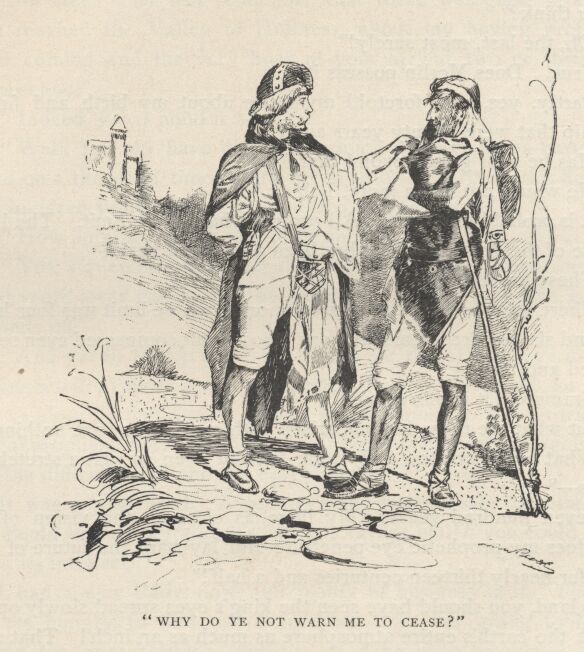
“When ye know that I meditate a thing inconvenient, or that hath a peril in it, why do you not warn me to cease from that project?”
“When you know I’m planning something troublesome or dangerous, why don’t you warn me to stop?”
It was a startling question, and a puzzler. I didn’t quite know how to take hold of it, or what to say, and so, of course, I ended by saying the natural thing:
It was a startling and puzzling question. I wasn’t quite sure how to approach it or what to say. So, of course, I ended up saying the natural thing:
“But, sire, how can I know what your thoughts are?”
“But, sire, how can I know what you're thinking?”
The king stopped dead in his tracks, and stared at me.
The king stopped dead in his tracks and stared at me.
“I believed thou wert greater than Merlin; and truly in magic thou art. But prophecy is greater than magic. Merlin is a prophet.”
“I believed you were greater than Merlin, and you truly are greater in magic. But prophecy is greater than magic. Merlin is a prophet.”
I saw I had made a blunder. I must get back my lost ground. After a deep reflection and careful planning, I said:
I realized I had made a mistake. I had to regain the ground I had lost. After thinking it over and planning carefully, I said:
“Sire, I have been misunderstood. I will explain. There are two kinds of prophecy. One is the gift to foretell things that are but a little way off, the other is the gift to foretell things that are whole ages and centuries away. Which is the mightier gift, do you think?”
“Sir, you have misunderstood me. Let me explain. There are two kinds of prophecy. One is the gift of predicting things that will happen soon. The other is the gift of predicting things that are ages and centuries away. Which gift do you think is more powerful?”
“Oh, the last, most surely!”
“Oh, definitely the last one!”
“True. Does Merlin possess it?”
“True. Does Merlin have it?”
“Partly, yes. He foretold mysteries about my birth and future kingship that were twenty years away.”
“Partly, yes. He predicted mysterious things about my birth and my becoming king twenty years later.”
“Has he ever gone beyond that?”
“Has he ever gone beyond that?”
“He would not claim more, I think.”
“I don't think he would claim more.”
“It is probably his limit. All prophets have their limit. The limit of some of the great prophets has been a hundred years.”
“That is probably his limit. All prophets have a limit. Some of the great prophets had a limit of a hundred years.”
“These are few, I ween.”
“There are few of these, I think.”
“There have been two still greater ones, whose limit was four hundred and six hundred years, and one whose limit compassed even seven hundred and twenty.”
“There have been two even greater ones, with limits of four hundred and six hundred years. Another reached a limit of seven hundred and twenty years.”
“Gramercy, it is marvelous!”
“Goodness, it’s amazing!”
“But what are these in comparison with me? They are nothing.”
“But what are these compared to me? They are nothing.”
“What? Canst thou truly look beyond even so vast a stretch of time as—”
“What? Can you really see that far into the future, as far as...”
“Seven hundred years? My liege, as clear as the vision of an eagle does my prophetic eye penetrate and lay bare the future of this world for nearly thirteen centuries and a half!”
“Seven hundred years? My lord, my prophetic eye sees the future of this world as clearly as an eagle sees. I can see nearly thirteen and a half centuries ahead!”
My land, you should have seen the king’s eyes spread slowly open, and lift the earth’s entire atmosphere as much as an inch! That settled Brer Merlin. One never had any occasion to prove his facts, with these people; all he had to do was to state them. It never occurred to anybody to doubt the statement.
Goodness, you should have seen the king’s eyes slowly open wide and lift the earth’s entire atmosphere an inch! That settled Brer Merlin. With these people, you never had to prove your facts. All you had to do was state them. It never occurred to anyone to doubt what you said.
“Now, then,” I continued, “I could work both kinds of prophecy—the long and the short—if I chose to take the trouble to keep in practice; but I seldom exercise any but the long kind, because the other is beneath my dignity. It is properer to Merlin’s sort—stump-tail prophets, as we call them in the profession. Of course, I whet up now and then and flirt out a minor prophecy, but not often—hardly ever, in fact. You will remember that there was great talk, when you reached the Valley of Holiness, about my having prophesied your coming and the very hour of your arrival, two or three days beforehand.”
“Now, then,” I continued, “I could practice both kinds of prophecy, the long and the short, if I chose to keep in practice. But I seldom use any but the long kind, because the other is beneath my dignity. It is better suited to Merlin’s sort, stump-tail prophets, as we call them in the profession. Of course, I sharpen my skills now and then and toss out a minor prophecy, but not often. Hardly ever, in fact. You will remember the great talk when you reached the Valley of Holiness. Two or three days beforehand, I had predicted your coming and the very hour of your arrival.”
“Indeed, yes, I mind it now.”
“Yes, I remember it now.”
“Well, I could have done it as much as forty times easier, and piled on a thousand times more detail into the bargain, if it had been five hundred years away instead of two or three days.”
“Well, I could have done it forty times more easily and added a thousand times more detail if it had been five hundred years away instead of two or three days.”
“How amazing that it should be so!”
“How amazing that this is true!”
“Yes, a genuine expert can always foretell a thing that is five hundred years away easier than he can a thing that’s only five hundred seconds off.”
“Yes, a real expert can always predict something 500 years away more easily than something only 500 seconds away.”
“And yet in reason it should clearly be the other way; it should be five hundred times as easy to foretell the last as the first, for, indeed, it is so close by that one uninspired might almost see it. In truth, the law of prophecy doth contradict the likelihoods, most strangely making the difficult easy, and the easy difficult.”
“And yet, logically, it should clearly be the other way around. It should be five hundred times easier to predict the last than the first. In fact, the last is so close that even someone without prophetic powers could almost see it. In truth, the law of prophecy goes against what seems likely. Strangely, it makes the difficult easy and the easy difficult.”
It was a wise head. A peasant’s cap was no safe disguise for it; you could know it for a king’s under a diving-bell, if you could hear it work its intellect.
It was a wise head. A peasant’s cap could not safely disguise it. You could recognize it as a king’s head even under a diving bell, if you could hear it thinking.
I had a new trade now, and plenty of business in it. The king was as hungry to find out everything that was going to happen during the next thirteen centuries as if he were expecting to live in them. From that time out, I prophesied myself bald-headed trying to supply the demand. I have done some indiscreet things in my day, but this thing of playing myself for a prophet was the worst. Still, it had its ameliorations. A prophet doesn’t have to have any brains. They are good to have, of course, for the ordinary exigencies of life, but they are no use in professional work. It is the restfulest vocation there is. When the spirit of prophecy comes upon you, you merely take your intellect and lay it off in a cool place for a rest, and unship your jaw and leave it alone; it will work itself: the result is prophecy.
I had a new trade now, and plenty of business. The king was eager to know everything that would happen over the next thirteen centuries. He was as eager as if he expected to live through them. From then on, I prophesied myself bald trying to keep up with the demand. I’ve done some foolish things in my time, but pretending to be a prophet was the worst. Still, it had its advantages. A prophet doesn’t need any brains. Brains are useful, of course, for ordinary problems in life, but they’re no use in a prophet’s work. It’s the most restful job there is. When the spirit of prophecy comes over you, you simply lay your mind in a cool place to rest. Then you loosen your jaw and leave it alone. It will work by itself, and the result is prophecy.
Every day a knight-errant or so came along, and the sight of them fired the king’s martial spirit every time. He would have forgotten himself, sure, and said something to them in a style a suspicious shade or so above his ostensible degree, and so I always got him well out of the road in time. Then he would stand and look with all his eyes; and a proud light would flash from them, and his nostrils would inflate like a war-horse’s, and I knew he was longing for a brush with them. But about noon of the third day I had stopped in the road to take a precaution which had been suggested by the whip-stroke that had fallen to my share two days before; a precaution which I had afterward decided to leave untaken, I was so loath to institute it; but now I had just had a fresh reminder: while striding heedlessly along, with jaw spread and intellect at rest, for I was prophesying, I stubbed my toe and fell sprawling. I was so pale I couldn’t think for a moment; then I got softly and carefully up and unstrapped my knapsack. I had that dynamite bomb in it, done up in wool in a box. It was a good thing to have along; the time would come when I could do a valuable miracle with it, maybe, but it was a nervous thing to have about me, and I didn’t like to ask the king to carry it. Yet I must either throw it away or think up some safe way to get along with its society. I got it out and slipped it into my scrip, and just then here came a couple of knights. The king stood, stately as a statue, gazing toward them—had forgotten himself again, of course—and before I could get a word of warning out, it was time for him to skip, and well that he did it, too. He supposed they would turn aside. Turn aside to avoid trampling peasant dirt under foot? When had he ever turned aside himself—or ever had the chance to do it, if a peasant saw him or any other noble knight in time to judiciously save him the trouble? The knights paid no attention to the king at all; it was his place to look out himself, and if he hadn’t skipped he would have been placidly ridden down, and laughed at besides.
Every day, a knight-errant or two came along, and the sight always stirred the king’s fighting spirit. He would surely have forgotten himself and spoken to them in a way that betrayed his supposed low rank. So I always got him well out of the road in time. Then he would stand and stare with all his might. A proud light would flash in his eyes, and his nostrils would flare like a warhorse’s. I knew he was longing to fight them. Around noon on the third day, I stopped in the road to take a precaution. The whipstroke I had received two days earlier had suggested it to me. I had decided afterward not to take the precaution, because I hated to do it. But now I had just had another reminder. I was striding along without paying attention, my mouth open and my mind at rest, for I was prophesying. Then I stubbed my toe and fell flat. I turned so pale I couldn’t think for a moment. Then I got up slowly and carefully and unstrapped my knapsack. I had that dynamite bomb in the knapsack, wrapped in wool inside a box. It was a good thing to have along. The time might come when I could use it to perform a useful miracle. But carrying it made me nervous, and I didn’t like to ask the king to carry it. Still, I had to either throw it away or think of a safe way to keep it with me. I took it out and slipped it into my bag. Just then, a couple of knights came along. The king stood as grandly as a statue, gazing at them. He had forgotten himself again, of course. Before I could warn him, it was time for him to jump aside, and it was a good thing he did. He expected the knights to move aside. Move aside to avoid trampling peasant dirt underfoot? When had he ever moved aside himself? When had he even had the chance, if a peasant saw him or any other noble knight in time to wisely save him the trouble? The knights paid no attention to the king. It was his job to look out for himself. If he hadn’t jumped aside, they would have calmly ridden him down and laughed at him besides.
The king was in a flaming fury, and launched out his challenge and epithets with a most royal vigor. The knights were some little distance by now. They halted, greatly surprised, and turned in their saddles and looked back, as if wondering if it might be worth while to bother with such scum as we. Then they wheeled and started for us. Not a moment must be lost. I started for them. I passed them at a rattling gait, and as I went by I flung out a hair-lifting soul-scorching thirteen-jointed insult which made the king’s effort poor and cheap by comparison. I got it out of the nineteenth century where they know how. They had such headway that they were nearly to the king before they could check up; then, frantic with rage, they stood up their horses on their hind hoofs and whirled them around, and the next moment here they came, breast to breast. I was seventy yards off, then, and scrambling up a great bowlder at the roadside. When they were within thirty yards of me they let their long lances droop to a level, depressed their mailed heads, and so, with their horse-hair plumes streaming straight out behind, most gallant to see, this lightning express came tearing for me! When they were within fifteen yards, I sent that bomb with a sure aim, and it struck the ground just under the horses’ noses.
The king was blazing with fury. He shouted his challenge and insults with truly royal vigor. The knights were some distance away by then. They stopped, greatly surprised, and turned in their saddles to look back. They seemed to wonder whether scum like us were worth bothering with. Then they turned their horses and started toward us. There was no time to lose. I started toward them. I raced past them and hurled a hair-raising, soul-scorching, thirteen-part insult at them. It made the king’s effort look poor and cheap by comparison. I got it from the nineteenth century, where they know how to insult people. The knights had so much momentum that they were nearly at the king before they could stop. Then, frantic with rage, they reared their horses up on their hind legs and spun them around. The next moment they came charging at me, side by side. By then, I was seventy yards away, scrambling up a huge boulder beside the road. When the knights were within thirty yards, they lowered their long lances and bowed their armored heads. Their horsehair plumes streamed straight out behind them. They were a magnificent sight as this lightning express came tearing toward me! When they were within fifteen yards, I threw the bomb with perfect aim. It hit the ground just under the horses’ noses.
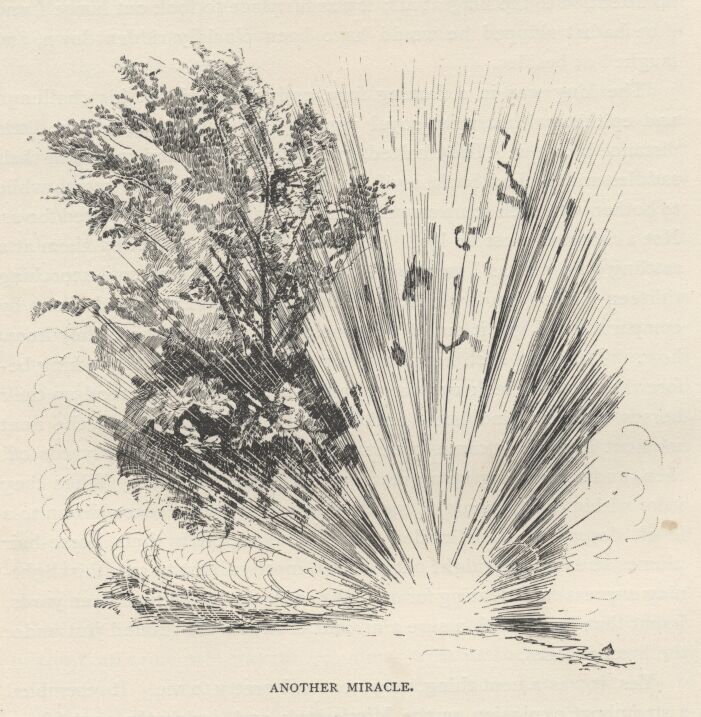
Yes, it was a neat thing, very neat and pretty to see. It resembled a steamboat explosion on the Mississippi; and during the next fifteen minutes we stood under a steady drizzle of microscopic fragments of knights and hardware and horse-flesh. I say we, for the king joined the audience, of course, as soon as he had got his breath again. There was a hole there which would afford steady work for all the people in that region for some years to come—in trying to explain it, I mean; as for filling it up, that service would be comparatively prompt, and would fall to the lot of a select few—peasants of that seignory; and they wouldn’t get anything for it, either.
Yes, it was a neat thing, very neat and pretty to see. It looked like a steamboat explosion on the Mississippi. For the next fifteen minutes, we stood under a steady drizzle of tiny fragments of knights, armor, and horse flesh. I say we because the king joined the audience, of course, as soon as he caught his breath. The hole would give everyone in the region steady work for years to come. I mean work trying to explain it. Filling it in would be comparatively quick, and that job would fall to a select few, the peasants of that lordship. They wouldn’t get anything for it, either.
But I explained it to the king myself. I said it was done with a dynamite bomb. This information did him no damage, because it left him as intelligent as he was before. However, it was a noble miracle, in his eyes, and was another settler for Merlin. I thought it well enough to explain that this was a miracle of so rare a sort that it couldn’t be done except when the atmospheric conditions were just right. Otherwise he would be encoring it every time we had a good subject, and that would be inconvenient, because I hadn’t any more bombs along.
But I explained it to the king myself. I said I had done it with a dynamite bomb. This information did him no harm, because it left him just as intelligent as before. Still, he saw it as a magnificent miracle, and another defeat for Merlin. I thought it best to explain that this rare kind of miracle required just the right atmospheric conditions. Otherwise, he would ask for a repeat whenever we had a good subject. That would be inconvenient, because I had no more bombs with me.