Chapter 40
Three Years Later
When I broke the back of knight-errantry that time, I no longer felt obliged to work in secret. So, the very next day I exposed my hidden schools, my mines, and my vast system of clandestine factories and workshops to an astonished world. That is to say, I exposed the nineteenth century to the inspection of the sixth.
When I broke the power of knight-errantry that time, I no longer felt I had to work in secret. So the very next day, I revealed my hidden schools, mines, and vast network of secret factories and workshops. The world was astonished. In other words, I let the sixth century see the nineteenth century.
Well, it is always a good plan to follow up an advantage promptly. The knights were temporarily down, but if I would keep them so I must just simply paralyze them—nothing short of that would answer. You see, I was “bluffing” that last time in the field; it would be natural for them to work around to that conclusion, if I gave them a chance. So I must not give them time; and I didn’t.
Well, it’s always a good idea to follow up on an advantage right away. The knights were down for the moment. But to keep them that way, I had to paralyze them. Nothing less would do. You see, I was “bluffing” that last time in the field. If I gave the knights a chance, they would naturally come to that conclusion. So I had to act quickly, and I did.
I renewed my challenge, engraved it on brass, posted it up where any priest could read it to them, and also kept it standing in the advertising columns of the paper.
I renewed my challenge and engraved it on brass. I posted it where any priest could read it to them. I also kept it running in the newspaper's advertising columns.
I not only renewed it, but added to its proportions. I said, name the day, and I would take fifty assistants and stand up against the massed chivalry of the whole earth and destroy it.
I not only renewed it, but made it even bigger. I said to name the day. I would take fifty assistants and face all the knights of the world together and destroy them.
I was not bluffing this time. I meant what I said; I could do what I promised. There wasn’t any way to misunderstand the language of that challenge. Even the dullest of the chivalry perceived that this was a plain case of “put up, or shut up.” They were wise and did the latter. In all the next three years they gave me no trouble worth mentioning.
I wasn’t bluffing this time. I meant what I said, and I could do what I promised. There was no mistaking what my challenge meant. Even the dullest knights understood that it was a plain case of “put up, or shut up.” They were wise enough to shut up. For the next three years, they gave me no trouble worth mentioning.
Consider the three years sped. Now look around on England. A happy and prosperous country, and strangely altered. Schools everywhere, and several colleges; a number of pretty good newspapers. Even authorship was taking a start; Sir Dinadan the Humorist was first in the field, with a volume of gray-headed jokes which I had been familiar with during thirteen centuries. If he had left out that old rancid one about the lecturer I wouldn’t have said anything; but I couldn’t stand that one. I suppressed the book and hanged the author.
Three years have passed. Now look around England. It is a happy and prosperous country, and it has changed remarkably. There are schools everywhere, several colleges, and a number of pretty good newspapers. Even writing books was starting to catch on. Sir Dinadan the Humorist was first, with a book of ancient jokes I had known for thirteen centuries. If he had left out that stale old joke about the lecturer, I wouldn’t have said anything. But I couldn’t stand that joke. I suppressed the book and hanged the author.
Slavery was dead and gone; all men were equal before the law; taxation had been equalized. The telegraph, the telephone, the phonograph, the typewriter, the sewing-machine, and all the thousand willing and handy servants of steam and electricity were working their way into favor. We had a steamboat or two on the Thames, we had steam warships, and the beginnings of a steam commercial marine; I was getting ready to send out an expedition to discover America.
Slavery was gone. All men were equal before the law, and taxes had been made equal. The telegraph, telephone, phonograph, typewriter, and sewing machine were becoming popular. So were the thousand other willing and handy servants powered by steam and electricity. We had a steamboat or two on the Thames. We had steam warships and the beginnings of a steam-powered merchant fleet. I was getting ready to send out an expedition to discover America.
We were building several lines of railway, and our line from Camelot to London was already finished and in operation. I was shrewd enough to make all offices connected with the passenger service places of high and distinguished honor. My idea was to attract the chivalry and nobility, and make them useful and keep them out of mischief. The plan worked very well, the competition for the places was hot. The conductor of the 4.33 express was a duke; there wasn’t a passenger conductor on the line below the degree of earl. They were good men, every one, but they had two defects which I couldn’t cure, and so had to wink at: they wouldn’t lay aside their armor, and they would “knock down” fare—I mean rob the company.
We were building several railway lines, and our line from Camelot to London was already finished and running. I was shrewd enough to make every job in the passenger service a position of great honor and distinction. My idea was to attract knights and nobles, make them useful, and keep them out of mischief. The plan worked very well. Competition for the jobs was fierce. The conductor of the 4:33 express was a duke. Every passenger conductor on the line was at least an earl. They were all good men, but they had two flaws I couldn’t cure, so I had to overlook them. They wouldn’t take off their armor, and they would “knock down” fares. I mean they robbed the company.
There was hardly a knight in all the land who wasn’t in some useful employment. They were going from end to end of the country in all manner of useful missionary capacities; their penchant for wandering, and their experience in it, made them altogether the most effective spreaders of civilization we had. They went clothed in steel and equipped with sword and lance and battle-axe, and if they couldn’t persuade a person to try a sewing-machine on the installment plan, or a melodeon, or a barbed-wire fence, or a prohibition journal, or any of the other thousand and one things they canvassed for, they removed him and passed on.
Hardly a knight in the whole country was without some useful job. They traveled all over the country as missionaries, doing all sorts of useful work. They loved to wander and had plenty of experience at it. That made them the most effective spreaders of civilization we had. They wore steel armor and carried swords, lances, and battle-axes. They sold sewing machines on installment plans, melodeons, barbed-wire fences, prohibition newspapers, and a thousand and one other things. If they couldn’t persuade someone to try one, they removed him and moved on.
I was very happy. Things were working steadily toward a secretly longed-for point. You see, I had two schemes in my head which were the vastest of all my projects. The one was to overthrow the Catholic Church and set up the Protestant faith on its ruins—not as an Established Church, but a go-as-you-please one; and the other project was to get a decree issued by and by, commanding that upon Arthur’s death unlimited suffrage should be introduced, and given to men and women alike—at any rate to all men, wise or unwise, and to all mothers who at middle age should be found to know nearly as much as their sons at twenty-one. Arthur was good for thirty years yet, he being about my own age—that is to say, forty—and I believed that in that time I could easily have the active part of the population of that day ready and eager for an event which should be the first of its kind in the history of the world—a rounded and complete governmental revolution without bloodshed. The result to be a republic. Well, I may as well confess, though I do feel ashamed when I think of it: I was beginning to have a base hankering to be its first president myself. Yes, there was more or less human nature in me; I found that out.
I was very happy. Things were moving steadily toward a goal I had secretly longed for. You see, I had two schemes in mind that were the biggest of all my projects. The first was to overthrow the Catholic Church and build the Protestant faith on its ruins. It would not be an Established Church, but one where people could worship as they pleased. The other was to have a decree issued eventually, ordering unlimited voting rights when Arthur died. Men and women would have equal voting rights. At any rate, all men would be able to vote, whether wise or foolish. So would all mothers who, by middle age, knew nearly as much as their sons did at twenty-one. Arthur had a good thirty years ahead of him. He was about my age, forty. I believed that during those years I could easily prepare the active part of the population for a revolution. They would be ready and eager for something never before seen in the history of the world: a complete revolution in government without bloodshed. The result would be a republic. Well, I might as well confess, though I feel ashamed when I think of it. I was beginning to have a low desire to be the republic’s first president myself. Yes, I discovered that I had a little human nature in me after all.
Clarence was with me as concerned the revolution, but in a modified way. His idea was a republic, without privileged orders, but with a hereditary royal family at the head of it instead of an elective chief magistrate. He believed that no nation that had ever known the joy of worshiping a royal family could ever be robbed of it and not fade away and die of melancholy. I urged that kings were dangerous. He said, then have cats. He was sure that a royal family of cats would answer every purpose. They would be as useful as any other royal family, they would know as much, they would have the same virtues and the same treacheries, the same disposition to get up shindies with other royal cats, they would be laughably vain and absurd and never know it, they would be wholly inexpensive; finally, they would have as sound a divine right as any other royal house, and “Tom VII, or Tom XI, or Tom XIV by the grace of God King,” would sound as well as it would when applied to the ordinary royal tomcat with tights on. “And as a rule,” said he, in his neat modern English, “the character of these cats would be considerably above the character of the average king, and this would be an immense moral advantage to the nation, for the reason that a nation always models its morals after its monarch’s. The worship of royalty being founded in unreason, these graceful and harmless cats would easily become as sacred as any other royalties, and indeed more so, because it would presently be noticed that they hanged nobody, beheaded nobody, imprisoned nobody, inflicted no cruelties or injustices of any sort, and so must be worthy of a deeper love and reverence than the customary human king, and would certainly get it. The eyes of the whole harried world would soon be fixed upon this humane and gentle system, and royal butchers would presently begin to disappear; their subjects would fill the vacancies with catlings from our own royal house; we should become a factory; we should supply the thrones of the world; within forty years all Europe would be governed by cats, and we should furnish the cats. The reign of universal peace would begin then, to end no more forever.... Me-e-e-yow-ow-ow-ow—fzt!—wow!”
Clarence agreed with me about the revolution, though only partly. He wanted a republic with no privileged classes, but with a hereditary royal family instead of an elected chief magistrate. He believed that any nation that had enjoyed worshiping a royal family would fade away and die of sadness if robbed of that joy. I argued that kings were dangerous. He said, then have cats. He was sure a royal family of cats would serve every purpose. They would be as useful as any other royal family and know as much. They would have the same virtues and the same betrayals. They would be just as inclined to start fights with other royal cats. They would be laughably vain and absurd, without ever knowing it. They would cost nothing at all. Finally, their divine right would be as valid as that of any other royal house. “Tom VII, or Tom XI, or Tom XIV by the grace of God King,” would sound just as good as it did when applied to the usual royal tomcat in tights. “And as a rule,” he said, in his polished modern English, “these cats would have considerably better character than the average king. That would be an immense moral advantage to the nation, because a nation always models its morals on its monarch’s. Worship of royalty is based on unreason, so these graceful, harmless cats would easily become as sacred as any other royalty. Indeed, they would become more sacred. People would soon notice that the cats hanged no one, beheaded no one, and imprisoned no one. They inflicted no cruelty or injustice of any kind. So they must be worthy of deeper love and reverence than the usual human king, and they would certainly get it. The whole troubled world would soon turn its eyes to this humane and gentle system. Royal butchers would soon begin to disappear. Their subjects would fill the empty thrones with kittens from our own royal house. We would become a factory. We would supply the thrones of the world. Within forty years, all Europe would be governed by cats, and we would provide the cats. Then the reign of universal peace would begin, never to end.... Me-e-e-yow-ow-ow-ow, fzt! Wow!”
Hang him, I supposed he was in earnest, and was beginning to be persuaded by him, until he exploded that cat-howl and startled me almost out of my clothes. But he never could be in earnest. He didn’t know what it was. He had pictured a distinct and perfectly rational and feasible improvement upon constitutional monarchy, but he was too feather-headed to know it, or care anything about it, either. I was going to give him a scolding, but Sandy came flying in at that moment, wild with terror, and so choked with sobs that for a minute she could not get her voice. I ran and took her in my arms, and lavished caresses upon her and said, beseechingly:
Damn him, I thought he was serious, and he was beginning to persuade me. Then he let out that cat-like howl and nearly scared me out of my clothes. But he could never be serious. He didn’t know what it meant. He had described a clear, perfectly sensible and workable improvement on constitutional monarchy. But he was too scatterbrained to realize it or care about it. I was going to scold him, but just then Sandy came rushing in, wild with terror. She was sobbing so hard that she couldn’t speak for a minute. I ran to her, took her in my arms, showered her with affection, and pleaded:
“Speak, darling, speak! What is it?”
“Speak, darling, speak! What is it?”
Her head fell limp upon my bosom, and she gasped, almost inaudibly:
Her head fell limply against my chest, and she gasped, so softly I could barely hear her:
“Hello-Central!”
“Hello-Central!”
“Quick!” I shouted to Clarence; “telephone the king’s homeopath to come!”
“Quick!” I shouted to Clarence. “Call the king’s homeopath and tell him to come!”
In two minutes I was kneeling by the child’s crib, and Sandy was dispatching servants here, there, and everywhere, all over the palace. I took in the situation almost at a glance—membranous croup! I bent down and whispered:
Within two minutes, I was kneeling by the child’s crib. Sandy was sending servants all over the palace. I saw almost at a glance what was wrong: membranous croup! I bent down and whispered:
“Wake up, sweetheart! Hello-Central.”
“Wake up, sweetheart! Hello-Central.”
She opened her soft eyes languidly, and made out to say:
She slowly opened her gentle eyes and managed to say:
“Papa.”
“Dad.”
That was a comfort. She was far from dead yet. I sent for preparations of sulphur, I rousted out the croup-kettle myself; for I don’t sit down and wait for doctors when Sandy or the child is sick. I knew how to nurse both of them, and had had experience. This little chap had lived in my arms a good part of its small life, and often I could soothe away its troubles and get it to laugh through the tear-dews on its eye-lashes when even its mother couldn’t.
That was a comfort. She was far from dead yet. I sent for sulfur remedies and got out the croup kettle myself. I don’t sit around waiting for doctors when Sandy or the child is sick. I knew how to care for both of them, and I had experience. This little one had spent much of its short life in my arms. Often, I could soothe its troubles and make it laugh through the tears on its eyelashes, even when its mother couldn’t.
Sir Launcelot, in his richest armor, came striding along the great hall now on his way to the stock-board; he was president of the stock-board, and occupied the Siege Perilous, which he had bought of Sir Galahad; for the stock-board consisted of the Knights of the Round Table, and they used the Round Table for business purposes now. Seats at it were worth—well, you would never believe the figure, so it is no use to state it. Sir Launcelot was a bear, and he had put up a corner in one of the new lines, and was just getting ready to squeeze the shorts to-day; but what of that? He was the same old Launcelot, and when he glanced in as he was passing the door and found out that his pet was sick, that was enough for him; bulls and bears might fight it out their own way for all him, he would come right in here and stand by little Hello-Central for all he was worth. And that was what he did. He shied his helmet into the corner, and in half a minute he had a new wick in the alcohol lamp and was firing up on the croup-kettle. By this time Sandy had built a blanket canopy over the crib, and everything was ready.
Sir Launcelot came striding through the great hall in his finest armor. He was on his way to the stock exchange, where he was president. He occupied the Siege Perilous, which he had bought from Sir Galahad. The exchange consisted of the Knights of the Round Table, who now used the Round Table for business. Seats at the table were worth, well, you would never believe the figure, so there is no use stating it. Sir Launcelot was a bear. He had cornered the stock in one of the new lines and was preparing to squeeze the short sellers that day. But what of that? He was the same old Launcelot. As he passed the door, he glanced in and saw that his pet was sick. That was enough for him. The bulls and bears could fight it out however they liked. He would come right in and stand by little Hello-Central with all his might. And that was what he did. He tossed his helmet into the corner. Within half a minute, he had put a new wick in the alcohol lamp and was heating the croup kettle. By then, Sandy had built a blanket canopy over the crib, and everything was ready.
Sir Launcelot got up steam, he and I loaded up the kettle with unslaked lime and carbolic acid, with a touch of lactic acid added thereto, then filled the thing up with water and inserted the steam-spout under the canopy. Everything was ship-shape now, and we sat down on either side of the crib to stand our watch. Sandy was so grateful and so comforted that she charged a couple of church-wardens with willow-bark and sumach-tobacco for us, and told us to smoke as much as we pleased, it couldn’t get under the canopy, and she was used to smoke, being the first lady in the land who had ever seen a cloud blown. Well, there couldn’t be a more contented or comfortable sight than Sir Launcelot in his noble armor sitting in gracious serenity at the end of a yard of snowy church-warden. He was a beautiful man, a lovely man, and was just intended to make a wife and children happy. But, of course Guenever—however, it’s no use to cry over what’s done and can’t be helped.
Sir Launcelot got the steam going, and we loaded the kettle with quicklime and carbolic acid, adding a touch of lactic acid. Then we filled it with water and put the steam spout under the canopy. Everything was in order now, and we sat down on either side of the crib to keep watch. Sandy was so grateful and comforted that she filled two long-stemmed pipes with willow bark and sumac tobacco for us. She told us to smoke as much as we pleased. The smoke couldn't get under the canopy, and she was used to it. She was the first lady in the land who had ever seen a cloud of smoke blown. There couldn't have been a more contented or comfortable sight than Sir Launcelot in his noble armor. He sat there in graceful serenity, smoking a yard-long white pipe. He was a beautiful man, a lovely man, and was just meant to make a wife and children happy. But, of course, Guenever. Well, it's no use crying over what's done and can't be helped.
Well, he stood watch-and-watch with me, right straight through, for three days and nights, till the child was out of danger; then he took her up in his great arms and kissed her, with his plumes falling about her golden head, then laid her softly in Sandy’s lap again and took his stately way down the vast hall, between the ranks of admiring men-at-arms and menials, and so disappeared. And no instinct warned me that I should never look upon him again in this world! Lord, what a world of heart-break it is.
Well, he took turns keeping watch with me for three days and nights, until the child was out of danger. Then he lifted her in his great arms and kissed her, his plumes falling around her golden head. He gently laid her back in Sandy’s lap. Then he walked majestically down the vast hall, between rows of admiring soldiers and servants, and disappeared. Nothing warned me that I would never see him again in this world! Lord, what a world of heartbreak this is.
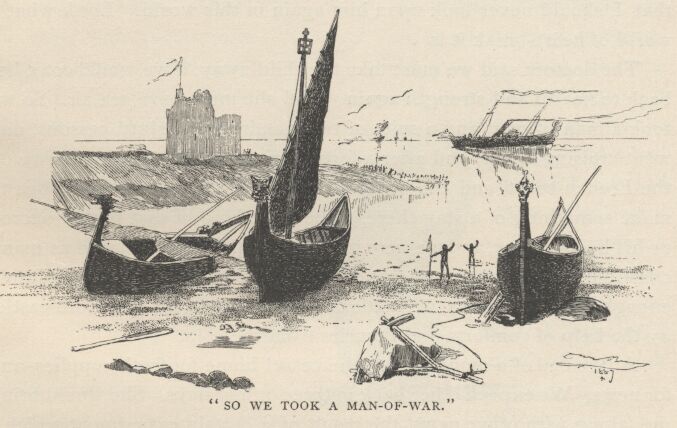
The doctors said we must take the child away, if we would coax her back to health and strength again. And she must have sea-air. So we took a man-of-war, and a suite of two hundred and sixty persons, and went cruising about, and after a fortnight of this we stepped ashore on the French coast, and the doctors thought it would be a good idea to make something of a stay there. The little king of that region offered us his hospitalities, and we were glad to accept. If he had had as many conveniences as he lacked, we should have been plenty comfortable enough; even as it was, we made out very well, in his queer old castle, by the help of comforts and luxuries from the ship.
The doctors said we had to take the child away if we wanted to help her regain her health and strength. She needed sea air, too. So we took a warship and a party of 260 people and went cruising. After two weeks, we went ashore on the French coast. The doctors thought it would be a good idea to stay there for a while. The little king of that region offered us his hospitality, and we were glad to accept. If he had had as many conveniences as he lacked, we would have been quite comfortable. Even so, we managed very well in his odd old castle, thanks to comforts and luxuries from the ship.
At the end of a month I sent the vessel home for fresh supplies, and for news. We expected her back in three or four days. She would bring me, along with other news, the result of a certain experiment which I had been starting. It was a project of mine to replace the tournament with something which might furnish an escape for the extra steam of the chivalry, keep those bucks entertained and out of mischief, and at the same time preserve the best thing in them, which was their hardy spirit of emulation. I had had a choice band of them in private training for some time, and the date was now arriving for their first public effort.
At the end of a month, I sent the ship home for fresh supplies and news. We expected it back in three or four days. Among other news, it would bring me the result of an experiment I had started. My plan was to replace the tournament with something that would let the knights blow off steam. It would keep those fellows entertained and out of trouble. At the same time, it would preserve the best thing in them, their vigorous competitive spirit. I had been training a select group of them in private for some time. The date of their first public performance was now approaching.
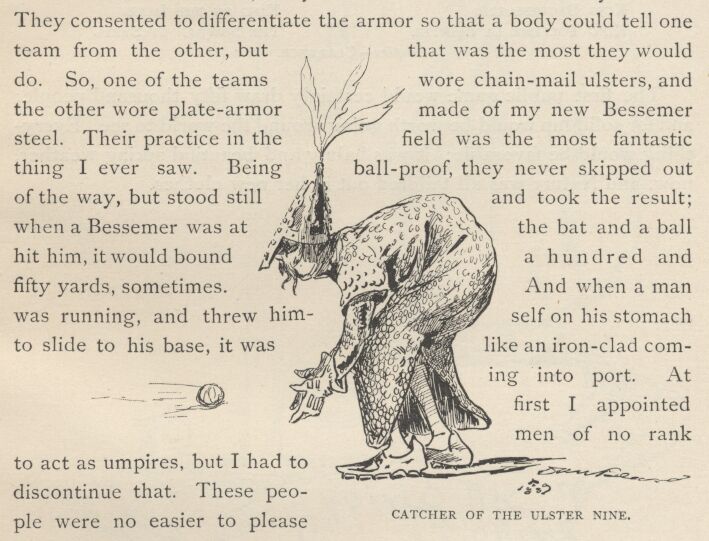
This experiment was baseball. In order to give the thing vogue from the start, and place it out of the reach of criticism, I chose my nines by rank, not capacity. There wasn’t a knight in either team who wasn’t a sceptered sovereign. As for material of this sort, there was a glut of it always around Arthur. You couldn’t throw a brick in any direction and not cripple a king. Of course, I couldn’t get these people to leave off their armor; they wouldn’t do that when they bathed. They consented to differentiate the armor so that a body could tell one team from the other, but that was the most they would do. So, one of the teams wore chain-mail ulsters, and the other wore plate-armor made of my new Bessemer steel. Their practice in the field was the most fantastic thing I ever saw. Being ball-proof, they never skipped out of the way, but stood still and took the result; when a Bessemer was at the bat and a ball hit him, it would bound a hundred and fifty yards sometimes. And when a man was running, and threw himself on his stomach to slide to his base, it was like an iron-clad coming into port. At first I appointed men of no rank to act as umpires, but I had to discontinue that. These people were no easier to please than other nines. The umpire’s first decision was usually his last; they broke him in two with a bat, and his friends toted him home on a shutter. When it was noticed that no umpire ever survived a game, umpiring got to be unpopular. So I was obliged to appoint somebody whose rank and lofty position under the government would protect him.
The experiment was baseball. To make it popular from the start and put it beyond criticism, I chose my teams by rank, not ability. Every knight on both teams was a king with a scepter. There were always plenty of those around Arthur. You couldn’t throw a brick in any direction without crippling a king. Of course, I couldn’t get these people to take off their armor. They wouldn’t do that even when they bathed. They agreed to wear different armor so people could tell the teams apart, but that was as far as they would go. One team wore long coats of chain mail, and the other wore plate armor made of my new Bessemer steel. Their practice on the field was the most fantastic thing I ever saw. Since the ball couldn’t hurt them, they never got out of its way. They just stood still and took the hit. When a ball hit a batter in Bessemer steel, it sometimes bounced 150 yards. And when a player threw himself on his stomach to slide into a base, it was like an ironclad ship coming into port. At first, I appointed men of no rank as umpires, but I had to stop doing that. These players were no easier to please than any other teams. An umpire’s first decision was usually his last. They broke him in two with a bat, and his friends carried him home on a shutter. When people noticed that no umpire ever survived a game, umpiring became unpopular. So I had to appoint someone whose rank and high position in the government would protect him.
Here are the names of the nines:
Here are the names of the teams:
| BESSEMERS | ULSTERS |
| KING ARTHUR. | EMPEROR LUCIUS. |
| KING LOT OF LOTHIAN. | KING LOGRIS. |
| KING OF NORTHGALIS. | KING MARHALT OF IRELAND. |
| KING MARSIL. | KING MORGANORE. |
| KING OF LITTLE BRITAIN. | KING MARK OF CORNWALL. |
| KING LABOR. | KING NENTRES OF GARLOT. |
| KING PELLAM OF LISTENGESE. | KING MELIODAS OF LIONES. |
| KING BAGDEMAGUS. | KING OF THE LAKE. |
| KING TOLLEME LA FEINTES. | THE SOWDAN OF SYRIA. |
| Umpire—CLARENCE. |
The first public game would certainly draw fifty thousand people; and for solid fun would be worth going around the world to see. Everything would be favorable; it was balmy and beautiful spring weather now, and Nature was all tailored out in her new clothes.
The first public game would certainly draw fifty thousand people. It would be so much fun that it would be worth traveling around the world to see. Everything would be in its favor. The spring weather was warm and beautiful, and Nature was dressed in her new clothes.