Stave 3
The Second Spirit
Awaking in the middle of a prodigiously tough snore, and sitting up in bed to get his thoughts together, Scrooge had no occasion to be told that the bell was again upon the stroke of One. He felt that he was restored to consciousness in the right nick of time, for the especial purpose of holding a conference with the second messenger despatched to him through Jacob Marley’s intervention. But finding that he turned uncomfortably cold when he began to wonder which of his curtains this new spectre would draw back, he put them every one aside with his own hands; and lying down again, established a sharp look-out all round the bed. For he wished to challenge the Spirit on the moment of its appearance, and did not wish to be taken by surprise, and made nervous.
Scrooge woke in the middle of an enormously loud snore and sat up in bed to collect his thoughts. He needed no one to tell him that the bell was about to strike One again. He felt he had awakened just in time to meet the second messenger sent to him through Jacob Marley’s intervention. But he grew uncomfortably cold when he wondered which of his bed curtains the new ghost would pull back. So he pulled every curtain aside himself. Then he lay down again and kept a sharp watch all around the bed. He wanted to challenge the Spirit the moment it appeared. He did not want to be caught by surprise and made nervous.
Gentlemen of the free-and-easy sort, who plume themselves on being acquainted with a move or two, and being usually equal to the time-of-day, express the wide range of their capacity for adventure by observing that they are good for anything from pitch-and-toss to manslaughter; between which opposite extremes, no doubt, there lies a tolerably wide and comprehensive range of subjects. Without venturing for Scrooge quite as hardily as this, I don’t mind calling on you to believe that he was ready for a good broad field of strange appearances, and that nothing between a baby and rhinoceros would have astonished him very much.
Easygoing gentlemen pride themselves on knowing a trick or two and usually being ready for whatever comes. They show how adventurous they are by saying they are up for anything from a game of pitch-and-toss to manslaughter. No doubt, those two extremes cover a fairly broad range of activities. I would not make quite so bold a claim for Scrooge. But I ask you to believe that he was prepared for a wide range of strange sights. Anything from a baby to a rhinoceros would not have surprised him very much.
Now, being prepared for almost anything, he was not by any means prepared for nothing; and, consequently, when the Bell struck One, and no shape appeared, he was taken with a violent fit of trembling. Five minutes, ten minutes, a quarter of an hour went by, yet nothing came. All this time, he lay upon his bed, the very core and centre of a blaze of ruddy light, which streamed upon it when the clock proclaimed the hour; and which, being only light, was more alarming than a dozen ghosts, as he was powerless to make out what it meant, or would be at; and was sometimes apprehensive that he might be at that very moment an interesting case of spontaneous combustion, without having the consolation of knowing it. At last, however, he began to think—as you or I would have thought at first; for it is always the person not in the predicament who knows what ought to have been done in it, and would unquestionably have done it too—at last, I say, he began to think that the source and secret of this ghostly light might be in the adjoining room, from whence, on further tracing it, it seemed to shine. This idea taking full possession of his mind, he got up softly and shuffled in his slippers to the door.
Now, though he was prepared for almost anything, he was certainly not prepared for nothing. So when the bell struck one and no figure appeared, he began to tremble violently. Five minutes, ten minutes, a quarter of an hour passed, yet nothing came. All this time, he lay on his bed at the very center of a blaze of reddish light. The light had streamed onto the bed when the clock struck the hour. Because it was only light, it was more alarming than a dozen ghosts. He could not make out what it meant or what it wanted. Sometimes he feared that he might be an interesting case of spontaneous combustion at that very moment. He would not even have the comfort of knowing it. At last, however, he began to think, as you or I would have thought at first. After all, the person who is not in the predicament always knows what ought to have been done. That person would unquestionably have done it too. At last, I say, he began to think that the source and secret of this ghostly light might be in the next room. When he traced the light farther, it seemed to shine from there. Once this idea took full possession of his mind, he got up quietly and shuffled to the door in his slippers.
The moment Scrooge’s hand was on the lock, a strange voice called him by his name, and bade him enter. He obeyed.
The moment Scrooge put his hand on the lock, a strange voice called his name and told him to enter. He obeyed.
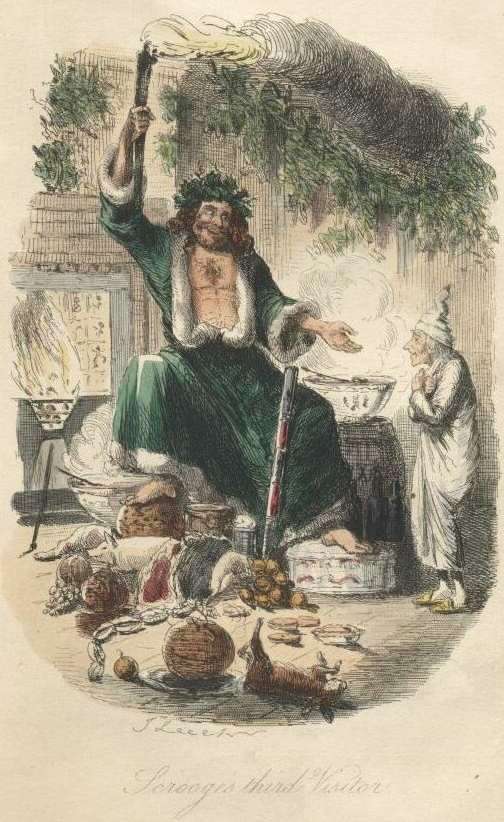
It was his own room. There was no doubt about that. But it had undergone a surprising transformation. The walls and ceiling were so hung with living green, that it looked a perfect grove; from every part of which, bright gleaming berries glistened. The crisp leaves of holly, mistletoe, and ivy reflected back the light, as if so many little mirrors had been scattered there; and such a mighty blaze went roaring up the chimney, as that dull petrification of a hearth had never known in Scrooge’s time, or Marley’s, or for many and many a winter season gone. Heaped up on the floor, to form a kind of throne, were turkeys, geese, game, poultry, brawn, great joints of meat, sucking-pigs, long wreaths of sausages, mince-pies, plum-puddings, barrels of oysters, red-hot chestnuts, cherry-cheeked apples, juicy oranges, luscious pears, immense twelfth-cakes, and seething bowls of punch, that made the chamber dim with their delicious steam. In easy state upon this couch, there sat a jolly Giant, glorious to see; who bore a glowing torch, in shape not unlike Plenty’s horn, and held it up, high up, to shed its light on Scrooge, as he came peeping round the door.
It was his own room. There was no doubt about that. But it had been transformed. The walls and ceiling were covered with living greenery, making the room look like a grove. Bright berries gleamed everywhere among the leaves. The crisp leaves of holly, mistletoe, and ivy reflected the light, as if little mirrors had been scattered all around. A great fire roared up the chimney. The dull, stone-cold hearth had never known such a blaze in Scrooge’s time, or Marley’s, or for many winters before that. Food was heaped on the floor to form a kind of throne. There were turkeys, geese, game, poultry, brawn, great cuts of meat, suckling pigs, and long wreaths of sausages. There were mince pies, plum puddings, barrels of oysters, hot chestnuts, red-cheeked apples, juicy oranges, and luscious pears. There were enormous Twelfth Night cakes and steaming bowls of punch. Their delicious steam filled the room and dimmed the light. A jolly Giant sat comfortably on this throne, a glorious sight. He held a glowing torch shaped rather like Plenty’s horn. As Scrooge peeped around the door, the Giant held the torch high to shine its light on him.
“Come in!” exclaimed the Ghost. “Come in! and know me better, man!”
“Come in!” exclaimed the Ghost. “Come in and get to know me better, man!”
Scrooge entered timidly, and hung his head before this Spirit. He was not the dogged Scrooge he had been; and though the Spirit’s eyes were clear and kind, he did not like to meet them.
Scrooge entered timidly and bowed his head before the Spirit. He was no longer as stubborn as he had been. Though the Spirit’s eyes were clear and kind, Scrooge did not like to meet them.
“I am the Ghost of Christmas Present,” said the Spirit. “Look upon me!”
“I am the Ghost of Christmas Present,” said the Spirit. “Look at me!”
Scrooge reverently did so. It was clothed in one simple green robe, or mantle, bordered with white fur. This garment hung so loosely on the figure, that its capacious breast was bare, as if disdaining to be warded or concealed by any artifice. Its feet, observable beneath the ample folds of the garment, were also bare; and on its head it wore no other covering than a holly wreath, set here and there with shining icicles. Its dark brown curls were long and free; free as its genial face, its sparkling eye, its open hand, its cheery voice, its unconstrained demeanour, and its joyful air. Girded round its middle was an antique scabbard; but no sword was in it, and the ancient sheath was eaten up with rust.
Scrooge reverently did so. The figure wore a simple green robe, trimmed with white fur. The robe hung loosely, leaving its broad chest bare, as if it scorned any attempt to protect or cover it. Its feet, visible beneath the robe’s generous folds, were also bare. The only covering on its head was a holly wreath, dotted with shining icicles. Its dark brown curls hung long and free. They were as free as its warm face, sparkling eye, open hand, cheerful voice, relaxed manner, and joyful air. Around its waist was an old scabbard, but it held no sword and was eaten away by rust.
“You have never seen the like of me before!” exclaimed the Spirit.
“You’ve never seen anyone like me before!” exclaimed the Spirit.
“Never,” Scrooge made answer to it.
“Never,” Scrooge answered.
“Have never walked forth with the younger members of my family; meaning (for I am very young) my elder brothers born in these later years?” pursued the Phantom.
“Have never gone out with the younger members of my family? I mean my older brothers, who were born in recent years. I am very young, you see,” continued the Phantom.
“I don’t think I have,” said Scrooge. “I am afraid I have not. Have you had many brothers, Spirit?”
“I don’t think I have,” said Scrooge. “I’m afraid I haven’t. Have you had many brothers, Spirit?”
“More than eighteen hundred,” said the Ghost.
“More than eighteen hundred,” said the Ghost.
“A tremendous family to provide for!” muttered Scrooge.
“What a huge family to support!” muttered Scrooge.
The Ghost of Christmas Present rose.
The Ghost of Christmas Present stood up.
“Spirit,” said Scrooge submissively, “conduct me where you will. I went forth last night on compulsion, and I learnt a lesson which is working now. To-night, if you have aught to teach me, let me profit by it.”
“Spirit,” said Scrooge humbly, “take me wherever you wish. Last night, I went because I was forced to, and I learned a lesson that is still affecting me. Tonight, if you have anything to teach me, let me learn from it.”
“Touch my robe!”
“Touch my robe!”
Scrooge did as he was told, and held it fast.
Scrooge did as he was told and held it tightly.
Holly, mistletoe, red berries, ivy, turkeys, geese, game, poultry, brawn, meat, pigs, sausages, oysters, pies, puddings, fruit, and punch, all vanished instantly. So did the room, the fire, the ruddy glow, the hour of night, and they stood in the city streets on Christmas morning, where (for the weather was severe) the people made a rough, but brisk and not unpleasant kind of music, in scraping the snow from the pavement in front of their dwellings, and from the tops of their houses, whence it was mad delight to the boys to see it come plumping down into the road below, and splitting into artificial little snow-storms.
Holly, mistletoe, red berries, ivy, turkeys, geese, game, poultry, brawn, meat, pigs, sausages, oysters, pies, puddings, fruit, and punch all vanished instantly. So did the room, the fire, the warm red glow, and the nighttime. They stood in the city streets on Christmas morning. The weather was harsh, and people were scraping snow from the pavement outside their homes and from their rooftops. They made a rough but lively and not unpleasant kind of music. The boys were wildly delighted to see the snow tumble from the rooftops into the road below, breaking into little artificial snowstorms.
The house fronts looked black enough, and the windows blacker, contrasting with the smooth white sheet of snow upon the roofs, and with the dirtier snow upon the ground; which last deposit had been ploughed up in deep furrows by the heavy wheels of carts and waggons; furrows that crossed and re-crossed each other hundreds of times where the great streets branched off; and made intricate channels, hard to trace in the thick yellow mud and icy water. The sky was gloomy, and the shortest streets were choked up with a dingy mist, half thawed, half frozen, whose heavier particles descended in a shower of sooty atoms, as if all the chimneys in Great Britain had, by one consent, caught fire, and were blazing away to their dear hearts’ content. There was nothing very cheerful in the climate or the town, and yet was there an air of cheerfulness abroad that the clearest summer air and brightest summer sun might have endeavoured to diffuse in vain.
The fronts of the houses looked black, and the windows looked even blacker. They stood in contrast to the smooth white sheet of snow on the roofs and the dirtier snow on the ground. The heavy wheels of carts and wagons had ploughed the snow on the ground into deep furrows. Where the great streets branched off, the furrows crossed and recrossed hundreds of times. They formed a tangle of channels that were hard to follow through the thick yellow mud and icy water. The sky was gloomy, and even the shortest streets were choked with a dirty mist, half thawed and half frozen. Its heavier particles fell in a shower of soot. It was as if all the chimneys in Great Britain had agreed to catch fire and blaze away to their hearts’ content. There was nothing very cheerful about the weather or the town. Yet there was a cheerfulness in the air that the clearest summer air and brightest summer sun might have tried in vain to spread.
For, the people who were shovelling away on the housetops were jovial and full of glee; calling out to one another from the parapets, and now and then exchanging a facetious snowball—better-natured missile far than many a wordy jest—laughing heartily if it went right and not less heartily if it went wrong. The poulterers’ shops were still half open, and the fruiterers’ were radiant in their glory. There were great, round, pot-bellied baskets of chestnuts, shaped like the waistcoats of jolly old gentlemen, lolling at the doors, and tumbling out into the street in their apoplectic opulence. There were ruddy, brown-faced, broad-girthed Spanish Onions, shining in the fatness of their growth like Spanish Friars, and winking from their shelves in wanton slyness at the girls as they went by, and glanced demurely at the hung-up mistletoe. There were pears and apples, clustered high in blooming pyramids; there were bunches of grapes, made, in the shopkeepers’ benevolence to dangle from conspicuous hooks, that people’s mouths might water gratis as they passed; there were piles of filberts, mossy and brown, recalling, in their fragrance, ancient walks among the woods, and pleasant shufflings ankle deep through withered leaves; there were Norfolk Biffins, squat and swarthy, setting off the yellow of the oranges and lemons, and, in the great compactness of their juicy persons, urgently entreating and beseeching to be carried home in paper bags and eaten after dinner. The very gold and silver fish, set forth among these choice fruits in a bowl, though members of a dull and stagnant-blooded race, appeared to know that there was something going on; and, to a fish, went gasping round and round their little world in slow and passionless excitement.
The people shoveling snow from the rooftops were cheerful and full of joy. They called to one another from the roof edges and sometimes tossed a playful snowball. A snowball was a much kinder missile than many a verbal joke. They laughed heartily when a snowball hit its mark, and just as heartily when it missed. The poultry shops were still half open, and the fruit shops were radiant in all their glory. Great, round, potbellied baskets of chestnuts lounged in the doorways and spilled into the street in an almost bursting abundance. The baskets were shaped like the waistcoats of jolly old gentlemen. There were reddish brown, broad Spanish onions, shining with the fullness of their growth like Spanish friars. They winked slyly from their shelves at the girls passing by, who glanced shyly at the mistletoe hanging overhead. Pears and apples were piled high in colorful pyramids. Kind shopkeepers had hung bunches of grapes from prominent hooks, so passersby could have their mouths watered for free. There were piles of brown, mossy hazelnuts. Their scent brought back memories of old walks in the woods and pleasant shuffling through ankle-deep fallen leaves. There were Norfolk Biffins, squat, dark apples that set off the yellow oranges and lemons. So plump and full of juice, they seemed to beg to be carried home in paper bags and eaten after dinner. Even the gold and silver fish displayed in a bowl among these fine fruits seemed to know something was happening. This was despite their being members of a dull, slow-blooded race. Every fish swam gasping around and around its little world in slow, passionless excitement.
The Grocers’! oh, the Grocers’! nearly closed, with perhaps two shutters down, or one; but through those gaps such glimpses! It was not alone that the scales descending on the counter made a merry sound, or that the twine and roller parted company so briskly, or that the canisters were rattled up and down like juggling tricks, or even that the blended scents of tea and coffee were so grateful to the nose, or even that the raisins were so plentiful and rare, the almonds so extremely white, the sticks of cinnamon so long and straight, the other spices so delicious, the candied fruits so caked and spotted with molten sugar as to make the coldest lookers-on feel faint and subsequently bilious. Nor was it that the figs were moist and pulpy, or that the French plums blushed in modest tartness from their highly-decorated boxes, or that everything was good to eat and in its Christmas dress; but the customers were all so hurried and so eager in the hopeful promise of the day, that they tumbled up against each other at the door, crashing their wicker baskets wildly, and left their purchases upon the counter, and came running back to fetch them, and committed hundreds of the like mistakes, in the best humour possible; while the Grocer and his people were so frank and fresh that the polished hearts with which they fastened their aprons behind might have been their own, worn outside for general inspection, and for Christmas daws to peck at if they chose.
The grocers’ shops! Oh, the grocers’ shops! They were nearly closed, with perhaps one or two shutters down. But what glimpses you could catch through the gaps! It was not just that the scales made a cheerful sound as they landed on the counter. Or that the twine came off its roller so briskly. Or that the canisters rattled up and down like a juggler’s props. Nor was it just that the mixed scents of tea and coffee were so pleasant. The raisins were plentiful and rare, the almonds so very white, and the cinnamon sticks so long and straight. The other spices were delicious, and the candied fruits were crusted and spotted with melted sugar. They could make even the least excitable onlookers feel faint, and then sick. Nor was it just that the figs were moist and soft, or that the French plums blushed with modest tartness in their highly decorated boxes. Everything was good to eat and dressed for Christmas. But all the customers were so hurried and eager, filled with hope for the day, that they bumped into one another at the door. They crashed their wicker baskets wildly together, left their purchases on the counter, and came running back for them. They made hundreds of similar mistakes, all in the best possible humor. Meanwhile, the grocer and his workers were so open and cheerful that the polished hearts fastening their aprons behind them might have been their own. They might have worn their own hearts on the outside for everyone to see, and for Christmas jackdaws to peck at if they chose.
But soon the steeples called good people all, to church and chapel, and away they came, flocking through the streets in their best clothes, and with their gayest faces. And at the same time there emerged from scores of bye-streets, lanes, and nameless turnings, innumerable people, carrying their dinners to the bakers’ shops. The sight of these poor revellers appeared to interest the Spirit very much, for he stood with Scrooge beside him in a baker’s doorway, and taking off the covers as their bearers passed, sprinkled incense on their dinners from his torch. And it was a very uncommon kind of torch, for once or twice when there were angry words between some dinner-carriers who had jostled each other, he shed a few drops of water on them from it, and their good humour was restored directly. For they said, it was a shame to quarrel upon Christmas Day. And so it was! God love it, so it was!
But soon the church bells called all the good people to church and chapel. They came flocking through the streets in their best clothes, looking as cheerful as could be. At the same time, countless people came out of side streets, lanes, and nameless turnings, carrying their dinners to the bakers’ shops. The sight of these poor celebrants seemed to interest the Spirit very much. He stood in a baker’s doorway with Scrooge beside him. As the people carrying dinners passed, he took off the covers and sprinkled incense on their dinners from his torch. It was a very unusual torch. Once or twice, some people carrying dinners bumped into one another and exchanged angry words. The Spirit sprinkled a few drops of water on them from the torch, and they became cheerful again at once. They said it was a shame to quarrel on Christmas Day. And so it was! God bless Christmas Day, so it was!
In time the bells ceased, and the bakers were shut up; and yet there was a genial shadowing forth of all these dinners and the progress of their cooking, in the thawed blotch of wet above each baker’s oven; where the pavement smoked as if its stones were cooking too.
Eventually the bells stopped ringing, and the bakeries closed. Yet the wet, thawed patch above each baker’s oven gave a cheerful hint of all the dinners cooking inside. The pavement there steamed as if its stones were cooking too.
“Is there a peculiar flavour in what you sprinkle from your torch?” asked Scrooge.
“Does what you sprinkle from your torch have a special flavor?” asked Scrooge.
“There is. My own.”
“There is. My own.”
“Would it apply to any kind of dinner on this day?” asked Scrooge.
“Would it apply to any kind of dinner today?” asked Scrooge.
“To any kindly given. To a poor one most.”
“To any that is given with kindness. Most of all, to a poor one.”
“Why to a poor one most?” asked Scrooge.
“Why most to a poor one?” asked Scrooge.
“Because it needs it most.”
“Because it needs it most.”
“Spirit,” said Scrooge, after a moment’s thought, “I wonder you, of all the beings in the many worlds about us, should desire to cramp these people’s opportunities of innocent enjoyment.”
“Spirit,” said Scrooge after a moment’s thought, “I’m surprised that you, of all the beings in the many worlds around us, would want to limit these people’s chances for innocent enjoyment.”
“I!” cried the Spirit.
“Me!” cried the Spirit.
“You would deprive them of their means of dining every seventh day, often the only day on which they can be said to dine at all,” said Scrooge. “Wouldn’t you?”
“You would take away their means of eating dinner every seventh day,” said Scrooge. “That is often the only day they can really be said to eat dinner at all. Wouldn’t you?”
“I!” cried the Spirit.
“Me!” cried the Spirit.
“You seek to close these places on the Seventh Day?” said Scrooge. “And it comes to the same thing.”
“You want to close these places on Sunday?” said Scrooge. “And it amounts to the same thing.”
“I seek!” exclaimed the Spirit.
“I look for it!” the Spirit exclaimed.
“Forgive me if I am wrong. It has been done in your name, or at least in that of your family,” said Scrooge.
“Forgive me if I’m wrong. It has been done in your name, or at least in your family’s name,” said Scrooge.
“There are some upon this earth of yours,” returned the Spirit, “who lay claim to know us, and who do their deeds of passion, pride, ill-will, hatred, envy, bigotry, and selfishness in our name, who are as strange to us and all our kith and kin, as if they had never lived. Remember that, and charge their doings on themselves, not us.”
“There are some people on your earth,” replied the Spirit, “who claim to know us. In our name, they act out of passion, pride, ill will, hatred, envy, bigotry, and selfishness. Yet they are as unknown to us and all our kin as if they had never lived. Remember that, and blame them for their actions, not us.”
Scrooge promised that he would; and they went on, invisible, as they had been before, into the suburbs of the town. It was a remarkable quality of the Ghost (which Scrooge had observed at the baker’s), that notwithstanding his gigantic size, he could accommodate himself to any place with ease; and that he stood beneath a low roof quite as gracefully and like a supernatural creature, as it was possible he could have done in any lofty hall.
Scrooge promised that he would, and they went on into the suburbs of the town, still invisible as before. The Ghost had a remarkable quality that Scrooge had noticed at the baker’s. Despite his enormous size, he could fit easily into any place. Under a low roof, he stood just as gracefully and as much like a supernatural creature as he could have in any grand hall.
And perhaps it was the pleasure the good Spirit had in showing off this power of his, or else it was his own kind, generous, hearty nature, and his sympathy with all poor men, that led him straight to Scrooge’s clerk’s; for there he went, and took Scrooge with him, holding to his robe; and on the threshold of the door the Spirit smiled, and stopped to bless Bob Cratchit’s dwelling with the sprinkling of his torch. Think of that! Bob had but fifteen “Bob” a-week himself; he pocketed on Saturdays but fifteen copies of his Christian name; and yet the Ghost of Christmas Present blessed his four-roomed house!
Perhaps the good Spirit enjoyed showing off his power. Or perhaps it was his kind, generous, hearty nature and his sympathy for all poor men that led him straight to Scrooge’s clerk’s home. He went there, taking Scrooge with him, as Scrooge held on to his robe. At the door, the Spirit smiled and stopped to bless Bob Cratchit’s home with a sprinkle from his torch. Think of that! Bob himself earned only fifteen “Bob” a week. Every Saturday, he pocketed only fifteen shillings, each one a copy of his Christian name. And yet the Ghost of Christmas Present blessed his four-room house!
Then up rose Mrs. Cratchit, Cratchit’s wife, dressed out but poorly in a twice-turned gown, but brave in ribbons, which are cheap and make a goodly show for sixpence; and she laid the cloth, assisted by Belinda Cratchit, second of her daughters, also brave in ribbons; while Master Peter Cratchit plunged a fork into the saucepan of potatoes, and getting the corners of his monstrous shirt collar (Bob’s private property, conferred upon his son and heir in honour of the day) into his mouth, rejoiced to find himself so gallantly attired, and yearned to show his linen in the fashionable Parks. And now two smaller Cratchits, boy and girl, came tearing in, screaming that outside the baker’s they had smelt the goose, and known it for their own; and basking in luxurious thoughts of sage and onion, these young Cratchits danced about the table, and exalted Master Peter Cratchit to the skies, while he (not proud, although his collars nearly choked him) blew the fire, until the slow potatoes bubbling up, knocked loudly at the saucepan-lid to be let out and peeled.
Then Mrs. Cratchit, Cratchit’s wife, got up. She was poorly dressed in a gown that had been turned twice to make it last. But she looked splendid in ribbons, which were cheap and made a fine show for sixpence. She laid the table with help from Belinda Cratchit, her second daughter, who also looked splendid in ribbons. Meanwhile, Master Peter Cratchit plunged a fork into the saucepan of potatoes. He got the corners of his enormous shirt collar into his mouth. The shirt belonged to Bob, who had given it to his son and heir in honor of the day. Peter was delighted to be so splendidly dressed and longed to show off his fine shirt in the fashionable Parks. Now two smaller Cratchits, a boy and a girl, came rushing in. They screamed that they had smelled the goose outside the baker’s and recognized it as their own. Basking in luxurious thoughts of sage and onion, they danced around the table and praised Master Peter Cratchit to the skies. Peter, who was not proud, though his collar nearly choked him, blew on the fire. At last the slow potatoes bubbled up and knocked loudly on the saucepan lid, asking to be let out and peeled.
“What has ever got your precious father then?” said Mrs. Cratchit. “And your brother, Tiny Tim! And Martha warn’t as late last Christmas Day by half-an-hour?”
“Whatever has happened to your precious father?” said Mrs. Cratchit. “And your brother, Tiny Tim! Martha wasn’t half an hour this late last Christmas Day, was she?”
“Here’s Martha, mother!” said a girl, appearing as she spoke.
“Here’s Martha, Mother!” said a girl as she appeared.
“Here’s Martha, mother!” cried the two young Cratchits. “Hurrah! There’s such a goose, Martha!”
“Here’s Martha, Mom!” cried the two young Cratchits. “Hurray! There’s such a goose, Martha!”
“Why, bless your heart alive, my dear, how late you are!” said Mrs. Cratchit, kissing her a dozen times, and taking off her shawl and bonnet for her with officious zeal.
“Goodness, my dear, you're so late!” said Mrs. Cratchit. She kissed her a dozen times and eagerly helped her take off her shawl and bonnet.
“We’d a deal of work to finish up last night,” replied the girl, “and had to clear away this morning, mother!”
“We had a lot of work to finish last night,” the girl replied, “and we had to clean up this morning, Mother!”
“Well! Never mind so long as you are come,” said Mrs. Cratchit. “Sit ye down before the fire, my dear, and have a warm, Lord bless ye!”
“Well! Never mind, as long as you’re here,” said Mrs. Cratchit. “Sit down by the fire, my dear, and warm yourself. Lord bless you!”
“No, no! There’s father coming,” cried the two young Cratchits, who were everywhere at once. “Hide, Martha, hide!”
“No, no! Here comes Father,” cried the two young Cratchits, who seemed to be everywhere at once. “Hide, Martha, hide!”
So Martha hid herself, and in came little Bob, the father, with at least three feet of comforter exclusive of the fringe, hanging down before him; and his threadbare clothes darned up and brushed, to look seasonable; and Tiny Tim upon his shoulder. Alas for Tiny Tim, he bore a little crutch, and had his limbs supported by an iron frame!
So Martha hid, and little Bob, her father, came in. At least three feet of his scarf hung down in front of him, not counting the fringe. His threadbare clothes had been mended and brushed to look festive. Tiny Tim sat on his shoulder. Alas for Tiny Tim! He carried a little crutch, and an iron frame supported his limbs.
“Why, where’s our Martha?” cried Bob Cratchit, looking round.
“Where’s our Martha?” cried Bob Cratchit, looking around.
“Not coming,” said Mrs. Cratchit.
“Not coming,” said Mrs. Cratchit.
“Not coming!” said Bob, with a sudden declension in his high spirits; for he had been Tim’s blood horse all the way from church, and had come home rampant. “Not coming upon Christmas Day!”
“Not coming!” said Bob, his high spirits suddenly falling. He had been Tim’s riding horse all the way from church and had come home full of energy. “Not coming on Christmas Day!”
Martha didn’t like to see him disappointed, if it were only in joke; so she came out prematurely from behind the closet door, and ran into his arms, while the two young Cratchits hustled Tiny Tim, and bore him off into the wash-house, that he might hear the pudding singing in the copper.
Martha didn’t like to see him disappointed, even as a joke. So she came out from behind the closet door early and ran into his arms. Meanwhile, the two young Cratchits hurried Tiny Tim off to the wash-house. They wanted him to hear the pudding singing in the copper pot.
“And how did little Tim behave?” asked Mrs. Cratchit, when she had rallied Bob on his credulity, and Bob had hugged his daughter to his heart’s content.
Mrs. Cratchit teased Bob for being so easily fooled, and Bob hugged his daughter as much as he wanted. Then Mrs. Cratchit asked, “And how did little Tim behave?”
“As good as gold,” said Bob, “and better. Somehow he gets thoughtful, sitting by himself so much, and thinks the strangest things you ever heard. He told me, coming home, that he hoped the people saw him in the church, because he was a cripple, and it might be pleasant to them to remember upon Christmas Day, who made lame beggars walk, and blind men see.”
“As good as gold,” said Bob, “and better. Somehow, sitting by himself so much makes him thoughtful, and he thinks the strangest things you’ve ever heard. On the way home, he told me he hoped people had seen him in church because he was a cripple. He thought seeing him might help them remember on Christmas Day who made lame beggars walk and blind men see.”
Bob’s voice was tremulous when he told them this, and trembled more when he said that Tiny Tim was growing strong and hearty.
Bob’s voice shook when he told them this. It shook even more when he said that Tiny Tim was growing stronger and healthier.
His active little crutch was heard upon the floor, and back came Tiny Tim before another word was spoken, escorted by his brother and sister to his stool before the fire; and while Bob, turning up his cuffs—as if, poor fellow, they were capable of being made more shabby—compounded some hot mixture in a jug with gin and lemons, and stirred it round and round and put it on the hob to simmer; Master Peter, and the two ubiquitous young Cratchits went to fetch the goose, with which they soon returned in high procession.
His little crutch tapped briskly on the floor, and Tiny Tim came back before anyone spoke again. His brother and sister escorted him to his stool by the fire. Bob turned up his cuffs. Poor fellow, it was as if they could be made any shabbier. He mixed a hot drink of gin and lemons in a jug, stirring it round and round. Then he put it on the hob to simmer. Meanwhile, Master Peter and the two young Cratchits, who seemed to be everywhere, went to fetch the goose. They soon returned with it in a grand procession.
Such a bustle ensued that you might have thought a goose the rarest of all birds; a feathered phenomenon, to which a black swan was a matter of course—and in truth it was something very like it in that house. Mrs. Cratchit made the gravy (ready beforehand in a little saucepan) hissing hot; Master Peter mashed the potatoes with incredible vigour; Miss Belinda sweetened up the apple-sauce; Martha dusted the hot plates; Bob took Tiny Tim beside him in a tiny corner at the table; the two young Cratchits set chairs for everybody, not forgetting themselves, and mounting guard upon their posts, crammed spoons into their mouths, lest they should shriek for goose before their turn came to be helped. At last the dishes were set on, and grace was said. It was succeeded by a breathless pause, as Mrs. Cratchit, looking slowly all along the carving-knife, prepared to plunge it in the breast; but when she did, and when the long expected gush of stuffing issued forth, one murmur of delight arose all round the board, and even Tiny Tim, excited by the two young Cratchits, beat on the table with the handle of his knife, and feebly cried Hurrah!
Such a bustle followed that you might have thought a goose was the rarest of all birds. It seemed a feathered marvel, beside which a black swan was an everyday sight. And in truth, a goose was something very like that in the Cratchit house. Mrs. Cratchit heated the gravy, which was already prepared in a small saucepan, until it hissed. Master Peter mashed the potatoes with incredible energy. Miss Belinda sweetened the apple sauce. Martha dusted the hot plates. Bob sat Tiny Tim beside him in a little corner of the table. The two young Cratchits set out chairs for everyone, including themselves. Then they took their places and stuffed spoons into their mouths. This kept them from shrieking for goose before their turn to be served. At last, the dishes were placed on the table, and grace was said. A breathless pause followed. Mrs. Cratchit slowly looked along the carving knife as she prepared to plunge it into the goose’s breast. When she did, the long-awaited stuffing poured out, and a murmur of delight rose around the table. Even Tiny Tim, caught up in the excitement of the two young Cratchits, beat the table with his knife handle. He gave a feeble cry of Hurrah!
There never was such a goose. Bob said he didn’t believe there ever was such a goose cooked. Its tenderness and flavour, size and cheapness, were the themes of universal admiration. Eked out by apple-sauce and mashed potatoes, it was a sufficient dinner for the whole family; indeed, as Mrs. Cratchit said with great delight (surveying one small atom of a bone upon the dish), they hadn’t ate it all at last! Yet every one had had enough, and the youngest Cratchits in particular, were steeped in sage and onion to the eyebrows! But now, the plates being changed by Miss Belinda, Mrs. Cratchit left the room alone—too nervous to bear witnesses—to take the pudding up and bring it in.
There had never been such a goose. Bob said he didn’t believe anyone had ever cooked a goose like it. Everyone admired how tender and flavorful it was, how big it was, and how little it had cost. With applesauce and mashed potatoes to stretch it, the goose was enough for the whole family. In fact, Mrs. Cratchit was delighted to see one tiny bit of bone left on the dish. As she said, they hadn’t eaten it all after all! Yet everyone had had enough. The youngest Cratchits in particular were covered in sage and onion stuffing up to their eyebrows! But now Miss Belinda changed the plates, and Mrs. Cratchit left the room alone. She was too nervous to have anyone watch her take up the pudding and bring it in.
Suppose it should not be done enough! Suppose it should break in turning out! Suppose somebody should have got over the wall of the back-yard, and stolen it, while they were merry with the goose—a supposition at which the two young Cratchits became livid! All sorts of horrors were supposed.
What if it wasn’t cooked enough? What if it broke when they turned it out? What if someone had climbed over the backyard wall and stolen it while they were enjoying the goose? That thought made the two young Cratchits turn pale! They imagined all sorts of horrors.
Hallo! A great deal of steam! The pudding was out of the copper. A smell like a washing-day! That was the cloth. A smell like an eating-house and a pastrycook’s next door to each other, with a laundress’s next door to that! That was the pudding! In half a minute Mrs. Cratchit entered—flushed, but smiling proudly—with the pudding, like a speckled cannon-ball, so hard and firm, blazing in half of half-a-quartern of ignited brandy, and bedight with Christmas holly stuck into the top.
Hello! What a lot of steam! The pudding was out of the copper cooking pot. There was a smell like laundry day! That was the cloth. There was a smell like a restaurant and a bakery next door to each other, with a laundry next door to those! That was the pudding! Half a minute later, Mrs. Cratchit came in, flushed but smiling proudly, carrying the pudding. It was as hard and firm as a speckled cannonball. A quarter of a quartern of brandy blazed around it, and a sprig of Christmas holly was stuck in the top.
Oh, a wonderful pudding! Bob Cratchit said, and calmly too, that he regarded it as the greatest success achieved by Mrs. Cratchit since their marriage. Mrs. Cratchit said that now the weight was off her mind, she would confess she had had her doubts about the quantity of flour. Everybody had something to say about it, but nobody said or thought it was at all a small pudding for a large family. It would have been flat heresy to do so. Any Cratchit would have blushed to hint at such a thing.
Oh, what a wonderful pudding! Bob Cratchit said, quite calmly, that it was Mrs. Cratchit's greatest success since their marriage. Mrs. Cratchit said that now she could stop worrying, she would admit she had doubted whether there was enough flour. Everyone had something to say about the pudding. But no one said or thought it was at all small for such a large family. That would have been outright heresy. Any Cratchit would have blushed even to suggest such a thing.
At last the dinner was all done, the cloth was cleared, the hearth swept, and the fire made up. The compound in the jug being tasted, and considered perfect, apples and oranges were put upon the table, and a shovel-full of chestnuts on the fire. Then all the Cratchit family drew round the hearth, in what Bob Cratchit called a circle, meaning half a one; and at Bob Cratchit’s elbow stood the family display of glass. Two tumblers, and a custard-cup without a handle.
At last, dinner was finished. The tablecloth was cleared away, the hearth was swept, and the fire was built up. They tasted the mixture in the jug and found it perfect. Then apples and oranges were placed on the table, and a shovelful of chestnuts was put on the fire. The whole Cratchit family gathered around the hearth in what Bob Cratchit called a circle. He meant a semicircle. Beside Bob Cratchit stood the family’s display of glassware: two tumblers and a custard cup without a handle.
These held the hot stuff from the jug, however, as well as golden goblets would have done; and Bob served it out with beaming looks, while the chestnuts on the fire sputtered and cracked noisily. Then Bob proposed:
These, however, held the hot drink from the jug just as well as golden goblets would have. Bob served the drink with a beaming smile, while the chestnuts sputtered and cracked noisily on the fire. Then Bob proposed:
“A Merry Christmas to us all, my dears. God bless us!”
“Merry Christmas to all of us, my dears. God bless us!”
Which all the family re-echoed.
Which the whole family repeated.
“God bless us every one!” said Tiny Tim, the last of all.
“God bless us all!” said Tiny Tim, speaking last.
He sat very close to his father’s side upon his little stool. Bob held his withered little hand in his, as if he loved the child, and wished to keep him by his side, and dreaded that he might be taken from him.
He sat on his little stool, very close beside his father. Bob held the child’s small, withered hand in his own. It was as if Bob loved him, wanted to keep him close, and feared he might be taken away.
“Spirit,” said Scrooge, with an interest he had never felt before, “tell me if Tiny Tim will live.”
“Spirit,” said Scrooge, with an interest he had never felt before, “tell me if Tiny Tim will live.”
“I see a vacant seat,” replied the Ghost, “in the poor chimney-corner, and a crutch without an owner, carefully preserved. If these shadows remain unaltered by the Future, the child will die.”
“I see an empty seat by the poor family’s fireplace,” replied the Ghost. “I see a carefully preserved crutch with no owner. If the future does not change these shadows, the child will die.”
“No, no,” said Scrooge. “Oh, no, kind Spirit! say he will be spared.”
“No, no,” said Scrooge. “Oh, no, kind Spirit! Please say he will be spared.”
“If these shadows remain unaltered by the Future, none other of my race,” returned the Ghost, “will find him here. What then? If he be like to die, he had better do it, and decrease the surplus population.”
“If the future does not change these shadows,” replied the Ghost, “no other spirit like me will find him here. What then? If he is going to die, he had better do it and reduce the surplus population.”
Scrooge hung his head to hear his own words quoted by the Spirit, and was overcome with penitence and grief.
Scrooge bowed his head as he heard the Spirit repeat his own words. He was overcome with regret and grief.
“Man,” said the Ghost, “if man you be in heart, not adamant, forbear that wicked cant until you have discovered What the surplus is, and Where it is. Will you decide what men shall live, what men shall die? It may be, that in the sight of Heaven, you are more worthless and less fit to live than millions like this poor man’s child. Oh God! to hear the Insect on the leaf pronouncing on the too much life among his hungry brothers in the dust!”
“Man,” said the Ghost, “if your heart is human and not made of stone, stop that wicked talk. First discover what the surplus is and where it is. Will you decide who will live and who will die? In Heaven’s sight, you may be more worthless and less fit to live than millions like this poor man’s child. Oh God! To hear the insect on the leaf declare that there is too much life among his hungry brothers in the dust!”
Scrooge bent before the Ghost’s rebuke, and trembling cast his eyes upon the ground. But he raised them speedily, on hearing his own name.
Scrooge bowed his head as the Ghost scolded him. Trembling, he looked down at the ground. But he quickly looked up when he heard his own name.
“Mr. Scrooge!” said Bob; “I’ll give you Mr. Scrooge, the Founder of the Feast!”
“Mr. Scrooge!” said Bob. “I propose a toast to Mr. Scrooge, who provided the feast!”
“The Founder of the Feast indeed!” cried Mrs. Cratchit, reddening. “I wish I had him here. I’d give him a piece of my mind to feast upon, and I hope he’d have a good appetite for it.”
“The Founder of the Feast, indeed!” cried Mrs. Cratchit, her face turning red. “I wish he were here. I’d give him a piece of my mind to feast on, and I hope he’d have a good appetite for it.”
“My dear,” said Bob, “the children! Christmas Day.”
“My dear,” Bob said, “the children! It’s Christmas Day.”
“It should be Christmas Day, I am sure,” said she, “on which one drinks the health of such an odious, stingy, hard, unfeeling man as Mr. Scrooge. You know he is, Robert! Nobody knows it better than you do, poor fellow!”
“It must be Christmas Day,” she said, “for anyone to drink to the health of such a hateful, stingy, hard-hearted man as Mr. Scrooge. You know he is, Robert! Nobody knows it better than you do, poor fellow!”
“My dear,” was Bob’s mild answer, “Christmas Day.”
“My dear,” Bob replied gently, “Christmas Day.”
“I’ll drink his health for your sake and the Day’s,” said Mrs. Cratchit, “not for his. Long life to him! A merry Christmas and a happy new year! He’ll be very merry and very happy, I have no doubt!”
“I’ll drink to his health for your sake and for Christmas, not for his,” said Mrs. Cratchit. “Long life to him! A merry Christmas and a happy new year! I have no doubt he’ll be very merry and very happy!”
The children drank the toast after her. It was the first of their proceedings which had no heartiness. Tiny Tim drank it last of all, but he didn’t care twopence for it. Scrooge was the Ogre of the family. The mention of his name cast a dark shadow on the party, which was not dispelled for full five minutes.
The children drank the toast after her. It was the first thing they did without enthusiasm. Tiny Tim drank the toast last, but he didn’t care at all for it. Scrooge was the Ogre of the family. His name cast a dark shadow over the party, and the shadow lingered for a full five minutes.
After it had passed away, they were ten times merrier than before, from the mere relief of Scrooge the Baleful being done with. Bob Cratchit told them how he had a situation in his eye for Master Peter, which would bring in, if obtained, full five-and-sixpence weekly. The two young Cratchits laughed tremendously at the idea of Peter’s being a man of business; and Peter himself looked thoughtfully at the fire from between his collars, as if he were deliberating what particular investments he should favour when he came into the receipt of that bewildering income. Martha, who was a poor apprentice at a milliner’s, then told them what kind of work she had to do, and how many hours she worked at a stretch, and how she meant to lie abed to-morrow morning for a good long rest; to-morrow being a holiday she passed at home. Also how she had seen a countess and a lord some days before, and how the lord “was much about as tall as Peter;” at which Peter pulled up his collars so high that you couldn’t have seen his head if you had been there. All this time the chestnuts and the jug went round and round; and by-and-bye they had a song, about a lost child travelling in the snow, from Tiny Tim, who had a plaintive little voice, and sang it very well indeed.
After it had passed, they were ten times merrier than before, simply relieved to be done with Scrooge the Baleful. Bob Cratchit told them he had a job in mind for Master Peter. If Peter got it, he would earn a full five shillings and sixpence a week. The two young Cratchits laughed tremendously at the thought of Peter being a businessman. Peter himself gazed thoughtfully at the fire from between his collars. He looked as if he were considering which investments to favor once he received that bewildering income. Martha was a poor apprentice at a hatmaker’s shop. She told them what kind of work she did and how many hours she worked without a break. She planned to sleep in the next morning for a good long rest, since it was a holiday she would spend at home. She also told them she had seen a countess and a lord a few days before. The lord “was much about as tall as Peter.” At that, Peter pulled his collars up so high that, if you had been there, you couldn’t have seen his head. All this time, the chestnuts and the jug kept going around. Before long, Tiny Tim sang them a song about a lost child traveling through the snow. He had a sweet, sorrowful little voice, and he sang it very well indeed.
There was nothing of high mark in this. They were not a handsome family; they were not well dressed; their shoes were far from being water-proof; their clothes were scanty; and Peter might have known, and very likely did, the inside of a pawnbroker’s. But, they were happy, grateful, pleased with one another, and contented with the time; and when they faded, and looked happier yet in the bright sprinklings of the Spirit’s torch at parting, Scrooge had his eye upon them, and especially on Tiny Tim, until the last.
There was nothing remarkable about this. They were not a handsome family, and they were not well dressed. Their shoes were far from waterproof, and they had too little clothing. Peter might have been inside a pawnbroker’s shop, and very likely had. But they were happy, grateful, pleased with one another, and content with the moment. As they faded from view, they looked happier still in the bright sparks from the Spirit’s torch at parting. Scrooge watched them, especially Tiny Tim, until the very last moment.
By this time it was getting dark, and snowing pretty heavily; and as Scrooge and the Spirit went along the streets, the brightness of the roaring fires in kitchens, parlours, and all sorts of rooms, was wonderful. Here, the flickering of the blaze showed preparations for a cosy dinner, with hot plates baking through and through before the fire, and deep red curtains, ready to be drawn to shut out cold and darkness. There all the children of the house were running out into the snow to meet their married sisters, brothers, cousins, uncles, aunts, and be the first to greet them. Here, again, were shadows on the window-blind of guests assembling; and there a group of handsome girls, all hooded and fur-booted, and all chattering at once, tripped lightly off to some near neighbour’s house; where, woe upon the single man who saw them enter—artful witches, well they knew it—in a glow!
By now it was getting dark, and the snow was falling heavily. As Scrooge and the Spirit walked through the streets, the roaring fires lit up kitchens, sitting rooms, and all sorts of rooms wonderfully. In one house, the flickering flames revealed preparations for a cozy dinner. Plates were warming thoroughly before the fire, and deep red curtains were ready to be drawn against the cold and darkness. At another house, all the children were running out into the snow. They wanted to be the first to greet their married sisters, brothers, cousins, uncles, and aunts. Elsewhere, the shadows of guests gathering appeared on a window blind. Nearby, a group of beautiful girls hurried off to a neighbor’s house. They all wore hoods and fur boots, and they all chattered at once. Pity any single man who saw them enter, glowing! Those cunning witches knew very well what they were doing.
But, if you had judged from the numbers of people on their way to friendly gatherings, you might have thought that no one was at home to give them welcome when they got there, instead of every house expecting company, and piling up its fires half-chimney high. Blessings on it, how the Ghost exulted! How it bared its breadth of breast, and opened its capacious palm, and floated on, outpouring, with a generous hand, its bright and harmless mirth on everything within its reach! The very lamplighter, who ran on before, dotting the dusky street with specks of light, and who was dressed to spend the evening somewhere, laughed out loudly as the Spirit passed, though little kenned the lamplighter that he had any company but Christmas!
But judging by the crowds on their way to friendly gatherings, you might have thought no one would be home to welcome them. In fact, every house was expecting guests and piling its fires halfway up the chimney. Bless it, how the Ghost rejoiced! It bared its broad chest and opened its huge hand. As it floated on, it generously scattered its bright, harmless cheer over everything within reach. Even the lamplighter laughed aloud as the Spirit passed. He ran ahead, dotting the dim street with specks of light, and was dressed to spend the evening somewhere. Yet he had no idea he had any company but Christmas!
And now, without a word of warning from the Ghost, they stood upon a bleak and desert moor, where monstrous masses of rude stone were cast about, as though it were the burial-place of giants; and water spread itself wheresoever it listed, or would have done so, but for the frost that held it prisoner; and nothing grew but moss and furze, and coarse rank grass. Down in the west the setting sun had left a streak of fiery red, which glared upon the desolation for an instant, like a sullen eye, and frowning lower, lower, lower yet, was lost in the thick gloom of darkest night.
Now, without any warning from the Ghost, they stood on a bleak, deserted moor. Huge masses of rough stone lay scattered about, as if this were a burial ground for giants. Water spread wherever it pleased, or would have, if the frost had not held it prisoner. Nothing grew there but moss, gorse, and coarse, thick grass. Low in the west, the setting sun had left a streak of fiery red. For an instant, it glared across the desolate land like a sullen eye. Then it sank lower, lower, lower still, until it disappeared into the thick gloom of darkest night.
“What place is this?” asked Scrooge.
“What is this place?” asked Scrooge.
“A place where Miners live, who labour in the bowels of the earth,” returned the Spirit. “But they know me. See!”
“A place where miners live and work deep underground,” the Spirit replied. “But they know me. Look!”
A light shone from the window of a hut, and swiftly they advanced towards it. Passing through the wall of mud and stone, they found a cheerful company assembled round a glowing fire. An old, old man and woman, with their children and their children’s children, and another generation beyond that, all decked out gaily in their holiday attire. The old man, in a voice that seldom rose above the howling of the wind upon the barren waste, was singing them a Christmas song—it had been a very old song when he was a boy—and from time to time they all joined in the chorus. So surely as they raised their voices, the old man got quite blithe and loud; and so surely as they stopped, his vigour sank again.
A light shone from the window of a hut, and they hurried toward it. Passing through the mud and stone wall, they found a cheerful group gathered around a glowing fire. A very old man and woman were there with their children, grandchildren, and great-grandchildren. All were dressed brightly in their holiday clothes. The old man was singing them a Christmas song. His voice could seldom be heard above the wind howling across the barren land. The song had been very old even when he was a boy. From time to time, everyone joined in the chorus. Whenever they raised their voices, the old man became cheerful and sang loudly. Whenever they stopped, his energy faded again.
The Spirit did not tarry here, but bade Scrooge hold his robe, and passing on above the moor, sped—whither? Not to sea? To sea. To Scrooge’s horror, looking back, he saw the last of the land, a frightful range of rocks, behind them; and his ears were deafened by the thundering of water, as it rolled and roared, and raged among the dreadful caverns it had worn, and fiercely tried to undermine the earth.
The Spirit did not stay there, but told Scrooge to hold his robe. They flew on above the moor, but where were they going? Not to sea? To sea. To Scrooge’s horror, he looked back and saw the last of the land behind them, a terrifying range of rocks. The thunder of the water deafened him. It rolled, roared, and raged among the dreadful caverns it had worn away, fiercely trying to undermine the earth.
Built upon a dismal reef of sunken rocks, some league or so from shore, on which the waters chafed and dashed, the wild year through, there stood a solitary lighthouse. Great heaps of sea-weed clung to its base, and storm-birds—born of the wind one might suppose, as sea-weed of the water—rose and fell about it, like the waves they skimmed.
A solitary lighthouse stood on a bleak reef of sunken rocks, about three miles from shore. The water churned and crashed against the reef throughout the wild year. Great heaps of seaweed clung to the lighthouse’s base. Storm birds rose and fell around it, like the waves they skimmed. One might imagine the birds were born of the wind, just as seaweed is born of the water.
But even here, two men who watched the light had made a fire, that through the loophole in the thick stone wall shed out a ray of brightness on the awful sea. Joining their horny hands over the rough table at which they sat, they wished each other Merry Christmas in their can of grog; and one of them: the elder, too, with his face all damaged and scarred with hard weather, as the figure-head of an old ship might be: struck up a sturdy song that was like a Gale in itself.
But even here, two men tending the light had made a fire. Its glow shone through an opening in the thick stone wall, casting a ray of light onto the dreadful sea. Sitting at a rough table, they clasped their calloused hands and wished each other Merry Christmas over their can of grog. Then one of them began a hearty song, as fierce as a gale itself. He was the older man, his face battered and scarred by harsh weather, like the figurehead of an old ship.
Again the Ghost sped on, above the black and heaving sea—on, on—until, being far away, as he told Scrooge, from any shore, they lighted on a ship. They stood beside the helmsman at the wheel, the look-out in the bow, the officers who had the watch; dark, ghostly figures in their several stations; but every man among them hummed a Christmas tune, or had a Christmas thought, or spoke below his breath to his companion of some bygone Christmas Day, with homeward hopes belonging to it. And every man on board, waking or sleeping, good or bad, had had a kinder word for another on that day than on any day in the year; and had shared to some extent in its festivities; and had remembered those he cared for at a distance, and had known that they delighted to remember him.
Once again, the Ghost sped on above the dark, rolling sea. He told Scrooge they were far from any shore when they landed on a ship. They stood beside the helmsman at the wheel, the lookout at the bow, and the officers on watch. Each was a dark, ghostly figure at his post. But every man hummed a Christmas tune, or had a Christmas thought, or spoke quietly to a companion. He spoke of a past Christmas Day and the hope of being home again. Every man on board, awake or asleep, good or bad, had spoken more kindly to another that day than on any other day of the year. Each had shared to some extent in the celebrations. Each had remembered the people he cared for who were far away, and knew they were glad to remember him.
It was a great surprise to Scrooge, while listening to the moaning of the wind, and thinking what a solemn thing it was to move on through the lonely darkness over an unknown abyss, whose depths were secrets as profound as Death: it was a great surprise to Scrooge, while thus engaged, to hear a hearty laugh. It was a much greater surprise to Scrooge to recognise it as his own nephew’s and to find himself in a bright, dry, gleaming room, with the Spirit standing smiling by his side, and looking at that same nephew with approving affability!
Scrooge listened to the wind moaning as he moved through the lonely darkness over an unknown abyss. He thought how solemn the journey was, with the depths below as mysterious as Death. As he was thinking about this, he was very surprised to hear a hearty laugh. He was even more surprised to recognize the laugh as his own nephew’s. He found himself in a bright, dry, gleaming room. The Spirit stood smiling beside him, looking at his nephew with friendly approval.
“Ha, ha!” laughed Scrooge’s nephew. “Ha, ha, ha!”
“Ha, ha!” laughed Scrooge’s nephew. “Ha, ha, ha!”
If you should happen, by any unlikely chance, to know a man more blest in a laugh than Scrooge’s nephew, all I can say is, I should like to know him too. Introduce him to me, and I’ll cultivate his acquaintance.
If, by some unlikely chance, you know a man with a better laugh than Scrooge’s nephew, all I can say is that I’d like to know him too. Introduce me to him, and I’ll get to know him.
It is a fair, even-handed, noble adjustment of things, that while there is infection in disease and sorrow, there is nothing in the world so irresistibly contagious as laughter and good-humour. When Scrooge’s nephew laughed in this way: holding his sides, rolling his head, and twisting his face into the most extravagant contortions: Scrooge’s niece, by marriage, laughed as heartily as he. And their assembled friends being not a bit behindhand, roared out lustily.
It is a fair and noble balance that, though disease and sorrow can spread, nothing is as irresistibly contagious as laughter and good humor. Scrooge’s nephew laughed, holding his sides, rolling his head, and twisting his face into the wildest expressions. Scrooge’s niece by marriage laughed just as heartily. Their friends gathered there were not far behind and roared with laughter.
“Ha, ha! Ha, ha, ha, ha!”
“Ha, ha! Ha, ha, ha, ha!”
“He said that Christmas was a humbug, as I live!” cried Scrooge’s nephew. “He believed it too!”
“He said Christmas was nonsense, I swear!” cried Scrooge’s nephew. “He believed it too!”
“More shame for him, Fred!” said Scrooge’s niece, indignantly. Bless those women; they never do anything by halves. They are always in earnest.
“Shame on him, Fred!” said Scrooge’s niece, indignantly. Bless those women. They never do anything halfway. They always mean what they say.
She was very pretty: exceedingly pretty. With a dimpled, surprised-looking, capital face; a ripe little mouth, that seemed made to be kissed—as no doubt it was; all kinds of good little dots about her chin, that melted into one another when she laughed; and the sunniest pair of eyes you ever saw in any little creature’s head. Altogether she was what you would have called provoking, you know; but satisfactory, too. Oh, perfectly satisfactory.
She was very pretty, exceptionally pretty. Her lovely face was dimpled and had a surprised look. Her full little mouth seemed made for kissing, and no doubt it was. Her chin was covered in sweet little dots that blended together when she laughed. And she had the sunniest pair of eyes you ever saw in any little creature’s head. All in all, you might have called her teasing, you know, but pleasing too. Oh, perfectly pleasing.
“He’s a comical old fellow,” said Scrooge’s nephew, “that’s the truth: and not so pleasant as he might be. However, his offences carry their own punishment, and I have nothing to say against him.”
“He’s a funny old fellow,” said Scrooge’s nephew. “That’s the truth, and he’s not as pleasant as he could be. Still, his faults punish him enough, and I have nothing to say against him.”
“I’m sure he is very rich, Fred,” hinted Scrooge’s niece. “At least you always tell me so.”
“I’m sure he’s very rich, Fred,” hinted Scrooge’s niece. “At least, you always tell me he is.”
“What of that, my dear!” said Scrooge’s nephew. “His wealth is of no use to him. He don’t do any good with it. He don’t make himself comfortable with it. He hasn’t the satisfaction of thinking—ha, ha, ha!—that he is ever going to benefit US with it.”
“What does that matter, my dear?” said Scrooge’s nephew. “His wealth is no use to him. He doesn’t do any good with it. He doesn’t use it to make himself comfortable. And he can’t even enjoy thinking that he’ll ever use it to benefit US. Ha, ha, ha!”
“I have no patience with him,” observed Scrooge’s niece. Scrooge’s niece’s sisters, and all the other ladies, expressed the same opinion.
“I have no patience with him,” said Scrooge’s niece. Her sisters and all the other women agreed.
“Oh, I have!” said Scrooge’s nephew. “I am sorry for him; I couldn’t be angry with him if I tried. Who suffers by his ill whims! Himself, always. Here, he takes it into his head to dislike us, and he won’t come and dine with us. What’s the consequence? He don’t lose much of a dinner.”
“Oh, I do!” said Scrooge’s nephew. “I feel sorry for him. I couldn’t be angry with him if I tried. Who suffers from his bad moods? He does, always. He decides he doesn’t like us, and he won’t come to dinner with us. What happens as a result? He doesn’t miss much of a dinner.”
“Indeed, I think he loses a very good dinner,” interrupted Scrooge’s niece. Everybody else said the same, and they must be allowed to have been competent judges, because they had just had dinner; and, with the dessert upon the table, were clustered round the fire, by lamplight.
“Really, I think he’s missing a very good dinner,” Scrooge’s niece interrupted. Everyone else agreed, and they must have been good judges, because they had just eaten dinner. Dessert was on the table, and they were gathered around the fire by lamplight.
“Well! I’m very glad to hear it,” said Scrooge’s nephew, “because I haven’t great faith in these young housekeepers. What do you say, Topper?”
“Well! I’m very glad to hear it,” said Scrooge’s nephew, “because I don’t have much faith in these young housekeepers. What do you say, Topper?”
Topper had clearly got his eye upon one of Scrooge’s niece’s sisters, for he answered that a bachelor was a wretched outcast, who had no right to express an opinion on the subject. Whereat Scrooge’s niece’s sister—the plump one with the lace tucker: not the one with the roses—blushed.
Topper was clearly interested in one of Scrooge’s niece’s sisters. He replied that a bachelor was a miserable outcast who had no right to an opinion on the subject. At this, Scrooge’s niece’s sister blushed. She was the plump one wearing lace at her neckline, not the one wearing roses.
“Do go on, Fred,” said Scrooge’s niece, clapping her hands. “He never finishes what he begins to say! He is such a ridiculous fellow!”
“Please go on, Fred,” said Scrooge’s niece, clapping her hands. “He never finishes what he starts to say! He’s so silly!”
Scrooge’s nephew revelled in another laugh, and as it was impossible to keep the infection off; though the plump sister tried hard to do it with aromatic vinegar; his example was unanimously followed.
Scrooge’s nephew enjoyed another laugh, and it was impossible to resist the contagion. Though the plump sister tried hard to resist it with aromatic vinegar, everyone joined in.
“I was only going to say,” said Scrooge’s nephew, “that the consequence of his taking a dislike to us, and not making merry with us, is, as I think, that he loses some pleasant moments, which could do him no harm. I am sure he loses pleasanter companions than he can find in his own thoughts, either in his mouldy old office, or his dusty chambers. I mean to give him the same chance every year, whether he likes it or not, for I pity him. He may rail at Christmas till he dies, but he can’t help thinking better of it—I defy him—if he finds me going there, in good temper, year after year, and saying Uncle Scrooge, how are you? If it only puts him in the vein to leave his poor clerk fifty pounds, that’s something; and I think I shook him yesterday.”
“I was only going to say,” said Scrooge’s nephew, “that by disliking us and refusing to celebrate with us, he misses some pleasant moments. Those moments could do him no harm, I think. I’m sure he misses better company than his own thoughts provide, whether in his musty old office or his dusty rooms. I intend to give him the same chance every year, whether he likes it or not, because I pity him. He may complain about Christmas until he dies, but he can’t help thinking better of it. I defy him not to, if he finds me visiting year after year, in good spirits, and saying, ‘Uncle Scrooge, how are you?’ If that only puts him in the mood to give his poor clerk fifty pounds, that’s something. And I think I got through to him yesterday.”
It was their turn to laugh now at the notion of his shaking Scrooge. But being thoroughly good-natured, and not much caring what they laughed at, so that they laughed at any rate, he encouraged them in their merriment, and passed the bottle joyously.
Now it was their turn to laugh at the idea of him shaking Scrooge. But he was very good-natured. He didn't much care what they laughed at, as long as they laughed. So he encouraged their laughter and cheerfully passed the bottle around.
After tea, they had some music. For they were a musical family, and knew what they were about, when they sung a Glee or Catch, I can assure you: especially Topper, who could growl away in the bass like a good one, and never swell the large veins in his forehead, or get red in the face over it. Scrooge’s niece played well upon the harp; and played among other tunes a simple little air (a mere nothing: you might learn to whistle it in two minutes), which had been familiar to the child who fetched Scrooge from the boarding-school, as he had been reminded by the Ghost of Christmas Past. When this strain of music sounded, all the things that Ghost had shown him, came upon his mind; he softened more and more; and thought that if he could have listened to it often, years ago, he might have cultivated the kindnesses of life for his own happiness with his own hands, without resorting to the sexton’s spade that buried Jacob Marley.
After tea, they had some music. They were a musical family, and I assure you, they knew what they were doing when they sang a glee or catch. Topper especially could growl away in the bass like a pro, without making the large veins in his forehead swell or turning red in the face. Scrooge’s niece played the harp well. Among other tunes, she played a simple little melody. It was hardly anything at all, and you could learn to whistle it in two minutes. The melody had been familiar to the child who fetched Scrooge from boarding school, as the Ghost of Christmas Past had reminded him. When Scrooge heard it, everything the Ghost had shown him came back to him. He grew softer and softer. He thought that if he had often heard the melody years ago, he might have nurtured life’s kindnesses himself and found happiness. He might not have needed the gravedigger’s spade that buried Jacob Marley.
But they didn’t devote the whole evening to music. After a while they played at forfeits; for it is good to be children sometimes, and never better than at Christmas, when its mighty Founder was a child himself. Stop! There was first a game at blind-man’s buff. Of course there was. And I no more believe Topper was really blind than I believe he had eyes in his boots. My opinion is, that it was a done thing between him and Scrooge’s nephew; and that the Ghost of Christmas Present knew it. The way he went after that plump sister in the lace tucker, was an outrage on the credulity of human nature. Knocking down the fire-irons, tumbling over the chairs, bumping against the piano, smothering himself among the curtains, wherever she went, there went he! He always knew where the plump sister was. He wouldn’t catch anybody else. If you had fallen up against him (as some of them did), on purpose, he would have made a feint of endeavouring to seize you, which would have been an affront to your understanding, and would instantly have sidled off in the direction of the plump sister. She often cried out that it wasn’t fair; and it really was not. But when at last, he caught her; when, in spite of all her silken rustlings, and her rapid flutterings past him, he got her into a corner whence there was no escape; then his conduct was the most execrable. For his pretending not to know her; his pretending that it was necessary to touch her head-dress, and further to assure himself of her identity by pressing a certain ring upon her finger, and a certain chain about her neck; was vile, monstrous! No doubt she told him her opinion of it, when, another blind-man being in office, they were so very confidential together, behind the curtains.
But they did not spend the whole evening on music. After a while, they played forfeits, a game with penalties. It is good to be children sometimes, and never better than at Christmas. After all, Christmas’s mighty Founder was a child himself. Wait! First, there was a game of blind-man’s buff. Of course there was. And I no more believe Topper was really blind than I believe he had eyes in his boots. In my opinion, Topper and Scrooge’s nephew had arranged the whole thing. And the Ghost of Christmas Present knew it. The way Topper pursued that plump sister in the lace neckline was an insult to anyone’s intelligence. He knocked down the fireplace tools, tumbled over chairs, bumped into the piano, and buried himself in the curtains. Wherever she went, he went too! He always knew where the plump sister was. He would not catch anyone else. If you had deliberately fallen against him, as some of them did, he would have pretended to grab you. That would have been an insult to your intelligence. Then he would have slipped away at once in the direction of the plump sister. She often cried out that the game was not fair, and it really was not. But when he finally caught her, his behavior was utterly dreadful. Despite all her silken rustling and her quick fluttering movements past him, he trapped her in a corner. There was no escape. Then he pretended not to know her. He pretended he had to touch her headdress to identify her. To be still more certain, he pressed a certain ring on her finger and a certain chain around her neck. It was vile, monstrous! No doubt she told him what she thought of his behavior. For when someone else had taken the blindfold, they were having a very private conversation behind the curtains.
Scrooge’s niece was not one of the blind-man’s buff party, but was made comfortable with a large chair and a footstool, in a snug corner, where the Ghost and Scrooge were close behind her. But she joined in the forfeits, and loved her love to admiration with all the letters of the alphabet. Likewise at the game of How, When, and Where, she was very great, and to the secret joy of Scrooge’s nephew, beat her sisters hollow: though they were sharp girls too, as Topper could have told you. There might have been twenty people there, young and old, but they all played, and so did Scrooge; for wholly forgetting in the interest he had in what was going on, that his voice made no sound in their ears, he sometimes came out with his guess quite loud, and very often guessed quite right, too; for the sharpest needle, best Whitechapel, warranted not to cut in the eye, was not sharper than Scrooge; blunt as he took it in his head to be.
Scrooge’s niece did not play blind-man’s buff. Instead, she sat comfortably in a snug corner with a large chair and a footstool. The Ghost and Scrooge stood close behind her. But she joined in the forfeits, and played “I love my love” admirably with every letter of the alphabet. She was also excellent at How, When, and Where. To Scrooge’s nephew’s secret delight, she easily beat her sisters, though they were sharp girls too, as Topper could have told you. There may have been twenty people there, young and old, but they all played. Scrooge played too, for he was so absorbed that he forgot his voice made no sound in their ears. He sometimes called out his guess quite loudly, and very often guessed right. For Scrooge was sharper than the sharpest needle, the best Whitechapel, guaranteed not to cut at the eye, though he liked to think himself dull.
The Ghost was greatly pleased to find him in this mood, and looked upon him with such favour, that he begged like a boy to be allowed to stay until the guests departed. But this the Spirit said could not be done.
The Ghost was delighted to see him in this mood and looked at him so kindly that he begged like a boy to stay until the guests left. But the Spirit said he could not.
“Here is a new game,” said Scrooge. “One half hour, Spirit, only one!”
“Here’s a new game,” said Scrooge. “Just half an hour, Spirit, only half an hour!”
It was a Game called Yes and No, where Scrooge’s nephew had to think of something, and the rest must find out what; he only answering to their questions yes or no, as the case was. The brisk fire of questioning to which he was exposed, elicited from him that he was thinking of an animal, a live animal, rather a disagreeable animal, a savage animal, an animal that growled and grunted sometimes, and talked sometimes, and lived in London, and walked about the streets, and wasn’t made a show of, and wasn’t led by anybody, and didn’t live in a menagerie, and was never killed in a market, and was not a horse, or an ass, or a cow, or a bull, or a tiger, or a dog, or a pig, or a cat, or a bear. At every fresh question that was put to him, this nephew burst into a fresh roar of laughter; and was so inexpressibly tickled, that he was obliged to get up off the sofa and stamp. At last the plump sister, falling into a similar state, cried out:
It was a game called Yes and No. Scrooge’s nephew had to think of something, and everyone else had to guess what it was. He could answer their questions only with yes or no, depending on the answer. Their rapid questions revealed that he was thinking of an animal. It was alive, rather unpleasant, and wild. It sometimes growled and grunted, and sometimes talked. It lived in London and walked about the streets. It was not put on display or led around by anyone. It did not live in a menagerie and was never killed at a market. It was not a horse, a donkey, a cow, a bull, a tiger, a dog, a pig, a cat, or a bear. With every new question, the nephew burst into another roar of laughter. He was so delighted that he had to get up from the sofa and stamp his feet. At last, the plump sister became just as amused and cried out:
“I have found it out! I know what it is, Fred! I know what it is!”
“I've figured it out! I know what it is, Fred! I know what it is!”
“What is it?” cried Fred.
“What is it?” cried Fred.
“It’s your Uncle Scro-o-o-o-oge!”
“It’s your Uncle Scro-o-o-o-oge!”
Which it certainly was. Admiration was the universal sentiment, though some objected that the reply to “Is it a bear?” ought to have been “Yes;” inasmuch as an answer in the negative was sufficient to have diverted their thoughts from Mr. Scrooge, supposing they had ever had any tendency that way.
Which it certainly was. Everyone admired it, though some objected that the answer to “Is it a bear?” should have been “Yes.” After all, a “No” would have been enough to turn their thoughts away from Mr. Scrooge, if they had ever been inclined to think of him.
“He has given us plenty of merriment, I am sure,” said Fred, “and it would be ungrateful not to drink his health. Here is a glass of mulled wine ready to our hand at the moment; and I say, ‘Uncle Scrooge!’ ”
“He has given us plenty to laugh about, I’m sure,” said Fred, “and it would be ungrateful not to drink to his health. We have a glass of mulled wine right here, so I say, ‘Uncle Scrooge!’ ”
“Well! Uncle Scrooge!” they cried.
“Well! Uncle Scrooge!” they exclaimed.
“A Merry Christmas and a Happy New Year to the old man, whatever he is!” said Scrooge’s nephew. “He wouldn’t take it from me, but may he have it, nevertheless. Uncle Scrooge!”
“A Merry Christmas and a Happy New Year to the old man, whatever he may be!” said Scrooge’s nephew. “He wouldn’t accept those wishes from me, but I hope he has them anyway. Uncle Scrooge!”
Uncle Scrooge had imperceptibly become so gay and light of heart, that he would have pledged the unconscious company in return, and thanked them in an inaudible speech, if the Ghost had given him time. But the whole scene passed off in the breath of the last word spoken by his nephew; and he and the Spirit were again upon their travels.
Uncle Scrooge had gradually become so cheerful and lighthearted that he would have returned the toast to the unsuspecting company. He would have thanked them in a speech they could not hear, if the Ghost had given him time. But the whole scene vanished as his nephew spoke his last word, and Scrooge and the Spirit were traveling again.
Much they saw, and far they went, and many homes they visited, but always with a happy end. The Spirit stood beside sick beds, and they were cheerful; on foreign lands, and they were close at home; by struggling men, and they were patient in their greater hope; by poverty, and it was rich. In almshouse, hospital, and jail, in misery’s every refuge, where vain man in his little brief authority had not made fast the door, and barred the Spirit out, he left his blessing, and taught Scrooge his precepts.
They saw much, traveled far, and visited many homes, but every visit ended happily. The Spirit stood beside sickbeds, and the sick grew cheerful. He stood in foreign lands, and those there felt close to home. He stood beside struggling men, and their greater hope made them patient. He stood beside poverty, and it became rich. He left his blessing in almshouses, hospitals, and jails, in every refuge for the miserable. He did so wherever a vain man, exercising his small, brief authority, had not locked the door against him. In these places, he taught Scrooge his principles.
It was a long night, if it were only a night; but Scrooge had his doubts of this, because the Christmas Holidays appeared to be condensed into the space of time they passed together. It was strange, too, that while Scrooge remained unaltered in his outward form, the Ghost grew older, clearly older. Scrooge had observed this change, but never spoke of it, until they left a children’s Twelfth Night party, when, looking at the Spirit as they stood together in an open place, he noticed that its hair was grey.
It was a long night, if it was only one night. Scrooge doubted this, because the Christmas Holidays seemed to be condensed into the time he and the Ghost spent together. It was strange, too, that Scrooge’s appearance stayed the same while the Ghost grew older, clearly older. Scrooge had noticed the change but said nothing about it until they left a children’s Twelfth Night party. As they stood together in an open space, he looked at the Spirit and noticed that its hair was grey.
“Are spirits’ lives so short?” asked Scrooge.
“Do spirits live such short lives?” asked Scrooge.
“My life upon this globe, is very brief,” replied the Ghost. “It ends to-night.”
“My life on this earth is very short,” replied the Ghost. “It ends tonight.”
“To-night!” cried Scrooge.
“Tonight!” cried Scrooge.
“To-night at midnight. Hark! The time is drawing near.”
“Tonight at midnight. Listen! The time is near.”
The chimes were ringing the three quarters past eleven at that moment.
At that moment, the chimes were ringing for a quarter to twelve.
“Forgive me if I am not justified in what I ask,” said Scrooge, looking intently at the Spirit’s robe, “but I see something strange, and not belonging to yourself, protruding from your skirts. Is it a foot or a claw?”
“Forgive me if I have no right to ask,” said Scrooge, staring at the Spirit’s robe. “But I see something strange sticking out from under your robe. It doesn’t belong to you. Is it a foot or a claw?”
“It might be a claw, for the flesh there is upon it,” was the Spirit’s sorrowful reply. “Look here.”
“It might be a claw, there is so little flesh on it,” the Spirit replied sadly. “Look here.”
From the foldings of its robe, it brought two children; wretched, abject, frightful, hideous, miserable. They knelt down at its feet, and clung upon the outside of its garment.
From the folds of its robe, it brought out two children. They were wretched, helpless, frightening, ugly, and miserable. They knelt at its feet and clung to its robe.
“Oh, Man! look here. Look, look, down here!” exclaimed the Ghost.
“Oh, man! Look here. Look, look down here!” cried the Ghost.
They were a boy and girl. Yellow, meagre, ragged, scowling, wolfish; but prostrate, too, in their humility. Where graceful youth should have filled their features out, and touched them with its freshest tints, a stale and shrivelled hand, like that of age, had pinched, and twisted them, and pulled them into shreds. Where angels might have sat enthroned, devils lurked, and glared out menacing. No change, no degradation, no perversion of humanity, in any grade, through all the mysteries of wonderful creation, has monsters half so horrible and dread.
They were a boy and a girl. They were pale yellow, thin, ragged, scowling, and wolfish, but they also lay bowed down in submission. Their faces should have been full and fresh with the beauty of youth. Instead, a withered hand, like that of old age, had pinched and twisted their features and torn them to shreds. Where angels might have sat on thrones, devils lurked and glared out threateningly. No change, degradation, or corruption of humanity, at any level, in all the mysteries of creation, produces monsters half as horrible and terrifying.
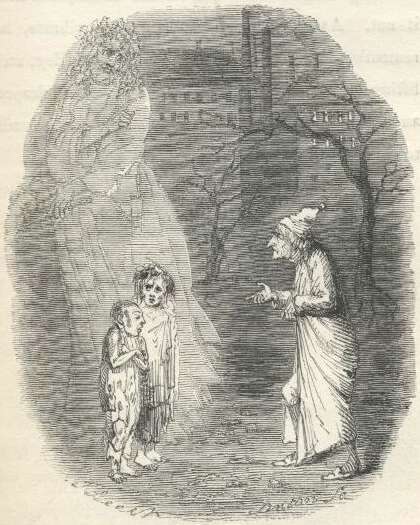
Scrooge started back, appalled. Having them shown to him in this way, he tried to say they were fine children, but the words choked themselves, rather than be parties to a lie of such enormous magnitude.
Scrooge recoiled in horror. Seeing the children presented this way, he tried to say they were fine children. But the words choked themselves rather than take part in such an enormous lie.
“Spirit! are they yours?” Scrooge could say no more.
“Spirit! Are they yours?” Scrooge could say nothing more.
“They are Man’s,” said the Spirit, looking down upon them. “And they cling to me, appealing from their fathers. This boy is Ignorance. This girl is Want. Beware them both, and all of their degree, but most of all beware this boy, for on his brow I see that written which is Doom, unless the writing be erased. Deny it!” cried the Spirit, stretching out its hand towards the city. “Slander those who tell it ye! Admit it for your factious purposes, and make it worse. And bide the end!”
“They belong to mankind,” said the Spirit, looking down at them. “And they cling to me, pleading against their fathers. This boy is Ignorance. This girl is Want. Beware them both, and all like them. But most of all, beware this boy. For on his forehead I see Doom written, unless the writing is erased. Deny it!” cried the Spirit, stretching out its hand toward the city. “Slander those who tell you of it! Admit it for your own political purposes, and make it worse. And wait for the end!”
“Have they no refuge or resource?” cried Scrooge.
“Is there nowhere they can go for shelter or help?” cried Scrooge.
“Are there no prisons?” said the Spirit, turning on him for the last time with his own words. “Are there no workhouses?”
“Are there no prisons?” said the Spirit, using Scrooge’s own words against him one last time. “Are there no workhouses?”
The bell struck twelve.
The bell struck twelve.
Scrooge looked about him for the Ghost, and saw it not. As the last stroke ceased to vibrate, he remembered the prediction of old Jacob Marley, and lifting up his eyes, beheld a solemn Phantom, draped and hooded, coming, like a mist along the ground, towards him.
Scrooge looked around for the Ghost but did not see it. As the last stroke faded, he remembered old Jacob Marley’s prediction. He looked up and saw a solemn Phantom, draped and hooded, coming toward him like mist along the ground.