Stave One
Marley's Ghost
Marley was dead: to begin with. There is no doubt whatever about that. The register of his burial was signed by the clergyman, the clerk, the undertaker, and the chief mourner. Scrooge signed it: and Scrooge’s name was good upon ’Change, for anything he chose to put his hand to. Old Marley was as dead as a door-nail.
To begin with, Marley was dead. There is no doubt about it. The burial register was signed by the clergyman, the clerk, the undertaker, and the chief mourner. Scrooge signed it. His signature was trusted on the stock exchange for anything he chose to sign. Old Marley was as dead as a doornail.
Mind! I don’t mean to say that I know, of my own knowledge, what there is particularly dead about a door-nail. I might have been inclined, myself, to regard a coffin-nail as the deadest piece of ironmongery in the trade. But the wisdom of our ancestors is in the simile; and my unhallowed hands shall not disturb it, or the Country’s done for. You will therefore permit me to repeat, emphatically, that Marley was as dead as a door-nail.
Mind you, I don’t mean that I know from personal experience what makes a door-nail particularly dead. I might have thought a coffin-nail was the deadest piece of ironware in the trade. But the comparison contains the wisdom of our ancestors. My unholy hands will not disturb it, or the country is done for. So please allow me to repeat, emphatically, that Marley was as dead as a door-nail.
Scrooge knew he was dead? Of course he did. How could it be otherwise? Scrooge and he were partners for I don’t know how many years. Scrooge was his sole executor, his sole administrator, his sole assign, his sole residuary legatee, his sole friend, and sole mourner. And even Scrooge was not so dreadfully cut up by the sad event, but that he was an excellent man of business on the very day of the funeral, and solemnised it with an undoubted bargain.
Did Scrooge know he was dead? Of course he did. How could it be otherwise? Scrooge and he had been partners for I don’t know how many years. Scrooge was his only executor, administrator, assignee, residuary beneficiary, friend, and mourner. Even so, Scrooge was not so terribly upset by the sad event that he neglected business. On the very day of the funeral, he proved himself an excellent businessman and marked the occasion with a genuine bargain.
The mention of Marley’s funeral brings me back to the point I started from. There is no doubt that Marley was dead. This must be distinctly understood, or nothing wonderful can come of the story I am going to relate. If we were not perfectly convinced that Hamlet’s Father died before the play began, there would be nothing more remarkable in his taking a stroll at night, in an easterly wind, upon his own ramparts, than there would be in any other middle-aged gentleman rashly turning out after dark in a breezy spot—say Saint Paul’s Churchyard for instance—literally to astonish his son’s weak mind.
The mention of Marley’s funeral brings me back to where I started. There is no doubt that Marley was dead. You must understand this clearly, or nothing wonderful can come of the story I am about to tell. We must be completely convinced that Hamlet’s Father died before the play began. Otherwise, his nighttime stroll on his own ramparts in an east wind would be no more remarkable than any other middle-aged gentleman rashly going out after dark in a windy place. Take Saint Paul’s Churchyard, for example, where he might go simply to astonish his son’s weak mind.
Scrooge never painted out Old Marley’s name. There it stood, years afterwards, above the warehouse door: Scrooge and Marley. The firm was known as Scrooge and Marley. Sometimes people new to the business called Scrooge Scrooge, and sometimes Marley, but he answered to both names. It was all the same to him.
Scrooge never painted over Old Marley’s name. Years later, it was still above the warehouse door: Scrooge and Marley. The firm was known as Scrooge and Marley. People new to the business sometimes called Scrooge by his own name and sometimes called him Marley. He answered to both names. It made no difference to him.
Oh! But he was a tight-fisted hand at the grindstone, Scrooge! a squeezing, wrenching, grasping, scraping, clutching, covetous, old sinner! Hard and sharp as flint, from which no steel had ever struck out generous fire; secret, and self-contained, and solitary as an oyster. The cold within him froze his old features, nipped his pointed nose, shrivelled his cheek, stiffened his gait; made his eyes red, his thin lips blue; and spoke out shrewdly in his grating voice. A frosty rime was on his head, and on his eyebrows, and his wiry chin. He carried his own low temperature always about with him; he iced his office in the dog-days; and didn’t thaw it one degree at Christmas.
Oh, but Scrooge was a tight-fisted man who kept others hard at work! He was a squeezing, wrenching, grasping, scraping, clutching, greedy old sinner! He was as hard and sharp as flint, from which no steel had ever struck a generous spark. He was as secretive, self-contained, and solitary as an oyster. The cold inside him froze his old features. It pinched his pointed nose, shriveled his cheek, and stiffened his walk. It made his eyes red and his thin lips blue. It spoke sharply in his grating voice. Frost covered his head, eyebrows, and wiry chin. He always carried his own cold with him. He froze his office in the hottest days of summer and didn’t warm it one degree at Christmas.
External heat and cold had little influence on Scrooge. No warmth could warm, no wintry weather chill him. No wind that blew was bitterer than he, no falling snow was more intent upon its purpose, no pelting rain less open to entreaty. Foul weather didn’t know where to have him. The heaviest rain, and snow, and hail, and sleet, could boast of the advantage over him in only one respect. They often “came down” handsomely, and Scrooge never did.
Heat and cold had little effect on Scrooge. No warmth could warm him, and no winter weather could chill him. No wind was more bitter than he was. No falling snow was more determined to do its work. No driving rain was less willing to listen to a plea. Bad weather could not get the better of him. Even the heaviest rain, snow, hail, and sleet had only one advantage over him. They often “came down” generously, but Scrooge never gave generously.
Nobody ever stopped him in the street to say, with gladsome looks, “My dear Scrooge, how are you? When will you come to see me?” No beggars implored him to bestow a trifle, no children asked him what it was o’clock, no man or woman ever once in all his life inquired the way to such and such a place, of Scrooge. Even the blind men’s dogs appeared to know him; and when they saw him coming on, would tug their owners into doorways and up courts; and then would wag their tails as though they said, “No eye at all is better than an evil eye, dark master!”
Nobody ever stopped Scrooge in the street and said cheerfully, “My dear Scrooge, how are you? When will you come to see me?” No beggars begged him for a little money. No children asked him the time. No man or woman had ever asked Scrooge for directions in his entire life. Even blind men’s dogs seemed to know him. When they saw him coming, they would pull their owners into doorways and down alleys. Then they would wag their tails as if to say, “No eyes at all are better than an evil eye, master who lives in darkness!”
But what did Scrooge care! It was the very thing he liked. To edge his way along the crowded paths of life, warning all human sympathy to keep its distance, was what the knowing ones call “nuts” to Scrooge.
But what did Scrooge care! It was exactly what he liked. He loved edging his way along life's crowded paths, warning all human sympathy to keep its distance. The people in the know would call that “nuts” to Scrooge.
Once upon a time—of all the good days in the year, on Christmas Eve—old Scrooge sat busy in his counting-house. It was cold, bleak, biting weather: foggy withal: and he could hear the people in the court outside, go wheezing up and down, beating their hands upon their breasts, and stamping their feet upon the pavement stones to warm them. The city clocks had only just gone three, but it was quite dark already—it had not been light all day—and candles were flaring in the windows of the neighbouring offices, like ruddy smears upon the palpable brown air. The fog came pouring in at every chink and keyhole, and was so dense without, that although the court was of the narrowest, the houses opposite were mere phantoms. To see the dingy cloud come drooping down, obscuring everything, one might have thought that Nature lived hard by, and was brewing on a large scale.
Once upon a time, on Christmas Eve, of all the good days in the year, old Scrooge sat working in his counting-house. The weather was cold, bleak, biting, and foggy. He could hear people wheezing as they walked up and down the courtyard outside. They beat their hands against their chests and stamped their feet on the paving stones to warm them. The city clocks had only just struck three, but it was already quite dark. It had not been light all day. Candles flared in the windows of the nearby offices, like reddish smears on the thick brown air. Fog poured in through every crack and keyhole. It was so dense outside that, although the courtyard was very narrow, the houses opposite looked like ghosts. Seeing the dirty cloud hanging low and hiding everything, you might have thought Nature lived nearby and was brewing on a grand scale.
The door of Scrooge’s counting-house was open that he might keep his eye upon his clerk, who in a dismal little cell beyond, a sort of tank, was copying letters. Scrooge had a very small fire, but the clerk’s fire was so very much smaller that it looked like one coal. But he couldn’t replenish it, for Scrooge kept the coal-box in his own room; and so surely as the clerk came in with the shovel, the master predicted that it would be necessary for them to part. Wherefore the clerk put on his white comforter, and tried to warm himself at the candle; in which effort, not being a man of a strong imagination, he failed.
Scrooge kept the door of his counting-house open so he could watch his clerk. The clerk was copying letters in a gloomy little cell beyond, which was rather like a tank. Scrooge had a very small fire, but the clerk’s fire was so much smaller that it looked like a single coal. The clerk couldn’t add more coal, because Scrooge kept the coal box in his own room. Whenever the clerk came in with the shovel, Scrooge warned that they would have to part ways. So the clerk put on his white scarf and tried to warm himself at the candle. But he was not a man with a strong imagination, and the attempt failed.
“A merry Christmas, uncle! God save you!” cried a cheerful voice. It was the voice of Scrooge’s nephew, who came upon him so quickly that this was the first intimation he had of his approach.
“A merry Christmas, uncle! God bless you!” cried a cheerful voice. It was Scrooge’s nephew. He had approached so quickly that Scrooge had no warning until he heard his voice.
“Bah!” said Scrooge, “Humbug!”
“Bah!” said Scrooge. “Nonsense!”
He had so heated himself with rapid walking in the fog and frost, this nephew of Scrooge’s, that he was all in a glow; his face was ruddy and handsome; his eyes sparkled, and his breath smoked again.
Scrooge’s nephew had walked so quickly through the fog and frost that he was glowing with warmth. His face was rosy and handsome, his eyes sparkled, and his breath steamed in the cold.
“Christmas a humbug, uncle!” said Scrooge’s nephew. “You don’t mean that, I am sure?”
“Christmas is nonsense, uncle!” said Scrooge’s nephew. “I’m sure you don’t mean that?”
“I do,” said Scrooge. “Merry Christmas! What right have you to be merry? What reason have you to be merry? You’re poor enough.”
“I do,” said Scrooge. “Merry Christmas! What right do you have to be merry? What reason do you have to be merry? You’re poor enough.”
“Come, then,” returned the nephew gaily. “What right have you to be dismal? What reason have you to be morose? You’re rich enough.”
“Come on, then,” the nephew replied cheerfully. “What right do you have to be miserable? What reason do you have to be gloomy? You’re rich enough.”
Scrooge having no better answer ready on the spur of the moment, said, “Bah!” again; and followed it up with “Humbug.”
Scrooge couldn’t think of a better answer right away, so he said “Bah!” again. Then he added, “Humbug.”
“Don’t be cross, uncle!” said the nephew.
“Don’t be angry, uncle!” said the nephew.
“What else can I be,” returned the uncle, “when I live in such a world of fools as this? Merry Christmas! Out upon merry Christmas! What’s Christmas time to you but a time for paying bills without money; a time for finding yourself a year older, but not an hour richer; a time for balancing your books and having every item in ’em through a round dozen of months presented dead against you? If I could work my will,” said Scrooge indignantly, “every idiot who goes about with ‘Merry Christmas’ on his lips, should be boiled with his own pudding, and buried with a stake of holly through his heart. He should!”
“What else can I be,” replied the uncle, “when I live in a world full of fools? Merry Christmas! To hell with merry Christmas! What is Christmas to you but a time to pay bills when you have no money? A time to find yourself a year older, but not an hour richer? A time to balance your books and find every entry for the past twelve months showing a loss? If I had my way,” Scrooge said indignantly, “every idiot who goes around saying ‘Merry Christmas’ would be boiled with his own pudding. Then he would be buried with a stake of holly through his heart. He would!”
“Uncle!” pleaded the nephew.
“Uncle!” pleaded the nephew.
“Nephew!” returned the uncle sternly, “keep Christmas in your own way, and let me keep it in mine.”
“Nephew!” the uncle replied sternly. “Celebrate Christmas your way, and let me celebrate it mine.”
“Keep it!” repeated Scrooge’s nephew. “But you don’t keep it.”
“Keep it!” Scrooge’s nephew repeated. “But you don’t keep it.”
“Let me leave it alone, then,” said Scrooge. “Much good may it do you! Much good it has ever done you!”
“Then I’ll leave it alone,” said Scrooge. “I hope it does you good! It certainly has done you a lot of good so far!”
“There are many things from which I might have derived good, by which I have not profited, I dare say,” returned the nephew. “Christmas among the rest. But I am sure I have always thought of Christmas time, when it has come round—apart from the veneration due to its sacred name and origin, if anything belonging to it can be apart from that—as a good time; a kind, forgiving, charitable, pleasant time; the only time I know of, in the long calendar of the year, when men and women seem by one consent to open their shut-up hearts freely, and to think of people below them as if they really were fellow-passengers to the grave, and not another race of creatures bound on other journeys. And therefore, uncle, though it has never put a scrap of gold or silver in my pocket, I believe that it has done me good, and will do me good; and I say, God bless it!”
“There are many things that might have done me good, but from which I have gained nothing, I suppose,” replied the nephew. “Christmas is one of them. But whenever Christmas comes around, I have always thought of it as a good time. I say that apart from the reverence due to its sacred name and origin. That is, if anything about Christmas can be separated from that reverence. Christmas is a kind, forgiving, charitable, pleasant time. It is the only time I know of in the whole year when men and women seem to agree to open their closed hearts freely. They seem to think of people below them as fellow travelers on the way to the grave, not as another race of creatures traveling somewhere else. And so, uncle, although Christmas has never put a scrap of gold or silver in my pocket, I believe it has done me good and will do me good. And I say, God bless it!”
The clerk in the Tank involuntarily applauded. Becoming immediately sensible of the impropriety, he poked the fire, and extinguished the last frail spark for ever.
The clerk in the Tank applauded without thinking. Realizing at once that this was improper, he poked the fire and put out its last faint spark forever.
“Let me hear another sound from you,” said Scrooge, “and you’ll keep your Christmas by losing your situation! You’re quite a powerful speaker, sir,” he added, turning to his nephew. “I wonder you don’t go into Parliament.”
“Let me hear another sound from you,” said Scrooge, “and you’ll spend Christmas out of a job! You’re quite a speaker, sir,” he added, turning to his nephew. “I’m surprised you don’t go into Parliament.”
“Don’t be angry, uncle. Come! Dine with us to-morrow.”
“Don’t be angry, uncle. Come! Have dinner with us tomorrow.”
Scrooge said that he would see him—yes, indeed he did. He went the whole length of the expression, and said that he would see him in that extremity first.
Scrooge said he would see him first. Yes, he really did. He used the full expression and said he would see him in that terrible place first.
“But why?” cried Scrooge’s nephew. “Why?”
“But why?” Scrooge’s nephew cried. “Why?”
“Why did you get married?” said Scrooge.
“Why did you get married?” said Scrooge.
“Because I fell in love.”
“Because I fell in love.”
“Because you fell in love!” growled Scrooge, as if that were the only one thing in the world more ridiculous than a merry Christmas. “Good afternoon!”
“Because you fell in love!” growled Scrooge, as if falling in love were the only thing more ridiculous than a merry Christmas. “Good afternoon!”
“Nay, uncle, but you never came to see me before that happened. Why give it as a reason for not coming now?”
“No, uncle, but you never came to see me before that happened. Why use it as a reason not to come now?”
“Good afternoon,” said Scrooge.
“Good afternoon,” said Scrooge.
“I want nothing from you; I ask nothing of you; why cannot we be friends?”
“I want nothing from you. I ask nothing of you. Why can’t we be friends?”
“Good afternoon,” said Scrooge.
“Good afternoon,” said Scrooge.
“I am sorry, with all my heart, to find you so resolute. We have never had any quarrel, to which I have been a party. But I have made the trial in homage to Christmas, and I’ll keep my Christmas humour to the last. So A Merry Christmas, uncle!”
“I am sorry with all my heart that you are so determined. I have never taken part in any quarrel between us. But I tried for the sake of Christmas, and I’ll keep my Christmas spirit to the end. So, Merry Christmas, uncle!”
“Good afternoon!” said Scrooge.
“Good afternoon!” said Scrooge.
“And A Happy New Year!”
“And a happy New Year!”
“Good afternoon!” said Scrooge.
“Good afternoon!” said Scrooge.
His nephew left the room without an angry word, notwithstanding. He stopped at the outer door to bestow the greetings of the season on the clerk, who, cold as he was, was warmer than Scrooge; for he returned them cordially.
Even so, his nephew left the room without an angry word. At the outer door, he stopped to wish the clerk a merry Christmas. Cold as the clerk was, he was warmer than Scrooge, for he returned the greeting warmly.
“There’s another fellow,” muttered Scrooge; who overheard him: “my clerk, with fifteen shillings a week, and a wife and family, talking about a merry Christmas. I’ll retire to Bedlam.”
“There’s another one,” muttered Scrooge, who had overheard him. “My clerk earns fifteen shillings a week and has a wife and family, yet he talks about a merry Christmas. I’ll retire to Bedlam.”
This lunatic, in letting Scrooge’s nephew out, had let two other people in. They were portly gentlemen, pleasant to behold, and now stood, with their hats off, in Scrooge’s office. They had books and papers in their hands, and bowed to him.
This lunatic had let two other people in while letting Scrooge’s nephew out. They were plump, pleasant-looking gentlemen, and they now stood in Scrooge’s office with their hats off. They held books and papers in their hands and bowed to him.
“Scrooge and Marley’s, I believe,” said one of the gentlemen, referring to his list. “Have I the pleasure of addressing Mr. Scrooge, or Mr. Marley?”
“Scrooge and Marley’s, I believe,” said one of the gentlemen, checking his list. “Am I speaking to Mr. Scrooge or Mr. Marley?”
“Mr. Marley has been dead these seven years,” Scrooge replied. “He died seven years ago, this very night.”
“Mr. Marley has been dead for seven years,” Scrooge replied. “He died seven years ago tonight.”
“We have no doubt his liberality is well represented by his surviving partner,” said the gentleman, presenting his credentials.
“We have no doubt that his surviving partner is just as generous,” said the gentleman, showing his credentials.
It certainly was; for they had been two kindred spirits. At the ominous word “liberality,” Scrooge frowned, and shook his head, and handed the credentials back.
It certainly was, because they were two people of the same spirit. At the ominous word “generosity,” Scrooge frowned, shook his head, and handed back the credentials.
“At this festive season of the year, Mr. Scrooge,” said the gentleman, taking up a pen, “it is more than usually desirable that we should make some slight provision for the Poor and destitute, who suffer greatly at the present time. Many thousands are in want of common necessaries; hundreds of thousands are in want of common comforts, sir.”
“At this festive time of year, Mr. Scrooge,” said the gentleman, picking up a pen, “it is especially important to make some small provision for the poor and destitute, who are suffering greatly right now. Many thousands lack basic necessities. Hundreds of thousands lack basic comforts, sir.”
“Are there no prisons?” asked Scrooge.
“Are there no prisons?” asked Scrooge.
“Plenty of prisons,” said the gentleman, laying down the pen again.
“Plenty of prisons,” said the gentleman, putting down the pen again.
“And the Union workhouses?” demanded Scrooge. “Are they still in operation?”
“And the Union workhouses?” Scrooge demanded. “Are they still open?”
“They are. Still,” returned the gentleman, “I wish I could say they were not.”
“They are. Still,” the gentleman replied, “I wish I could say they weren’t.”
“The Treadmill and the Poor Law are in full vigour, then?” said Scrooge.
“So the Treadmill and the Poor Law are still in full force?” said Scrooge.
“Both very busy, sir.”
“Both very busy, sir.”
“Oh! I was afraid, from what you said at first, that something had occurred to stop them in their useful course,” said Scrooge. “I’m very glad to hear it.”
“Oh! From what you said at first, I was afraid something had stopped them from doing their useful work,” said Scrooge. “I’m very glad to hear it.”
“Under the impression that they scarcely furnish Christian cheer of mind or body to the multitude,” returned the gentleman, “a few of us are endeavouring to raise a fund to buy the Poor some meat and drink, and means of warmth. We choose this time, because it is a time, of all others, when Want is keenly felt, and Abundance rejoices. What shall I put you down for?”
“Since we believe they provide little Christian comfort for the minds or bodies of the many people in need,” replied the gentleman, “a few of us are trying to raise money to buy the poor food, drink, and warmth. We choose this time because, more than any other, it is when poverty is keenly felt and abundance rejoices. How much shall I put you down for?”
“Nothing!” Scrooge replied.
“Nothing!” Scrooge replied.
“You wish to be anonymous?”
“Do you want to remain anonymous?”
“I wish to be left alone,” said Scrooge. “Since you ask me what I wish, gentlemen, that is my answer. I don’t make merry myself at Christmas and I can’t afford to make idle people merry. I help to support the establishments I have mentioned—they cost enough; and those who are badly off must go there.”
“I want to be left alone,” said Scrooge. “Since you ask what I want, gentlemen, that is my answer. I don’t celebrate Christmas myself, and I can’t afford to make idle people happy. I help support the institutions I mentioned. They cost enough, and those who are poor must go there.”
“Many can’t go there; and many would rather die.”
“Many can’t go there, and many would rather die.”
“If they would rather die,” said Scrooge, “they had better do it, and decrease the surplus population. Besides—excuse me—I don’t know that.”
“If they would rather die,” said Scrooge, “they should do it and reduce the surplus population. Besides, excuse me, I don’t know that.”
“But you might know it,” observed the gentleman.
“But you might know it,” the gentleman said.
“It’s not my business,” Scrooge returned. “It’s enough for a man to understand his own business, and not to interfere with other people’s. Mine occupies me constantly. Good afternoon, gentlemen!”
“That’s not my business,” Scrooge replied. “It’s enough for a man to understand his own business and not interfere in other people’s affairs. My own business keeps me busy all the time. Good afternoon, gentlemen!”
Seeing clearly that it would be useless to pursue their point, the gentlemen withdrew. Scrooge resumed his labours with an improved opinion of himself, and in a more facetious temper than was usual with him.
The gentlemen saw clearly that there was no use pressing their point, so they left. Scrooge went back to work, feeling better about himself and more playful than usual.
Meanwhile the fog and darkness thickened so, that people ran about with flaring links, proffering their services to go before horses in carriages, and conduct them on their way. The ancient tower of a church, whose gruff old bell was always peeping slily down at Scrooge out of a Gothic window in the wall, became invisible, and struck the hours and quarters in the clouds, with tremulous vibrations afterwards as if its teeth were chattering in its frozen head up there. The cold became intense. In the main street, at the corner of the court, some labourers were repairing the gas-pipes, and had lighted a great fire in a brazier, round which a party of ragged men and boys were gathered: warming their hands and winking their eyes before the blaze in rapture. The water-plug being left in solitude, its overflowings sullenly congealed, and turned to misanthropic ice. The brightness of the shops where holly sprigs and berries crackled in the lamp heat of the windows, made pale faces ruddy as they passed. Poulterers’ and grocers’ trades became a splendid joke: a glorious pageant, with which it was next to impossible to believe that such dull principles as bargain and sale had anything to do. The Lord Mayor, in the stronghold of the mighty Mansion House, gave orders to his fifty cooks and butlers to keep Christmas as a Lord Mayor’s household should; and even the little tailor, whom he had fined five shillings on the previous Monday for being drunk and bloodthirsty in the streets, stirred up to-morrow’s pudding in his garret, while his lean wife and the baby sallied out to buy the beef.
Meanwhile, the fog and darkness grew thicker. People ran about with blazing torches, offering to lead carriage horses safely along their way. The old church tower disappeared from sight. Its gruff old bell had always peered slyly down at Scrooge from a Gothic window in the wall. Now it struck the hours and quarter hours in the clouds. Its trembling echoes sounded as if its teeth were chattering in its frozen head up there. The cold became intense. In the main street, at the corner of the court, some laborers were repairing the gas pipes. They had lit a great fire in a brazier. A group of ragged men and boys gathered around it, warming their hands and blinking happily in the blaze. The water plug stood unattended, and its overflowing water froze sullenly into ice that seemed to hate everyone. The bright shop windows made passing pale faces look rosy. Sprigs of holly and their berries crackled in the heat of the window lamps. The poultry sellers’ and grocers’ businesses became a splendid joke, a glorious spectacle. It was almost impossible to believe that anything so dull as buying and selling had anything to do with them. In the stronghold of the mighty Mansion House, the Lord Mayor gave orders to his fifty cooks and butlers. They were to keep Christmas as a Lord Mayor’s household should. The previous Monday, he had fined a little tailor five shillings for being drunk and bloodthirsty in the streets. Even the tailor was stirring up tomorrow’s pudding in his attic room, while his thin wife and the baby went out to buy the beef.
Foggier yet, and colder. Piercing, searching, biting cold. If the good Saint Dunstan had but nipped the Evil Spirit’s nose with a touch of such weather as that, instead of using his familiar weapons, then indeed he would have roared to lusty purpose. The owner of one scant young nose, gnawed and mumbled by the hungry cold as bones are gnawed by dogs, stooped down at Scrooge’s keyhole to regale him with a Christmas carol: but at the first sound of
It grew foggier and colder still. The cold pierced, probed, and bit. If good Saint Dunstan had pinched the Evil Spirit’s nose with weather like that, instead of using his usual weapons, the Evil Spirit would have roared with real force. One small young nose had been chewed and gnawed by the hungry cold, as dogs gnaw bones. Its owner bent down to Scrooge’s keyhole to treat him to a Christmas carol. But at the first sound of
| “God bless you, merry gentleman! May nothing you dismay!” |
Scrooge seized the ruler with such energy of action, that the singer fled in terror, leaving the keyhole to the fog and even more congenial frost.
Scrooge grabbed the ruler so fiercely that the singer fled in terror. He left the keyhole to the fog and the even more welcoming frost.
At length the hour of shutting up the counting-house arrived. With an ill-will Scrooge dismounted from his stool, and tacitly admitted the fact to the expectant clerk in the Tank, who instantly snuffed his candle out, and put on his hat.
At last, it was time to close the counting-house. Scrooge reluctantly climbed down from his stool, silently acknowledging the time to the waiting clerk in the Tank. The clerk immediately put out his candle and put on his hat.
“You’ll want all day to-morrow, I suppose?” said Scrooge.
“You’ll want all day off tomorrow, I suppose?” said Scrooge.
“If quite convenient, sir.”
“If it's convenient, sir.”
“It’s not convenient,” said Scrooge, “and it’s not fair. If I was to stop half-a-crown for it, you’d think yourself ill-used, I’ll be bound?”
“It’s inconvenient,” said Scrooge, “and it’s not fair. If I deducted half a crown for it, I bet you’d think I’d treated you unfairly.”
The clerk smiled faintly.
The clerk smiled faintly.
“And yet,” said Scrooge, “you don’t think me ill-used, when I pay a day’s wages for no work.”
“And yet,” said Scrooge, “you don’t think I’m treated unfairly when I pay a day’s wages for no work.”
The clerk observed that it was only once a year.
The clerk pointed out that it was only once a year.
“A poor excuse for picking a man’s pocket every twenty-fifth of December!” said Scrooge, buttoning his great-coat to the chin. “But I suppose you must have the whole day. Be here all the earlier next morning.”
“A poor excuse for picking a man’s pocket every December 25!” said Scrooge, buttoning his overcoat up to his chin. “But I suppose you must have the whole day off. Be here even earlier the next morning.”
The clerk promised that he would; and Scrooge walked out with a growl. The office was closed in a twinkling, and the clerk, with the long ends of his white comforter dangling below his waist (for he boasted no great-coat), went down a slide on Cornhill, at the end of a lane of boys, twenty times, in honour of its being Christmas Eve, and then ran home to Camden Town as hard as he could pelt, to play at blindman’s-buff.
The clerk promised he would, and Scrooge walked out with a growl. The office was closed in no time. The clerk had no overcoat, and the long ends of his white scarf hung below his waist. He joined a line of boys sliding on Cornhill and went down the slide twenty times in honor of Christmas Eve. Then he ran home to Camden Town as fast as he could, to play blindman’s-buff.
Scrooge took his melancholy dinner in his usual melancholy tavern; and having read all the newspapers, and beguiled the rest of the evening with his banker’s-book, went home to bed. He lived in chambers which had once belonged to his deceased partner. They were a gloomy suite of rooms, in a lowering pile of building up a yard, where it had so little business to be, that one could scarcely help fancying it must have run there when it was a young house, playing at hide-and-seek with other houses, and forgotten the way out again. It was old enough now, and dreary enough, for nobody lived in it but Scrooge, the other rooms being all let out as offices. The yard was so dark that even Scrooge, who knew its every stone, was fain to grope with his hands. The fog and frost so hung about the black old gateway of the house, that it seemed as if the Genius of the Weather sat in mournful meditation on the threshold.
Scrooge ate his gloomy dinner at his usual gloomy tavern. He read all the newspapers and passed the rest of the evening looking over his bank book. Then he went home to bed. He lived in rooms that had once belonged to his dead partner. They were a gloomy set of rooms in a forbidding building at the end of a yard. The building seemed so out of place there that you could almost imagine it had run into the yard when it was young, playing hide-and-seek with other houses, and forgotten the way out. The building was old and dreary enough now. Nobody lived there but Scrooge, and all the other rooms were rented out as offices. The yard was so dark that even Scrooge, who knew every stone, had to feel his way with his hands. Fog and frost hung so thickly around the house’s black old gateway that the Genius of the Weather seemed to be sitting on the threshold, lost in mournful thought.
Now, it is a fact, that there was nothing at all particular about the knocker on the door, except that it was very large. It is also a fact, that Scrooge had seen it, night and morning, during his whole residence in that place; also that Scrooge had as little of what is called fancy about him as any man in the city of London, even including—which is a bold word—the corporation, aldermen, and livery. Let it also be borne in mind that Scrooge had not bestowed one thought on Marley, since his last mention of his seven years’ dead partner that afternoon. And then let any man explain to me, if he can, how it happened that Scrooge, having his key in the lock of the door, saw in the knocker, without its undergoing any intermediate process of change—not a knocker, but Marley’s face.
Now, the fact is that there was nothing at all unusual about the door knocker, except that it was very large. It is also a fact that Scrooge had seen the knocker night and morning throughout the time he had lived there. And Scrooge had as little imagination as any man in London. That even included the city corporation, its aldermen, and its livery members, though that is a bold claim. Remember, too, that Scrooge had not given Marley a single thought since mentioning his partner that afternoon. Marley had been dead for seven years. With all that in mind, let anyone explain to me, if they can, how this happened. Scrooge had his key in the door lock when he saw something in the knocker. Without any change in between, it was not a knocker but Marley’s face.
Marley’s face. It was not in impenetrable shadow as the other objects in the yard were, but had a dismal light about it, like a bad lobster in a dark cellar. It was not angry or ferocious, but looked at Scrooge as Marley used to look: with ghostly spectacles turned up on its ghostly forehead. The hair was curiously stirred, as if by breath or hot air; and, though the eyes were wide open, they were perfectly motionless. That, and its livid colour, made it horrible; but its horror seemed to be in spite of the face and beyond its control, rather than a part of its own expression.
Marley’s face. It was not hidden in deep shadow like the other objects in the yard. Instead, it had a gloomy light around it, like a spoiled lobster in a dark cellar. It was not angry or fierce. It looked at Scrooge as Marley used to, with ghostly glasses pushed up on its ghostly forehead. The hair moved strangely, as if stirred by breath or hot air. And though the eyes were wide open, they were completely still. The stillness and the face’s pale, bluish color made it horrible. But the horror seemed to be there against the face’s will and beyond its control, rather than part of its expression.
As Scrooge looked fixedly at this phenomenon, it was a knocker again.
As Scrooge stared at the strange sight, it became a knocker again.
To say that he was not startled, or that his blood was not conscious of a terrible sensation to which it had been a stranger from infancy, would be untrue. But he put his hand upon the key he had relinquished, turned it sturdily, walked in, and lighted his candle.
It would be untrue to say he was not startled. He felt a terrible sensation in his blood that he had not known since infancy. But he took hold of the key he had let go, turned it firmly, walked in, and lit his candle.
He did pause, with a moment’s irresolution, before he shut the door; and he did look cautiously behind it first, as if he half expected to be terrified with the sight of Marley’s pigtail sticking out into the hall. But there was nothing on the back of the door, except the screws and nuts that held the knocker on, so he said “Pooh, pooh!” and closed it with a bang.
He did pause for a moment, unsure whether to close the door. And he did look carefully behind it first. He seemed to half expect the terrifying sight of Marley’s pigtail sticking out into the hall. But there was nothing behind the door except the screws and nuts holding the knocker on. So he said “Pooh, pooh!” and slammed the door shut.
The sound resounded through the house like thunder. Every room above, and every cask in the wine-merchant’s cellars below, appeared to have a separate peal of echoes of its own. Scrooge was not a man to be frightened by echoes. He fastened the door, and walked across the hall, and up the stairs; slowly too: trimming his candle as he went.
The sound echoed through the house like thunder. Every room upstairs seemed to have its own series of echoes. So did every cask in the wine merchant’s cellars below. Scrooge was not a man to be frightened by echoes. He fastened the door and walked across the hall and up the stairs. He walked slowly, trimming his candle as he went.
You may talk vaguely about driving a coach-and-six up a good old flight of stairs, or through a bad young Act of Parliament; but I mean to say you might have got a hearse up that staircase, and taken it broadwise, with the splinter-bar towards the wall and the door towards the balustrades: and done it easy. There was plenty of width for that, and room to spare; which is perhaps the reason why Scrooge thought he saw a locomotive hearse going on before him in the gloom. Half-a-dozen gas-lamps out of the street wouldn’t have lighted the entry too well, so you may suppose that it was pretty dark with Scrooge’s dip.
You may speak vaguely of driving a six-horse coach up a good old staircase, or through a bad new Act of Parliament. But I mean that you could have driven a hearse up this staircase sideways, quite easily. Its front crossbar could have faced the wall, and its door the railing. The staircase was wide enough for that, with room to spare. Perhaps that was why Scrooge thought he saw a hearse moving ahead of him in the gloom. Even half a dozen street gas lamps would not have lit the entry very well. So you can imagine how dark it was with Scrooge’s little candle.
Up Scrooge went, not caring a button for that. Darkness is cheap, and Scrooge liked it. But before he shut his heavy door, he walked through his rooms to see that all was right. He had just enough recollection of the face to desire to do that.
Scrooge went upstairs, not caring at all about that. Darkness is cheap, and Scrooge liked it. But before he shut his heavy door, he walked through his rooms to make sure all was right. He remembered the face just enough to want to check.
Sitting-room, bedroom, lumber-room. All as they should be. Nobody under the table, nobody under the sofa; a small fire in the grate; spoon and basin ready; and the little saucepan of gruel (Scrooge had a cold in his head) upon the hob. Nobody under the bed; nobody in the closet; nobody in his dressing-gown, which was hanging up in a suspicious attitude against the wall. Lumber-room as usual. Old fire-guard, old shoes, two fish-baskets, washing-stand on three legs, and a poker.
Sitting room, bedroom, storage room. Everything was as it should be. Nobody under the table, nobody under the sofa. A small fire burned in the fireplace. A spoon and bowl were ready. A small saucepan of gruel stood on the shelf beside the fire. Scrooge had a head cold. Nobody under the bed, nobody in the closet. Nobody in his dressing gown, which hung against the wall in a suspicious pose. The storage room was as usual. An old fireguard, old shoes, two fish baskets, a three-legged washstand, and a poker.
Quite satisfied, he closed his door, and locked himself in; double-locked himself in, which was not his custom. Thus secured against surprise, he took off his cravat; put on his dressing-gown and slippers, and his nightcap; and sat down before the fire to take his gruel.
Quite satisfied, he closed the door and locked himself in. He double-locked the door, which he did not usually do. Now safe from surprises, he took off his neckcloth. He put on his dressing gown, slippers, and nightcap, then sat down by the fire to eat his gruel.
It was a very low fire indeed; nothing on such a bitter night. He was obliged to sit close to it, and brood over it, before he could extract the least sensation of warmth from such a handful of fuel. The fireplace was an old one, built by some Dutch merchant long ago, and paved all round with quaint Dutch tiles, designed to illustrate the Scriptures. There were Cains and Abels, Pharaoh’s daughters; Queens of Sheba, Angelic messengers descending through the air on clouds like feather-beds, Abrahams, Belshazzars, Apostles putting off to sea in butter-boats, hundreds of figures to attract his thoughts; and yet that face of Marley, seven years dead, came like the ancient Prophet’s rod, and swallowed up the whole. If each smooth tile had been a blank at first, with power to shape some picture on its surface from the disjointed fragments of his thoughts, there would have been a copy of old Marley’s head on every one.
The fire was very small indeed, hardly enough on such a bitterly cold night. He had to sit close and hunch over it to feel even the slightest warmth from that handful of fuel. The fireplace was old, built long ago by a Dutch merchant. Quaint Dutch tiles surrounded it, with pictures illustrating the Scriptures. There were Cains and Abels, Pharaoh’s daughters, and Queens of Sheba. Angelic messengers came down through the air on clouds like feather-beds. There were Abrahams, Belshazzars, and Apostles setting out to sea in butter-boats. Hundreds of figures could have drawn his thoughts. Yet the face of Marley, dead for seven years, appeared like the ancient Prophet’s rod and swallowed them all. Suppose each smooth tile had been blank at first, but could form a picture from his scattered thoughts. Then every tile would have shown old Marley’s head.
“Humbug!” said Scrooge; and walked across the room.
“Nonsense!” said Scrooge, and walked across the room.
After several turns, he sat down again. As he threw his head back in the chair, his glance happened to rest upon a bell, a disused bell, that hung in the room, and communicated for some purpose now forgotten with a chamber in the highest story of the building. It was with great astonishment, and with a strange, inexplicable dread, that as he looked, he saw this bell begin to swing. It swung so softly in the outset that it scarcely made a sound; but soon it rang out loudly, and so did every bell in the house.
After walking back and forth several times, he sat down again. As he leaned his head back in the chair, his eyes happened to fall on an unused bell hanging in the room. It was connected to a room on the building’s top floor, for a purpose now forgotten. As he watched, the bell began to swing. He was astonished and felt a strange, inexplicable dread. At first, the bell swung so gently that it barely made a sound. But soon it rang loudly, along with every other bell in the house.
This might have lasted half a minute, or a minute, but it seemed an hour. The bells ceased as they had begun, together. They were succeeded by a clanking noise, deep down below; as if some person were dragging a heavy chain over the casks in the wine-merchant’s cellar. Scrooge then remembered to have heard that ghosts in haunted houses were described as dragging chains.
This might have lasted half a minute, or a minute, but it seemed like an hour. The bells stopped together, just as they had started. Then came a clanking noise from deep below. It sounded as if someone were dragging a heavy chain over the casks in the wine merchant’s cellar. Scrooge remembered hearing that ghosts in haunted houses were said to drag chains.
The cellar-door flew open with a booming sound, and then he heard the noise much louder, on the floors below; then coming up the stairs; then coming straight towards his door.
The cellar door flew open with a booming sound. Then he heard the noise much more loudly on the floors below. It came up the stairs, then straight toward his door.
“It’s humbug still!” said Scrooge. “I won’t believe it.”
“It’s still nonsense!” said Scrooge. “I won’t believe it.”
His colour changed though, when, without a pause, it came on through the heavy door, and passed into the room before his eyes. Upon its coming in, the dying flame leaped up, as though it cried, “I know him; Marley’s Ghost!” and fell again.
His face changed color, though, when it came straight through the heavy door and entered the room before his eyes. As it came in, the dying flame leaped up, as if crying, “I know him; Marley’s Ghost!” Then it sank again.
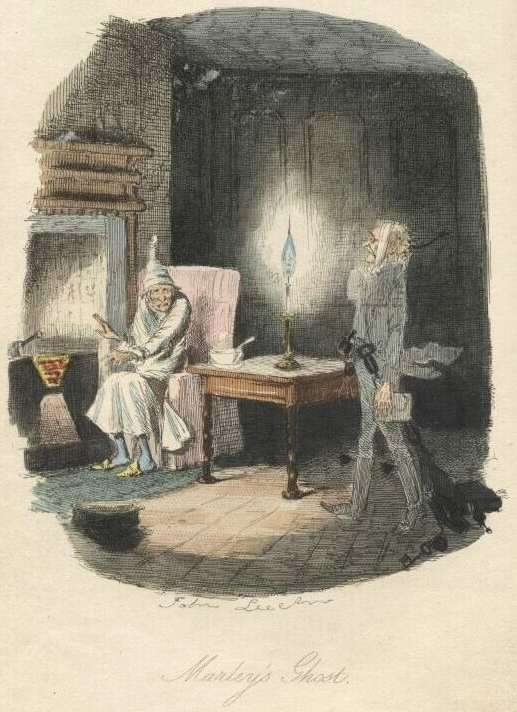
The same face: the very same. Marley in his pigtail, usual waistcoat, tights and boots; the tassels on the latter bristling, like his pigtail, and his coat-skirts, and the hair upon his head. The chain he drew was clasped about his middle. It was long, and wound about him like a tail; and it was made (for Scrooge observed it closely) of cash-boxes, keys, padlocks, ledgers, deeds, and heavy purses wrought in steel. His body was transparent; so that Scrooge, observing him, and looking through his waistcoat, could see the two buttons on his coat behind.
The same face, the very same. Marley wore his pigtail, usual waistcoat, tights, and boots. The tassels on his boots bristled, as did his pigtail, his coat tails, and the hair on his head. The chain he dragged was fastened around his waist. It was long and wound around him like a tail. Scrooge looked closely at the chain. It was made of cash boxes, keys, padlocks, account books, deeds, and heavy steel purses. Marley’s body was transparent. Scrooge could look through his waistcoat and see the two buttons on the back of his coat.
Scrooge had often heard it said that Marley had no bowels, but he had never believed it until now.
Scrooge had often heard people say that Marley had no heart, but he had never believed them until now.
No, nor did he believe it even now. Though he looked the phantom through and through, and saw it standing before him; though he felt the chilling influence of its death-cold eyes; and marked the very texture of the folded kerchief bound about its head and chin, which wrapper he had not observed before; he was still incredulous, and fought against his senses.
No, he still did not believe it. He looked the phantom over and saw it standing before him. He felt the chill of its death-cold eyes. He even noticed the texture of the folded cloth tied around its head and chin, which he had not seen before. Yet he still refused to believe, fighting against the evidence of his senses.
“How now!” said Scrooge, caustic and cold as ever. “What do you want with me?”
“What is it?” said Scrooge, as sharp and cold as ever. “What do you want with me?”
“Much!”—Marley’s voice, no doubt about it.
“Much!” There was no doubt that it was Marley’s voice.
“Who are you?”
“Who are you?”
“Ask me who I was.”
“Ask me who I was.”
“Who were you then?” said Scrooge, raising his voice. “You’re particular, for a shade.” He was going to say “to a shade,” but substituted this, as more appropriate.
“Who were you then?” Scrooge said, raising his voice. “You’re particular, for a ghost.” He had been going to say “to a shade,” but chose “for a ghost” as more appropriate.
“In life I was your partner, Jacob Marley.”
“When I was alive, I was your partner, Jacob Marley.”
“Can you—can you sit down?” asked Scrooge, looking doubtfully at him.
“Can you, can you sit down?” Scrooge asked, looking at him uncertainly.
“I can.”
“I can.”
“Do it, then.”
“Do it, then.”
Scrooge asked the question, because he didn’t know whether a ghost so transparent might find himself in a condition to take a chair; and felt that in the event of its being impossible, it might involve the necessity of an embarrassing explanation. But the ghost sat down on the opposite side of the fireplace, as if he were quite used to it.
Scrooge asked because he didn’t know whether a ghost so transparent could sit in a chair. He thought that if the ghost couldn’t, an embarrassing explanation might be necessary. But the ghost sat down on the opposite side of the fireplace, as if he were quite used to it.
“You don’t believe in me,” observed the Ghost.
“You don’t believe in me,” said the Ghost.
“I don’t,” said Scrooge.
“I don’t,” said Scrooge.
“What evidence would you have of my reality beyond that of your senses?”
“What proof would you need that I am real, beyond what your senses tell you?”
“I don’t know,” said Scrooge.
“I don’t know,” said Scrooge.
“Why do you doubt your senses?”
“Why don't you trust your senses?”
“Because,” said Scrooge, “a little thing affects them. A slight disorder of the stomach makes them cheats. You may be an undigested bit of beef, a blot of mustard, a crumb of cheese, a fragment of an underdone potato. There’s more of gravy than of grave about you, whatever you are!”
“Because,” said Scrooge, “a little thing affects them. A slight stomach upset makes them deceive us. You may be an undigested bit of beef, a dab of mustard, a crumb of cheese, or a piece of undercooked potato. There’s more of gravy than of grave about you, whatever you are!”
Scrooge was not much in the habit of cracking jokes, nor did he feel, in his heart, by any means waggish then. The truth is, that he tried to be smart, as a means of distracting his own attention, and keeping down his terror; for the spectre’s voice disturbed the very marrow in his bones.
Scrooge was not in the habit of making jokes, and he certainly did not feel playful at that moment. In truth, he tried to be clever to distract himself and hold back his terror. For the spectre’s voice chilled him to the marrow of his bones.
To sit, staring at those fixed glazed eyes, in silence for a moment, would play, Scrooge felt, the very deuce with him. There was something very awful, too, in the spectre’s being provided with an infernal atmosphere of its own. Scrooge could not feel it himself, but this was clearly the case; for though the Ghost sat perfectly motionless, its hair, and skirts, and tassels, were still agitated as by the hot vapour from an oven.
Scrooge felt that sitting in silence for even a moment, staring at those fixed, glassy eyes, would unnerve him terribly. It was also frightening that the spectre seemed to have a hellish atmosphere of its own. Scrooge could not feel this atmosphere himself, but it was clearly there. For though the Ghost sat perfectly still, its hair, skirts, and tassels kept moving as if in the hot air from an oven.
“You see this toothpick?” said Scrooge, returning quickly to the charge, for the reason just assigned; and wishing, though it were only for a second, to divert the vision’s stony gaze from himself.
“You see this toothpick?” Scrooge quickly pressed his point again, for the reason just given. He wanted to draw the vision’s stony gaze away from himself, even if only for a second.
“I do,” replied the Ghost.
“I do,” said the Ghost.
“You are not looking at it,” said Scrooge.
“You’re not looking at it,” said Scrooge.
“But I see it,” said the Ghost, “notwithstanding.”
“But I see it anyway,” said the Ghost.
“Well!” returned Scrooge, “I have but to swallow this, and be for the rest of my days persecuted by a legion of goblins, all of my own creation. Humbug, I tell you! humbug!”
“Well!” replied Scrooge. “I only have to believe this, and a legion of goblins will haunt me for the rest of my days. I will have created them all myself. Nonsense, I tell you! Nonsense!”
At this the spirit raised a frightful cry, and shook its chain with such a dismal and appalling noise, that Scrooge held on tight to his chair, to save himself from falling in a swoon. But how much greater was his horror, when the phantom taking off the bandage round its head, as if it were too warm to wear indoors, its lower jaw dropped down upon its breast!
At this, the spirit let out a terrifying cry and shook its chain with a dreadful, horrifying noise. Scrooge gripped his chair tightly to keep himself from fainting and falling. But his horror grew even greater when the phantom removed the bandage from around its head. It did so as if the bandage were too warm to wear indoors. Its lower jaw dropped onto its chest!
Scrooge fell upon his knees, and clasped his hands before his face.
Scrooge fell to his knees and clasped his hands in front of his face.
“Mercy!” he said. “Dreadful apparition, why do you trouble me?”
“Have mercy!” he said. “Terrifying ghost, why do you trouble me?”
“Man of the worldly mind!” replied the Ghost, “do you believe in me or not?”
“Man who cares only about worldly things!” replied the Ghost. “Do you believe in me or not?”
“I do,” said Scrooge. “I must. But why do spirits walk the earth, and why do they come to me?”
“I do,” said Scrooge. “I must. But why do spirits walk the earth? And why do they come to me?”
“It is required of every man,” the Ghost returned, “that the spirit within him should walk abroad among his fellowmen, and travel far and wide; and if that spirit goes not forth in life, it is condemned to do so after death. It is doomed to wander through the world—oh, woe is me!—and witness what it cannot share, but might have shared on earth, and turned to happiness!”
“Everyone is required,” the Ghost replied, “to let the spirit within them go out among other people and travel far and wide. If the spirit does not go out during life, it is condemned to do so after death. It is doomed to wander through the world. Oh, what misery is mine! It must witness what it cannot share, but could have shared on earth and made into happiness!”
Again the spectre raised a cry, and shook its chain and wrung its shadowy hands.
Once again, the ghost cried out, shook its chain, and wrung its shadowy hands.
“You are fettered,” said Scrooge, trembling. “Tell me why?”
“You are chained,” said Scrooge, trembling. “Tell me why?”
“I wear the chain I forged in life,” replied the Ghost. “I made it link by link, and yard by yard; I girded it on of my own free will, and of my own free will I wore it. Is its pattern strange to you?”
“I wear the chain I made in life,” replied the Ghost. “I made it link by link, and yard by yard. I put it on of my own free will, and I wore it of my own free will. Does its pattern seem strange to you?”
Scrooge trembled more and more.
Scrooge trembled more and more.
“Or would you know,” pursued the Ghost, “the weight and length of the strong coil you bear yourself? It was full as heavy and as long as this, seven Christmas Eves ago. You have laboured on it, since. It is a ponderous chain!”
“Or would you like to know how long and heavy the chain you carry is?” the Ghost continued. “Seven Christmas Eves ago, it was just as heavy and long as this one. You have worked on it since then. It is a massive chain!”
Scrooge glanced about him on the floor, in the expectation of finding himself surrounded by some fifty or sixty fathoms of iron cable: but he could see nothing.
Scrooge looked around on the floor, expecting to find fifty or sixty fathoms of iron cable surrounding him. But he could see nothing.
“Jacob,” he said, imploringly. “Old Jacob Marley, tell me more. Speak comfort to me, Jacob!”
“Jacob,” he pleaded. “Old Jacob Marley, tell me more. Give me some comfort, Jacob!”
“I have none to give,” the Ghost replied. “It comes from other regions, Ebenezer Scrooge, and is conveyed by other ministers, to other kinds of men. Nor can I tell you what I would. A very little more is all permitted to me. I cannot rest, I cannot stay, I cannot linger anywhere. My spirit never walked beyond our counting-house—mark me!—in life my spirit never roved beyond the narrow limits of our money-changing hole; and weary journeys lie before me!”
“I have none to give,” the Ghost replied. “It comes from other realms, Ebenezer Scrooge, and is brought by other messengers to other kinds of people. Nor can I tell you what I wish to tell you. I am permitted to say only a very little more. I cannot rest. I cannot stay. I cannot linger anywhere. My spirit never ventured beyond our counting-house. Mark my words! In life, my spirit never wandered beyond the narrow limits of our money-changing office. And now weary journeys lie ahead of me!”
It was a habit with Scrooge, whenever he became thoughtful, to put his hands in his breeches pockets. Pondering on what the Ghost had said, he did so now, but without lifting up his eyes, or getting off his knees.
Whenever Scrooge became thoughtful, he had a habit of putting his hands in his trouser pockets. As he considered what the Ghost had said, he put his hands in his pockets. But he did not look up or get off his knees.
“You must have been very slow about it, Jacob,” Scrooge observed, in a business-like manner, though with humility and deference.
“You must have been very slow about it, Jacob,” Scrooge said in a businesslike way, though humbly and respectfully.
“Slow!” the Ghost repeated.
“Slow!” the Ghost repeated.
“Seven years dead,” mused Scrooge. “And travelling all the time!”
“Dead for seven years,” Scrooge thought. “And traveling all the time!”
“The whole time,” said the Ghost. “No rest, no peace. Incessant torture of remorse.”
“The whole time,” said the Ghost. “No rest, no peace. Constant torment from remorse.”
“You travel fast?” said Scrooge.
“Do you travel fast?” said Scrooge.
“On the wings of the wind,” replied the Ghost.
“On the wings of the wind,” said the Ghost.
“You might have got over a great quantity of ground in seven years,” said Scrooge.
“You could have traveled a great distance in seven years,” said Scrooge.
The Ghost, on hearing this, set up another cry, and clanked its chain so hideously in the dead silence of the night, that the Ward would have been justified in indicting it for a nuisance.
When the Ghost heard this, it cried out again. It rattled its chain so horribly in the dead silence of the night that the Ward would have been justified in charging it with causing a nuisance.
“Oh! captive, bound, and double-ironed,” cried the phantom, “not to know, that ages of incessant labour by immortal creatures, for this earth must pass into eternity before the good of which it is susceptible is all developed. Not to know that any Christian spirit working kindly in its little sphere, whatever it may be, will find its mortal life too short for its vast means of usefulness. Not to know that no space of regret can make amends for one life’s opportunity misused! Yet such was I! Oh! such was I!”
“Oh! I was a prisoner, bound and chained twice over,” cried the phantom. “I did not know that immortal beings must work tirelessly for ages before this earth passes into eternity. Only then can all the good possible on earth be fully developed. I did not know that any Christian spirit working kindly within its own small sphere, whatever it may be, will find its mortal life too short for all the good it could do. I did not know that no amount of regret can make up for a lifetime of wasted opportunities! Yet that was what I was! Oh! That was what I was!”
“But you were always a good man of business, Jacob,” faltered Scrooge, who now began to apply this to himself.
“But you were always a good businessman, Jacob,” Scrooge said hesitantly. He was now beginning to apply this to himself.
“Business!” cried the Ghost, wringing its hands again. “Mankind was my business. The common welfare was my business; charity, mercy, forbearance, and benevolence, were, all, my business. The dealings of my trade were but a drop of water in the comprehensive ocean of my business!”
“Business!” cried the Ghost, wringing its hands again. “Humanity was my business. The welfare of everyone was my business. Charity, mercy, patience, and kindness were all my business. The affairs of my trade were only a drop of water in the vast ocean of my business!”
It held up its chain at arm’s length, as if that were the cause of all its unavailing grief, and flung it heavily upon the ground again.
It held its chain out at arm’s length, as if the chain caused all its hopeless grief. Then it threw the chain heavily onto the ground again.
“At this time of the rolling year,” the spectre said, “I suffer most. Why did I walk through crowds of fellow-beings with my eyes turned down, and never raise them to that blessed Star which led the Wise Men to a poor abode! Were there no poor homes to which its light would have conducted me!”
“At this time of year,” the spirit said, “I suffer most. Why did I walk through crowds of people with my eyes lowered? Why did I never look up at that blessed Star that led the Wise Men to a poor home? Were there no poor homes its light could have led me to!”
Scrooge was very much dismayed to hear the spectre going on at this rate, and began to quake exceedingly.
Scrooge was deeply distressed to hear the ghost go on like this, and he began to tremble violently.
“Hear me!” cried the Ghost. “My time is nearly gone.”
“Listen to me!” cried the Ghost. “My time is almost up.”
“I will,” said Scrooge. “But don’t be hard upon me! Don’t be flowery, Jacob! Pray!”
“I will,” said Scrooge. “But don’t be hard on me! Don’t use flowery language, Jacob! Please!”
“How it is that I appear before you in a shape that you can see, I may not tell. I have sat invisible beside you many and many a day.”
“I cannot tell you how I appear before you in a form you can see. I have sat invisibly beside you for many, many days.”
It was not an agreeable idea. Scrooge shivered, and wiped the perspiration from his brow.
It was an unpleasant idea. Scrooge shivered and wiped the sweat from his forehead.
“That is no light part of my penance,” pursued the Ghost. “I am here to-night to warn you, that you have yet a chance and hope of escaping my fate. A chance and hope of my procuring, Ebenezer.”
“That is a serious part of my punishment,” the Ghost continued. “I am here tonight to warn you that you still have a chance and hope of escaping my fate. I secured that chance and hope for you, Ebenezer.”
“You were always a good friend to me,” said Scrooge. “Thank’ee!”
“You were always a good friend to me,” said Scrooge. “Thank you!”
“You will be haunted,” resumed the Ghost, “by Three Spirits.”
“You will be haunted,” the Ghost continued, “by Three Spirits.”
Scrooge’s countenance fell almost as low as the Ghost’s had done.
Scrooge’s face fell almost as much as the Ghost’s had.
“Is that the chance and hope you mentioned, Jacob?” he demanded, in a faltering voice.
“Is that the chance and hope you mentioned, Jacob?” he asked, his voice unsteady.
“It is.”
“It is.”
“I—I think I’d rather not,” said Scrooge.
“I, I think I’d rather not,” said Scrooge.
“Without their visits,” said the Ghost, “you cannot hope to shun the path I tread. Expect the first to-morrow, when the bell tolls One.”
“Without their visits,” said the Ghost, “you cannot hope to avoid the path I follow. Expect the first tomorrow, when the clock strikes one.”
“Couldn’t I take ’em all at once, and have it over, Jacob?” hinted Scrooge.
“Couldn’t I take them all at once and get it over with, Jacob?” Scrooge suggested.
“Expect the second on the next night at the same hour. The third upon the next night when the last stroke of Twelve has ceased to vibrate. Look to see me no more; and look that, for your own sake, you remember what has passed between us!”
“Expect the second on the next night at the same hour. Expect the third the night after that, when the last stroke of twelve has stopped sounding. Do not expect to see me again. For your own sake, make sure you remember what has passed between us!”
When it had said these words, the spectre took its wrapper from the table, and bound it round its head, as before. Scrooge knew this, by the smart sound its teeth made, when the jaws were brought together by the bandage. He ventured to raise his eyes again, and found his supernatural visitor confronting him in an erect attitude, with its chain wound over and about its arm.
After saying these words, the spectre took its wrapper from the table and tied it around its head as before. Scrooge knew this from the sharp sound of its teeth snapping together as the bandage closed its jaws. He dared to look up again. The supernatural visitor stood facing him, its chain wrapped around its arm.
The apparition walked backward from him; and at every step it took, the window raised itself a little, so that when the spectre reached it, it was wide open.
The ghost walked backward away from him. With each step, the window rose a little, so that it was wide open when the ghost reached it.
It beckoned Scrooge to approach, which he did. When they were within two paces of each other, Marley’s Ghost held up its hand, warning him to come no nearer. Scrooge stopped.
It motioned for Scrooge to come closer, and he did. When they were two steps apart, Marley’s Ghost raised its hand, warning him not to come any closer. Scrooge stopped.
Not so much in obedience, as in surprise and fear: for on the raising of the hand, he became sensible of confused noises in the air; incoherent sounds of lamentation and regret; wailings inexpressibly sorrowful and self-accusatory. The spectre, after listening for a moment, joined in the mournful dirge; and floated out upon the bleak, dark night.
Not so much out of obedience as from surprise and fear. For when the hand rose, he became aware of confused noises in the air. They were jumbled sounds of grief and regret, cries of sorrow and self-blame beyond words. After listening for a moment, the ghost joined in the mournful wailing and floated out into the bleak, dark night.
Scrooge followed to the window: desperate in his curiosity. He looked out.
Scrooge followed to the window, desperate to know more. He looked out.
The air was filled with phantoms, wandering hither and thither in restless haste, and moaning as they went. Every one of them wore chains like Marley’s Ghost; some few (they might be guilty governments) were linked together; none were free. Many had been personally known to Scrooge in their lives. He had been quite familiar with one old ghost, in a white waistcoat, with a monstrous iron safe attached to its ankle, who cried piteously at being unable to assist a wretched woman with an infant, whom it saw below, upon a door-step. The misery with them all was, clearly, that they sought to interfere, for good, in human matters, and had lost the power for ever.
The air was filled with ghosts, rushing restlessly here and there, moaning as they went. Every one of them wore chains like Marley’s Ghost. A few were chained together (they might have been guilty governments). None were free. Scrooge had personally known many of them when they were alive. He had known one old ghost quite well. The ghost wore a white waistcoat and had an enormous iron safe attached to its ankle. It wept pitifully because it could not help a miserable woman with a baby, whom it saw below on a doorstep. Clearly, all the ghosts suffered because they wanted to help in human affairs, but had lost that power forever.
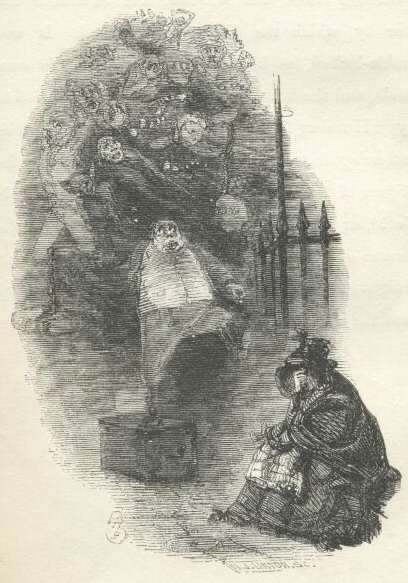
Whether these creatures faded into mist, or mist enshrouded them, he could not tell. But they and their spirit voices faded together; and the night became as it had been when he walked home.
He could not tell whether the creatures faded into mist or the mist surrounded them. But the creatures and their ghostly voices faded together. The night became as it had been when he walked home.
Scrooge closed the window, and examined the door by which the Ghost had entered. It was double-locked, as he had locked it with his own hands, and the bolts were undisturbed. He tried to say “Humbug!” but stopped at the first syllable. And being, from the emotion he had undergone, or the fatigues of the day, or his glimpse of the Invisible World, or the dull conversation of the Ghost, or the lateness of the hour, much in need of repose; went straight to bed, without undressing, and fell asleep upon the instant.
Scrooge closed the window and examined the door through which the Ghost had entered. It was still double-locked, just as he had locked it himself, and the bolts had not been disturbed. He tried to say “Humbug!” but stopped after the first syllable. He badly needed rest. Perhaps it was because of all he had felt, or the day’s exhaustion, or his glimpse of the Invisible World. Perhaps it was because of the Ghost’s dull conversation, or the late hour. So he went straight to bed without undressing and fell asleep at once.